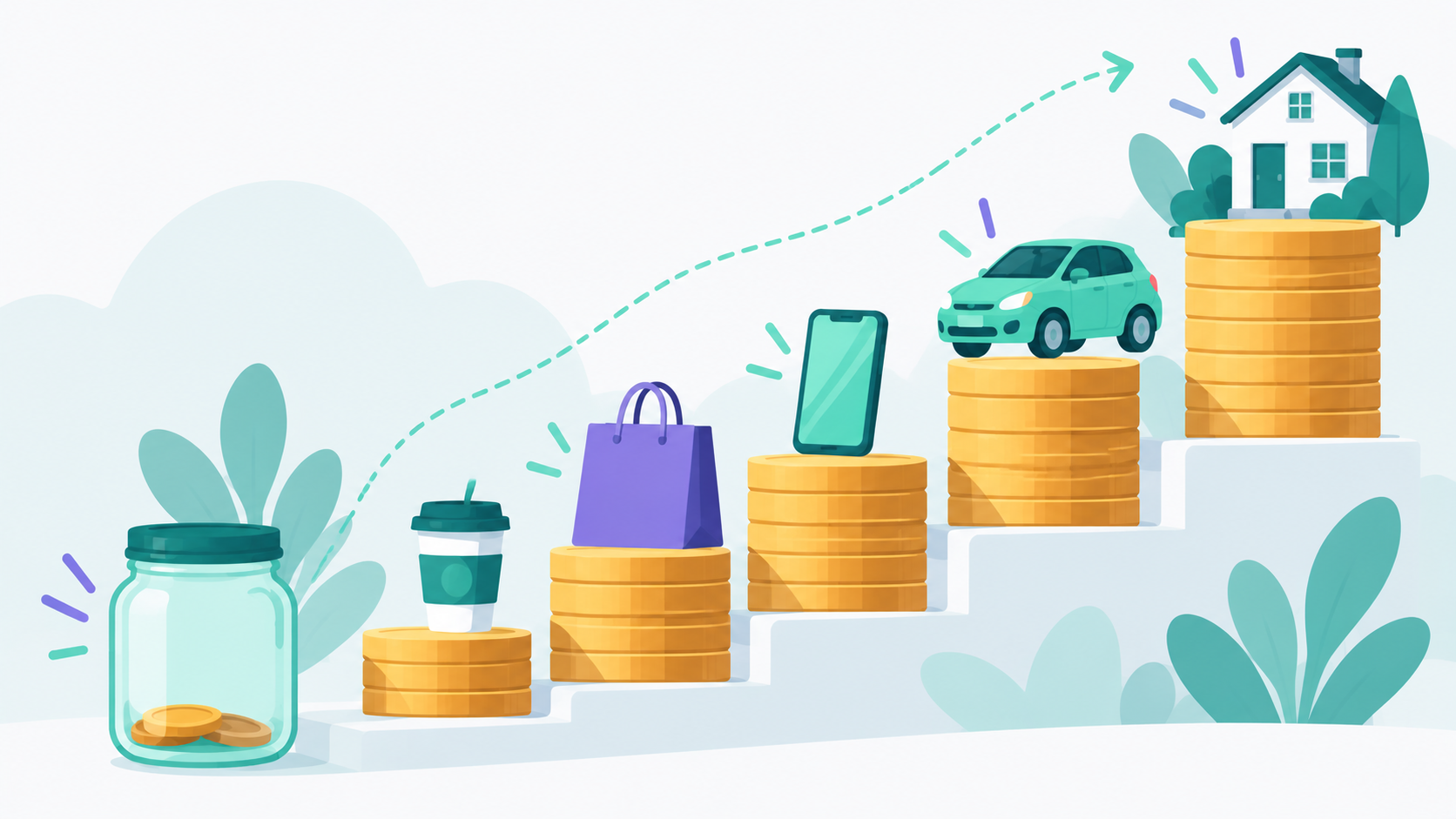
Lifestyle inflation, also called lifestyle creep, happens when your spending rises every time your income does, so a raise never actually turns into more savings. It sneaks up on you because each upgrade feels small, feels earned, and quickly becomes your new normal. The fix isn't to stop enjoying your money. It's to decide on purpose where each raise goes before your spending decides for you.
Below, we'll break down how lifestyle creep happens, what it really costs over time, and a few simple habits that keep your next raise from quietly disappearing.
What is lifestyle inflation?
Lifestyle inflation is the gradual increase in spending that follows an increase in income. When you earn more, you spend more on housing, food, cars, travel, and convenience, until your savings rate stays flat even though your paycheck grew.
Here's a common version. You earn $60,000 a year and save $300 a month. You get promoted to $70,000, which adds roughly $600 a month to your take home pay after taxes. A year later, you're still saving $300 a month. The extra $600 didn't vanish. It went to a slightly nicer apartment, a newer car payment, more takeout, and a few subscriptions that seemed reasonable at the time.
Nothing about that is reckless. Every single choice probably made sense. That's exactly why lifestyle inflation is so hard to spot.
It's also showing up in the national numbers. The U.S. personal saving rate, which measures how much of after tax income households save, was 3.0% in July 2026, according to the Bureau of Economic Analysis. That means the average household saved about 3 cents of every dollar it had left after taxes.
How does lifestyle inflation sneak up on you?
Lifestyle creep rarely comes from one big purchase. It comes from many small upgrades, recurring charges, and convenience habits that each seem minor, but together absorb most or all of a raise.
Raises and bonuses with no plan
When extra money shows up without a job assigned to it, it gets spent by default. A $4,000 bonus with no plan often turns into a weekend trip, a new TV, and a few dinners out. None of those are bad, but they're probably not what you would have picked if you'd decided ahead of time.
Small upgrades that become permanent
The unlimited phone plan. The premium gym. The bigger apartment with in unit laundry. These upgrades don't feel like spending decisions. They feel like quality of life improvements. And they're usually recurring, so a $40 a month upgrade quietly becomes $480 a year, every year.
Subscriptions you forget you have
Subscriptions are one of the sneakiest forms of creep because they renew automatically. In a 2022 survey commissioned by C+R Research, consumers guessed they spent about $86 a month on subscriptions. When asked to add them up by category, the real number averaged $219, about $133 more than they thought. And 42% said they'd forgotten about a subscription they were still paying for.
Convenience spending
Delivery fees, grocery pickup, rideshares instead of the bus, and buying lunch because you didn't pack one. Convenience gets more tempting the busier you are, and the busier you are, the more you probably earn. A family that shifts four home cooked dinners a week to delivery can easily add $400 to $600 a month without noticing.
Keeping up with the people around you
When your coworkers, friends, or neighbors upgrade, it's natural to follow. A new job with a bigger salary often comes with a social circle that spends more too: pricier happy hours, destination weddings, and nicer vacations.
Getting used to the upgrade
Psychologists call this hedonic adaptation. The excitement of something new fades quickly, and the upgrade becomes the baseline. The heated seats felt amazing for a month. Now they're just how cars work. Once your baseline moves, going back feels like a loss, which makes trimming spending much harder than avoiding it in the first place.
How much does lifestyle inflation really cost?
Lifestyle creep can cost tens of thousands of dollars over a decade. Spending an extra $400 a month instead of investing it could mean giving up about $69,000 over 10 years, assuming a 7% average annual return.
Here's the math. If you invested $400 a month for 10 years and earned an average of 7% a year, you'd end up with roughly $69,000, and more than $20,000 of that would be growth. Stretch it to 20 years and the number climbs to about $208,000. That's the real price of letting a raise slip into everyday spending.
And it's not only about investing. The same $400 a month could build a three month emergency fund in a year or two, pay off a $5,000 credit card balance in about 14 months, or cover a car purchase in cash so you never take on a loan.
This is why your savings rate matters more than your income. A person earning $55,000 who saves 15% is building more security than someone earning $110,000 who saves 3%. If you want to see where you stand, our post on why budgeting apps fail and the savings rate wake up call walks through why that one number tells you so much.
Is lifestyle inflation always bad?
No. Spending more as you earn more is normal and often healthy. Lifestyle inflation becomes a problem only when it happens by accident and crowds out savings, debt payoff, or goals you care about.
Moving to a safer neighborhood, buying a reliable car, paying for childcare that lets you work, or finally taking a real vacation are all good uses of a raise. The goal isn't to live like a college student forever. It's to make upgrades intentionally, in a way that still leaves room for your future.
A useful test: if you could go back to before your raise, would you choose to spend the extra money exactly the way you're spending it now? If the answer is yes, that's not creep. That's a plan.
How can you tell if lifestyle creep is happening to you?
Compare your spending and savings now to a year or two ago. If your income went up but your savings didn't, or your fixed monthly bills grew faster than your pay, lifestyle creep is likely at work.
Here are some common signs:
- You earn more than you did two years ago, but your savings balance looks about the same
- Your fixed monthly bills (rent, car, subscriptions, insurance) went up faster than your income
- You're not sure where your last raise went
- Payday feels exciting, but the end of the month still feels tight
- You have more subscriptions than you can name off the top of your head
- You're carrying a credit card balance even though you earn more than ever
The most reliable way to check is to look at real numbers instead of your memory. Pull up a month from last year and a month from this year, then compare each spending category side by side. The categories that grew the most are usually where the creep is hiding.
How do you stop lifestyle inflation?
Decide where each raise will go before it arrives, automate savings increases so they happen first, and review your spending regularly so upgrades are choices, not defaults. You don't need to cut everything. You just need a plan.
Use the 50/50 raise rule
When your income goes up, send at least half of the increase to savings, investing, or debt payoff, and enjoy the other half. If a raise adds $600 a month to your take home pay, $300 goes to your goals and $300 is yours to spend guilt free. You still get to feel the raise, and your savings grow every time your income does.
Automate the increase the same week your pay changes
Raise your automatic savings transfer or retirement contribution before your first bigger paycheck lands. If the money never hits your checking account, you won't build a lifestyle around it. Once it's been gone for a couple of months, you won't miss it.
Give bonuses and windfalls a job ahead of time
Before a bonus, tax refund, or gift arrives, decide how it'll be split. Something like 70% toward a goal and 30% for fun works well for many people. If you're still building your safety net, our guide to starting an emergency fund when you're already behind is a great place to send that first windfall.
Make one upgrade at a time
Instead of upgrading your apartment, car, and phone plan in the same year, pick the one that matters most. Live with it for a few months, then decide whether another upgrade is worth it. Spacing them out makes it easy to see what each one actually costs.
Audit recurring charges every quarter
Set a reminder every three months to list every subscription and recurring bill. Cancel anything you haven't used in the last month. Given that most people underestimate their subscription spending, this one habit often frees up $50 to $100 a month.
Use a waiting period for big purchases
For anything over a set amount, like $200, wait 48 hours before buying. If you still want it after two days, buy it without guilt. A lot of upgrades lose their urgency once the excitement passes.
How can a budgeting app help you catch lifestyle creep?
A budgeting app helps you catch lifestyle inflation by showing how each spending category changes over time, comparing planned vs. actual spending, and tracking whether your net worth is actually growing as your income rises.
Lifestyle creep is hard to see because it happens slowly. A budgeting app turns that slow drift into something you can actually look at. Here's how Lucky Friday helps:
- Annual and historical views. Toggle between monthly and annual budgets and pull up any past month or year. Comparing this year's dining out or shopping categories to last year's makes creep obvious.
- Planned vs. actual tracking. When you set a plan for each category, you'll see right away when actual spending starts drifting above it.
- Custom categories that reveal hidden spending. A lot of budgeting apps lump everything into broad preset categories, so a growing pile of streaming services just disappears into "Entertainment." Lucky Friday lets you create unlimited custom categories and subcategories, like "Streaming," "Apps," and "Delivery fees," so each source of creep has its own line.
- Net worth tracking. Your net worth chart shows assets minus liabilities over time. If your income keeps rising but that line stays flat, lifestyle inflation is probably absorbing the difference.
Lucky Friday is a free budgeting app on iOS and the web, built for people starting their financial journey and for people in the FIRE community who want a deeper understanding of where every dollar goes. The free tier is permanent and includes all core budgeting tools: unlimited categories, manual transaction entry, monthly and annual views, and net worth tracking. Bank sync is available on the premium plan if you want transactions to import automatically. It's also privacy first, so your financial data is never sold, never used for advertising, and never sent to AI. You can see everything it includes on our features page.
Common Questions About Lifestyle Inflation
What is lifestyle creep?
Lifestyle creep is another name for lifestyle inflation. It's the gradual rise in spending that happens as your income grows, often through small upgrades and recurring costs. Over time, it can absorb raises entirely and keep your savings flat even when you're earning more.
Is lifestyle inflation bad?
Not always. Spending more as you earn more is normal, and some upgrades improve your safety, health, or quality of life. It becomes a problem when it happens without a plan and crowds out savings, debt payoff, or long term goals.
How much of a raise should I save?
A common approach is to save at least half of every raise and enjoy the other half. If a raise adds $500 a month to your take home pay, putting $250 toward savings or debt still lets you feel the increase while making real progress. If you're behind on savings, you might save more than half for a while.
How do I stop lifestyle creep?
Decide where each raise or bonus will go before it arrives, and increase your automatic savings the same week your pay goes up. Audit your subscriptions every few months, make one upgrade at a time, and compare your spending categories year over year to spot creep early.
Sources
- U.S. Bureau of Economic Analysis. "Personal Income and Outlays, July 2026" (released August 26, 2026). https://www.bea.gov/news/2026/personal-income-and-outlays-july-2026
- CNBC via NBC Washington. "Consumers Spend an Average $133 More Each Month on Subscriptions Than They Realize, Study Shows" (reporting on a 2022 C+R Research survey). https://www.nbcwashington.com/news/business/money-report/consumers-spend-an-average-133-more-each-month-on-subscriptions-than-they-realize-study-shows/3067565/