Every article about emergency funds opens the same way. You need three to six months of expenses saved. Then you check your bank account, see $47 until Friday, and close the tab.
If you're behind on bills, carrying credit card debt, or wondering how to start an emergency fund with no money to spare, that advice is not just unhelpful. It actively makes things worse, because it tells you the only goal worth pursuing is one you cannot reach from where you stand.
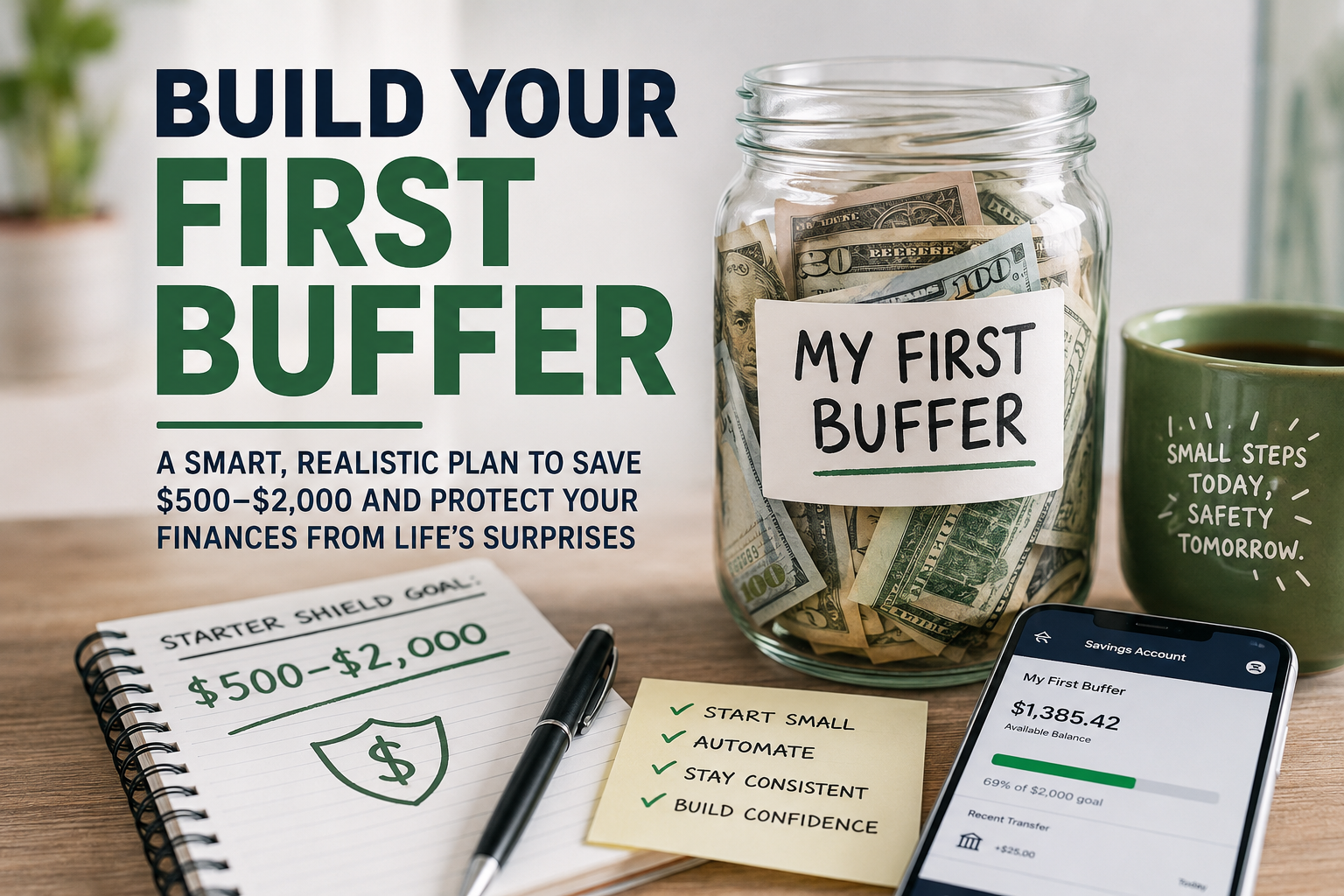
There is a better starting point. It is small, specific, and built for people who are still figuring it out. I call it My First Buffer, and the entire goal is to get $500 to $2,000 into a separate account that exists only to absorb the next financial shock.
Why a Small Buffer Matters More Than a Full Emergency Fund
The Federal Reserve's 2024 Survey of Household Economics and Decisionmaking found that 37% of U.S. adults could not cover a $400 emergency expense with cash or its equivalent. They would have to borrow, sell something, or simply not pay. 13% of adults said they could not pay the expense at all.
That is the reality the standard advice ignores. Most Americans are not optimizing for retirement. They are one car repair away from a credit card balance.
The good news is that the first dollars you save do more work than any of the dollars that come after them. The Consumer Financial Protection Bureau's 2022 research on emergency savings found that consumers with some savings (but less than a month of income) had overdraft rates of 19%, compared to 35% for consumers with no savings at all. Their average financial well-being score was 50, versus 40 for those with nothing set aside. The jump from zero to "a little" is bigger than the jump from "a little" to "a lot."
Vanguard's 2025 research found something similar. Having just $2,000 in emergency savings is associated with a 21% higher financial well-being score, even after accounting for income, debt, and total assets. Reaching three to six months of expenses adds another 13% on top of that. The biggest single gain comes from getting to $2,000.
That is why My First Buffer starts where you are, not where the personal finance industry says you should be.
Step 1: Set a Starter Shield, Not a Six-Month Target
The most common reason people give up on emergency funds is that the goal is too far away to feel real. Three to six months of expenses is the destination. It is not the starting line.
Set a Starter Shield goal of $500 to $2,000. That range is not arbitrary. The lower end covers most common household emergencies: a blown tire, an urgent dental visit, a utility deposit when you move, an appliance that dies right before a holiday. The upper end is where Vanguard's research shows financial well-being measurably improves.
If $500 feels distant, start smaller. $100 is a legitimate first goal. The habit matters more than the dollar amount, because a savings account with $5 in it is a savings account. An empty intention is not.
Step 2: Find the Money That Is Already Leaking
When you live paycheck to paycheck, finding money to save feels like squeezing a stone. Most people have more financial leakage than they realize, though. The work is identifying it before it disappears.
Pull the last three months of your bank and credit card statements. Look at every recurring charge and ask one question: did I actively use this in the last 30 days? If not, cancel. Not downgrade. Cancel. You can resubscribe in six months when your buffer is built.
Then call one bill provider. Internet, insurance, or cell carrier. Ask about promotional rates, loyalty discounts, or competitor price matching. A 15-minute call can free up $20 to $50 a month, which is real money toward your shield.
Finally, track every purchase under $20 for one week. No judgment, just data. Coffees, app downloads, gas station snacks, convenience markups. These are invisible individually and often total $100 to $200 a month. You do not have to eliminate them. You do have to know where the money is going before you can redirect any of it.
This is the work a real budgeting habit makes easier. If tracking by hand feels like a part-time job, an app that categorizes your spending the way you think about it (not the way a bank decides to categorize it) makes the difference between doing this once and doing it consistently.
Step 3: Automate Before You Can Spend It
The most effective way to save when there is no money left over is to remove the decision entirely. Automation turns saving from a willpower problem into a background process.
Three setups that work when you are behind:
Split your direct deposit. Ask your employer to send a small portion of each paycheck, even $10 or $20, directly into a separate savings account. If your employer cannot split deposits, set up an automatic transfer from checking to savings for the day after payday. The money moves before you see it.
Turn on round-ups. Many banks and apps round debit purchases to the nearest dollar and move the difference into savings. A $3.65 coffee becomes $4.00, with $0.35 going to your buffer. Over a year, this quietly adds $200 to $400 with no effort.
Schedule everything for payday, not the end of the month. The CFPB research found that people who consistently had money left over at the end of the month were dramatically more likely to have emergency savings (85% versus 13% among those who never had money left over). The timing of when you move money matters as much as the amount.
Step 4: Pick the Right Place to Keep It
Where you keep your buffer matters almost as much as how you build it.
Open the account at a different bank than your primary checking. The 1 to 2 business day transfer delay creates what behavioral economists call positive friction. It is just enough inconvenience to stop you from raiding the fund when a sale catches your eye, but not so much that you cannot reach the money in a real emergency.
Use a high-yield savings account. In 2026, the best high-yield savings rates are well above what traditional savings accounts pay, and the money is FDIC-insured up to the legal limit. Your buffer will not make you rich. It will earn a meaningful return while it protects you, which beats the zero earnings of money sitting in checking.
Avoid the wrong vehicles. Not checking (too easy to spend). Not stocks or crypto (too volatile for an emergency). Not a CD (too restrictive to access on short notice). Liquid, safe, slightly inconvenient. That is the formula.
Step 5: Define "Emergency" Before You Need To
An emergency fund only works if you use it correctly. Before you finish building it, write down, on actual paper, what counts as an emergency in your household.
True emergencies:
- Job loss or hours cut
- Medical or dental costs your insurance does not cover
- Urgent car or home repairs that affect your safety or your ability to work
- Essential travel for a family emergency
Not emergencies:
- Holiday spending, gifts, or birthdays
- Sales, deals, or "limited time" offers
- A planned expense you forgot to budget for
- Anything you simply want
Keep the list with your account information. When you are tempted to redefine emergency on the fly, read it.
Step 6: Build the Buffer Before You Accelerate Debt Payoff
If you are carrying high-interest debt, the instinct is to throw every spare dollar at it. Without a buffer, though, every unexpected expense goes right back onto the card you are trying to pay down. You are running up the down escalator.
The order that actually works:
- Build your $500 to $2,000 Starter Shield first. Make minimum payments on debt to protect your credit.
- Then attack high-interest debt aggressively. Start with anything above 20% APR.
- If you tap your buffer, rebuild it before resuming accelerated debt payments.
A small buffer breaks the cycle that keeps debt growing.
Step 7: Use Windfalls Without Derailing
Tax refunds, work bonuses, birthday cash, cash-back rewards. These feel like permission to splurge, because you have been deprived for so long.
Use a 50/50 split. Half to your buffer, half to whatever you actually want. A $1,200 tax refund becomes $600 toward your shield and $600 you spend with no guilt. You still get a reward, but the buffer grows faster than weekly contributions alone could move it.
For most people living paycheck to paycheck, the tax refund is the largest single check of the year. Putting half of it to work is often what turns a slow buffer into a finished one.
My First Buffer Checklist (This Week)
- Open a high-yield savings account at a different bank than your checking
- Set up an automatic transfer of $10 to $25 per paycheck
- Audit your subscriptions and cancel anything unused in the last 30 days
- Call one bill provider and ask for a lower rate
- Write down your personal definition of "emergency" and keep it with your account info
- Track every purchase under $20 for one week
FAQ
Can I start an emergency fund with $100?Yes. You can start with $1. The CFPB's research shows that consumers with any savings have measurably better financial outcomes than those with none. The first $100 matters more than any later milestone because it proves to you that saving is possible at your current income.
How fast can I build a buffer if I live paycheck to paycheck?That depends on your income and expenses, but consistency matters more than speed. $5 a day is $1,825 in a year. Start with what is possible, not what is impressive.
What if my income is irregular?Save more during high-earning months and treat your buffer as non-negotiable overhead. Visibility into your spending matters even more with variable income.
Should I use my emergency fund for regular expenses if I am short?No. If you are routinely raiding your buffer for predictable costs, the issue is your budget, not your savings. Go back to Step 5.
Where should I keep my emergency fund in 2026?A high-yield, FDIC-insured savings account at a different bank than your checking. Liquid, safe, slightly inconvenient to access on impulse.
Sources
- Board of Governors of the Federal Reserve System, Report on the Economic Well-Being of U.S. Households in 2024, May 2025.
- Consumer Financial Protection Bureau, Emergency Savings and Financial Security, Report 2022-3.
- Paulo Costa, Malena de la Fuente, and Marsella Martino, Vanguard, The Relationship Between Emergency Savings, Financial Well-Being, and Financial Stress, 2025.
Kelly is the founder of Lucky Friday, a personal finance and budgeting app built for people who want to actually see where their money goes, not just track it in someone else's categories.