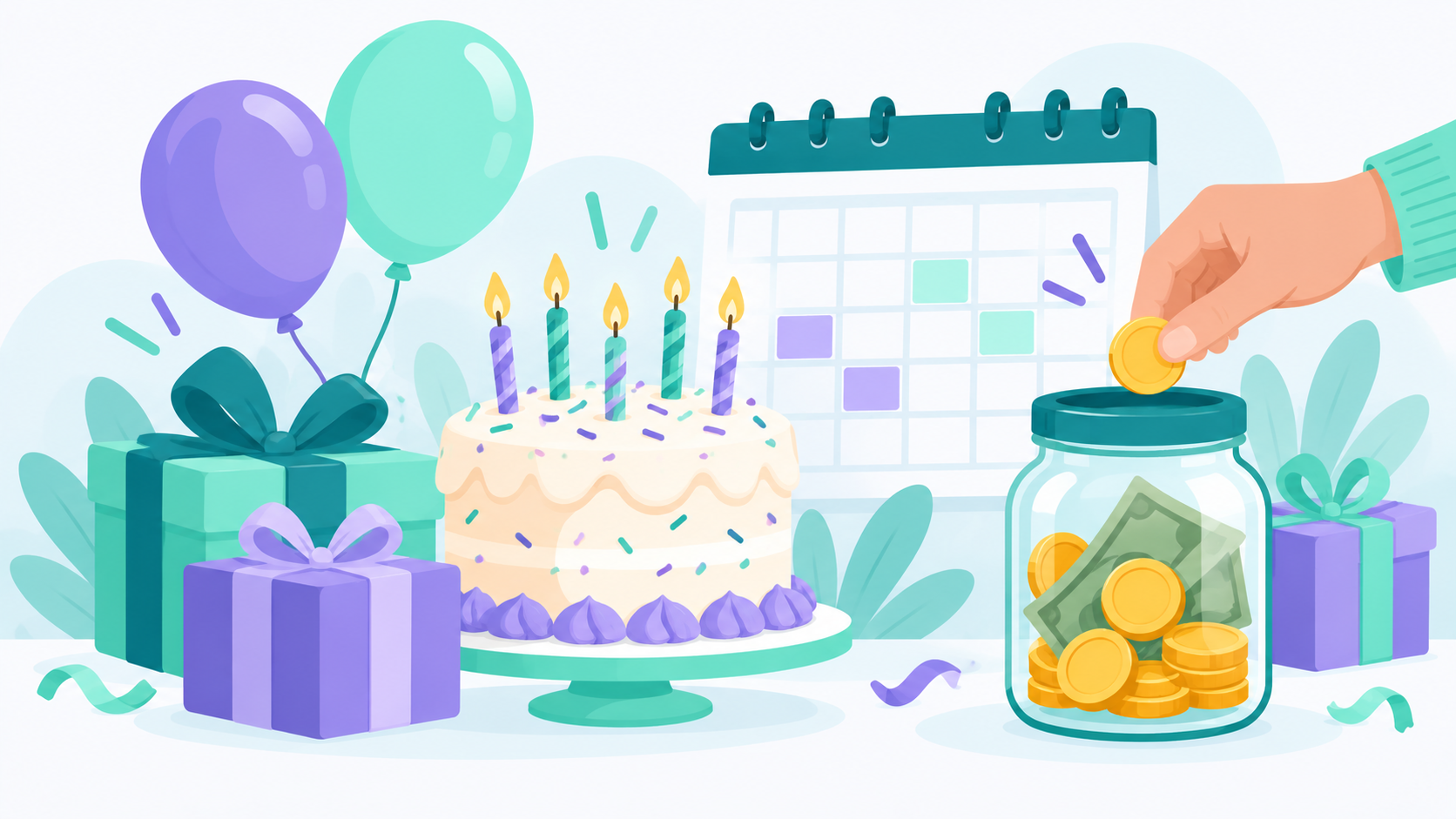
A stress free birthday budget plan starts with one number: how much you want to spend on all the birthdays in your year, including kids' parties, gifts for family and friends, and your own celebration. Divide that total by 12, set it aside every month in its own budget category, and every birthday is already paid for when it arrives. Then spend that money on what the birthday person actually values, which is usually less about price than you'd think.
Below, you'll find a step by step plan, a sample budget for a kid's party, ideas for celebrating yourself, and how to handle friends' expensive birthday plans without feeling like the bad guy.
Why do birthdays wreck so many budgets?
Birthdays feel small one at a time, but they add up fast. Between kids' parties, gifts for family and friends, group dinners, and your own celebration, many households spend more than $1,000 a year on birthdays, often without ever planning for it.
The problem isn't that birthdays are expensive. It's that they're treated like surprises, even though they happen on the same date every single year. When a party, two gifts, and a friend's birthday dinner all land in the same month, the money comes out of groceries, savings, or a credit card.
Kids' parties are a big part of it. According to a survey by Everyday Health Group reported by The Bump, parents spent an average of about $314 on a child's birthday party, not including gifts, and 20% spent more than $500. Costs rose as kids got older, averaging about $344 for 6 to 10 year olds.
None of this means you need to skip the celebrations. It just means birthdays deserve a spot in your budget, the same way rent and groceries do.
How much should you spend on a birthday?
There's no single right number. A good birthday budget is one you can pay for in cash without dipping into savings or carrying a credit card balance. For most families, that means planning the year's birthday total ahead of time and spreading it out monthly.
What feels reasonable depends on your income, your family size, and what birthdays mean to you. Some families go all out for kids' parties and keep adult gifts simple. Others skip big parties in favor of a special family day. Both work, as long as the plan is yours and not one you feel pushed into.
A helpful gut check: if a birthday would require using your emergency fund or putting the cost on a card you can't pay off right away, it's bigger than your budget can handle right now. Your emergency fund is for real emergencies, and a bounce house isn't one. If you're still building that cushion, our guide to starting an emergency fund when you're already behind can help you protect it.
How do you build a birthday budget plan?
List every birthday you'll celebrate this year, assign a spending amount to each one, add them up, and divide by 12. That monthly amount goes into a dedicated birthday category so the money is ready when each birthday comes around.
Here's how to set it up step by step.
Step 1: List every birthday for the year
Write down everyone whose birthday you celebrate with money: your kids, your partner, yourself, parents, siblings, close friends, and any regular events like your kids' classmates' parties. Note the month for each one.
Step 2: Assign an amount to each
Be realistic, not aspirational. Here's an example for a family of four:
- Two kids' birthday parties: $250 each = $500
- Two kids' birthday gifts: $75 each = $150
- Partner's gift and dinner: $125
- Your own birthday celebration: $100
- Parents and siblings (6 people): $40 each = $240
- Close friends (5 people): $30 each = $150
- Kids' classmates' parties (8 gifts): $20 each = $160
That's $1,425 for the year.
Step 3: Divide by 12
$1,425 divided by 12 is about $119 a month. That's your birthday savings target. Set up an automatic transfer to a separate savings account, or set aside that amount in a dedicated budget category each month. This approach is often called a sinking fund, and it's the easiest way to keep predictable expenses from feeling like emergencies.
Step 4: Check your busy months
If three birthdays fall in March, make sure enough has built up by then. If not, front load your savings for a couple of months or trim one of the March budgets slightly.
Step 5: Track as you go
Every time you spend on a birthday, log it against that person's budget. If you come in under on one, you can roll the extra toward someone else or keep it as a cushion for next year.
How do you plan a kid's birthday party on a budget?
Pick a total first, then split it across food, cake, activities, decorations, and favors. Hosting at home or a park, keeping the guest list smaller, and skipping elaborate favors are the three biggest ways to cut costs without making the party feel less special.
Here's a sample breakdown for a $250 party with about 10 kids:
- Food: $70 for pizza, fruit, and drinks
- Cake: $35 for a homemade or grocery store cake
- Activities: $60 for a craft station, piñata, or games
- Decorations: $30 for balloons, a tablecloth, and a banner
- Favors: $40 for one simple item per guest
- Buffer: $15 for last minute extras
Smart ways to spend less
- Host at home or a park. Venue rentals can eat up half a budget on their own. A backyard or park pavilion often costs little or nothing.
- Keep the guest list manageable. Some parents use the rule of inviting one guest per year of age, plus one. A 6 year old's party with 7 friends costs a lot less than one with 25.
- Choose the time wisely. A 2 p.m. party means snacks and cake instead of a full meal.
- Skip or simplify favor bags. One small item, like a book, bubbles, or a craft the kids made at the party, is plenty.
- Use free digital invitations. Paper invitations and postage add up quickly.
- Make the activity the decoration. A themed craft table or scavenger hunt can carry the whole party.
Kids tend to remember who came and what they did, not how much it cost. A water balloon fight in the backyard can easily beat a $600 venue in your child's memory.
How can you celebrate your own birthday without overspending?
Choose one or two things that feel truly special to you and spend there, then keep the rest simple. Experiences with people you love, free birthday perks, and low cost traditions often feel more meaningful than expensive plans.
A few ideas:
- Host instead of going out. A potluck dinner or backyard gathering can cost a fraction of a restaurant meal for a group.
- Plan one meaningful splurge. A favorite restaurant, a massage, or a day trip. Pick one and budget for it on purpose.
- Take advantage of birthday freebies. Many restaurants, coffee shops, and retailers offer free items or discounts during your birthday month when you join their rewards programs.
- Start a free tradition. A sunrise hike, a picnic, or a movie marathon with friends can become something you look forward to every year.
- Give yourself something lasting. Some people mark their birthday by making an extra deposit toward a savings goal. Watching that balance grow is a gift that keeps going.
What if friends plan an expensive birthday celebration?
You can say no to the expensive part and still show up for your friend. Offer to join for part of the plan, suggest a lower cost alternative, or send a thoughtful gift instead. Most friends care more about your presence than your spending.
Adult birthdays have gotten bigger: group dinners at pricey restaurants, weekend trips, and destination celebrations. They can be wonderful, but they can also cost hundreds of dollars for one night or weekend.
Here are a few ways to handle it:
- Decide your limit before you're asked. If you've set $30 for a friend's birthday, you'll know right away whether a $120 dinner fits.
- Join for part of it. Skip the dinner and meet everyone for dessert or drinks afterward.
- Suggest an alternative. "I can't swing the weekend trip, but I'd love to take you to lunch the week after."
- Be honest without over explaining. Something like "That one's not in my budget this month, but I really want to celebrate you" is enough. Real friends get it.
If you do go to a group dinner, ask about splitting the bill by what each person ordered rather than evenly, especially if you're ordering water and an entrée while others are ordering cocktails and appetizers.
Do expensive birthday gifts actually mean more?
Not usually. Research from Stanford found that gift givers expect more expensive gifts to be more appreciated, but recipients don't report feeling more appreciation for gifts that cost more.
In a series of studies published in the Journal of Experimental Social Psychology, Stanford researchers Frank Flynn and Gabrielle Adams asked people to think about a recent birthday gift they had either given or received. Givers believed that pricier gifts would make the recipient feel more appreciated. Recipients, on the other hand, didn't feel more appreciation for gifts that cost more.
Later research from Flynn and colleagues found something else useful: people appreciated gifts they had actually asked for more than gifts the giver picked as a surprise. So the most budget friendly move might also be the most thoughtful one. Ask what someone wants, or pay attention when they mention something, and buy that.
How can a budgeting app make birthdays stress free?
A budgeting app keeps every birthday in one place, shows how much you've set aside, and tracks spending against each person's budget so nothing catches you off guard. The key is a dedicated category you can customize.
A lot of budgeting apps give you a few preset categories, so birthday spending ends up scattered across "Shopping," "Dining," and "Gifts." Lucky Friday lets you create unlimited custom categories and subcategories with your own icons and colors. You can build a "Birthdays" category with a subcategory for each person, so you can see exactly how much you've spent on Mom's gift versus your daughter's party.
Here's how it fits together:
- Default monthly budgets. Set your birthday category's default monthly budget, like $119, so it carries forward automatically.
- Planned vs. actual tracking. See how much you planned for each birthday and how much you actually spent.
- Annual view. Toggle to the annual budget to see your whole year of birthdays and spot the busy months early.
- Manual entry for cash. Log cash gifts or party supplies paid in cash so your birthday totals stay accurate.
Lucky Friday is a free budgeting app on iOS and the web, built for people starting their financial journey and for anyone who wants to manage money in a way that fits their life. The free tier is permanent and includes all core budgeting tools, including unlimited categories, manual transaction entry, monthly and annual budget views, and junior accounts for kids under 18, so older kids can budget for friends' gifts too. Bank sync is available on the premium plan. You can get started at luckyfriday.app or see everything included on our features page.
And if you've tried budgeting before and it didn't last, our post on why budgeting apps fail and what to focus on instead can help you build a plan that sticks, birthdays and all.
Common Questions About Birthday Budgets
How much should I spend on a kid's birthday party?
It depends on your budget, but a survey reported by The Bump found parents spent an average of about $314 on a child's party, not including gifts. Many families throw great parties for $150 to $250 by hosting at home or a park, keeping the guest list small, and skipping elaborate favors.
How much should I spend on a birthday gift?
Spend an amount you can pay for in cash without stress, and focus on what the person actually wants. Stanford research found that recipients don't appreciate expensive gifts much more than less expensive ones. Gifts people have asked for tend to be appreciated most.
How do I save for birthdays all year?
List every birthday you celebrate, assign an amount to each, add them up, and divide by 12. Set that amount aside each month in a dedicated birthday category or savings account. When a birthday comes up, the money is already there.
How do I say no to an expensive birthday celebration?
Be honest and keep it simple, like "That one's not in my budget, but I'd love to celebrate you another way." Offer to join for part of the plan, suggest a lower cost alternative, or send a thoughtful gift. Most friends care more about you being there than about what you spend.
Sources
- The Bump. "The Average Child's Birthday Party Now Costs Over $300" (reporting on an Everyday Health Group survey). https://www.thebump.com/news/childs-birthday-party-cost
- Stanford Graduate School of Business. "Research Confirms It's the Thought That Counts" (on Flynn and Adams, "Money can't buy love: Asymmetric beliefs about gift price and feelings of appreciation," Journal of Experimental Social Psychology, 2009). https://www.gsb.stanford.edu/insights/research-confirms-its-thought-counts
- Stanford Graduate School of Business. "Give Them the Gift They're Expecting." https://www.gsb.stanford.edu/insights/give-them-gift-theyre-expecting