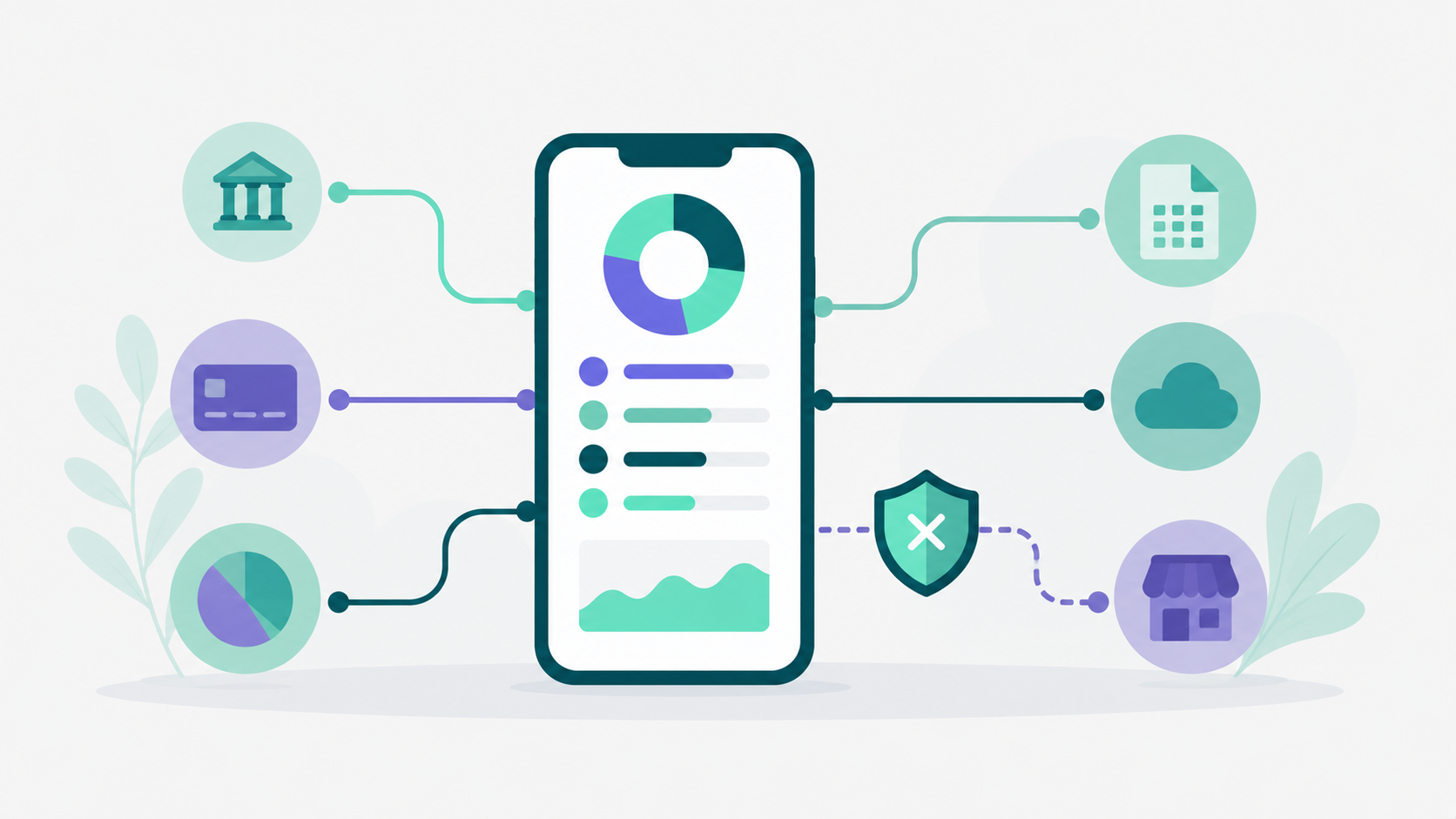
What Happens to Your Data Inside Budgeting Apps? A Privacy Breakdown
When you connect your bank account to a budgeting app, you're handing over one of the most detailed datasets about your life that exists anywhere. Your transaction history reveals where you shop, what you eat, which medications you might be buying, how stable your income is, whether you're seeing a therapist, and dozens of other personal details that most people would never voluntarily share with a company. What happens to that data after it enters the app depends almost entirely on the app's business model, and most users have no idea what that is.
This post is a plain-language breakdown of the data flows involved in most budgeting apps, what "selling" and "sharing" actually mean under current law, and what you can do to evaluate an app's real privacy practices before you connect anything.
What Data Does a Budgeting App Actually Collect?
A budgeting app that connects to your bank through a financial data aggregator like Plaid collects significantly more than just your account balance. The data typically includes your full transaction history, including merchant names, amounts, dates, and merchant category codes that reveal what type of purchase was made; your account balances across all connected accounts; your income deposits and their sources; recurring charges including subscriptions, loan payments, and rent; and in some cases, additional inferred data like estimated income, spending patterns by category, and financial stress indicators derived from account behavior.
Transaction data is particularly sensitive because it's specific and longitudinal. A single month of bank transactions reveals your approximate grocery budget, your dining habits, whether you're paying a therapy or psychiatry provider, whether you take regular prescription medications, how far you commute, what entertainment you pay for, and whether you're carrying credit card debt. Six months of that data is a detailed financial and behavioral profile that most people would consider deeply private.
What Does "Selling" Financial Data Actually Mean?
Under the California Consumer Privacy Act (CCPA) and similar state laws, "selling" personal information has a specific legal meaning: transferring it to a third party for monetary or other valuable consideration. But the law also distinguishes a second category called "sharing for cross-context behavioral advertising," which covers making your data available to advertising networks or marketing platforms even without a direct cash payment.
This distinction matters because many companies that technically don't "sell" your data in the legal sense are still making it available to advertising partners in ways that most users would consider selling. An app that passes your financial profile to a credit card network so that network can target you with offers has transferred your data for valuable consideration (the referral fee), even if the privacy policy describes this activity as "sharing with partners" rather than "selling."
The Federal Trade Commission's 2024 data broker report found that data brokers typically hold between 1,500 and 3,000 data points per individual, including financial behavioral data derived from transaction histories. Financial data flows through multiple parties before reaching advertising networks, often in ways that make individual transactions impossible to trace. By the time your spending pattern on medical appointments has become a targeting attribute for health insurance offers, it has passed through several hands since you connected your bank account.
What Did the Plaid Settlement Reveal About Financial Data Practices?
In 2022, Plaid, the financial data aggregation company used by the majority of budgeting apps to connect bank accounts, settled a class action lawsuit for $58 million. The settlement covered approximately 98 million consumers and addressed allegations that Plaid had collected more financial data than was necessary to provide its stated services and had used that data in ways users hadn't consented to.
The lawsuit alleged that Plaid had collected users' complete historical transaction data even when apps only needed current balances, and that this data was being used to build consumer financial profiles for Plaid's own commercial purposes beyond the app's connection to the user's bank.
The settlement didn't mean that Plaid's practices were necessarily illegal, and the company denied wrongdoing as part of the resolution. But it revealed that the data aggregation layer between your bank and your budgeting app is itself a party with its own data interests, separate from and in addition to whatever the budgeting app does with your information. There are at minimum three parties involved when you connect a bank account to a budgeting app: you, the app, and the aggregator. All three have privacy policies, and all three may have different interests.
Plaid subsequently updated its privacy controls and launched a consumer portal at my.plaid.com where users can view the apps connected to their financial data and revoke access. That portal is worth using if you have accounts connected through Plaid, regardless of which app you're using.
How Do Free Budgeting Apps Generate Revenue From Your Data?
The most common mechanism isn't direct data sales. It's financial product referrals. An app that recommends a credit card offer, a personal loan, a high-yield savings account, or an investment account based on what your transaction data reveals about your financial situation is generating revenue from that recommendation, typically through an affiliate or referral fee paid by the financial product provider.
This is how Mint operated, and it's how Credit Karma (the app Intuit redirected Mint users to when Mint shut down in March 2024) primarily makes money. It's also how many personal finance apps that appear to be budgeting tools actually function: the budgeting features are the engagement mechanism that produces the behavioral data that powers the product recommendation engine that generates revenue.
This model isn't inherently deceptive. These apps typically disclose it somewhere in their terms of service. But most users don't understand that "free budgeting app with personalized recommendations" means "app whose business model depends on using your transaction history to identify which financial products to pitch you." A 2025 Thales Group survey of more than 14,000 consumers found that 82% stopped using a brand in the past year over data privacy concerns. The post-Mint wave of consumer interest in privacy-first budgeting apps is partly a response to users finally understanding this model.
What's the Difference Between Data Security and Data Privacy in Budgeting Apps?
These two concepts are often conflated but address different risks. Data security means whether your information is protected against unauthorized access, theft, or breach. Data privacy means what the app does with your information by design, as part of its intended operation.
An app can have excellent data security (encrypted connections, secure authentication, no data breaches) while having poor data privacy (selling your financial data to third parties, routing your transactions through AI systems, using your spending patterns to serve targeted advertising). Good security means hackers can't get your data. Good privacy means the company itself isn't using your data in ways you haven't consented to.
Most budgeting apps have reasonably good security in 2026, since industry standards like HTTPS, OAuth 2.0, and bank-grade encryption are now baseline requirements. The meaningful differentiation is in privacy, not security. When evaluating a budgeting app's privacy practices, the right question isn't "is my data encrypted" but "what is this company doing with my data by design."
Lucky Friday uses enterprise-grade authentication through Auth0, supports OAuth 2.0, OpenID Connect, passwordless login, and multi-factor authentication, and uses HTTPS encryption across all communications. But the privacy commitment goes beyond security infrastructure: user financial data is never sent to AI models, never sold to third parties, and never used for advertising. That covers both security (data is protected against unauthorized access) and privacy (data is protected against authorized misuse by the company itself).
How Do You Actually Evaluate a Budgeting App's Privacy Practices?
Marketing pages are not a reliable source. They're written to reassure, not to inform. Here's where to look instead.
Read the privacy policy's data sharing section and look for specific language. Phrases like "we do not sell or share your financial data with third parties for marketing or advertising purposes" are specific. Phrases like "we may share your information with trusted partners for business purposes" are not, and should be treated as a warning sign.
Check whether the app has a financial product recommendation engine. If the app surfaces credit card offers, loan recommendations, or investment account promotions based on your spending, that feature is funded by your data even if the word "sell" never appears anywhere.
Look for disclosures about AI. As budgeting apps add AI features, the question of whether your transaction history is being processed by third-party AI providers is increasingly relevant. An app can have a strong no-sell commitment while still routing your financial data through a third-party AI system for "personalized insights," which is a data sharing practice that most users haven't thought to ask about.
Check what the aggregator does. If the app uses Plaid, visit my.plaid.com to review which apps are connected to your financial data and what permissions each one has. You can revoke access for apps you no longer use directly from that portal.
If you want a more structured framework for what to look for before connecting any financial account, our guide on privacy-first budgeting apps covers the specific standards and what to look for in a privacy policy before you connect anything.
What Should You Do If You're Already Using an App With Poor Privacy Practices?
First, you don't necessarily need to delete it immediately. You need to understand what's happening and decide whether you're comfortable with it. Some people are fine with their transaction data being used for financial product recommendations if the budgeting features are genuinely useful. That's a reasonable position as long as it's a conscious choice rather than an accidental one.
If you decide the trade-off isn't worth it, the practical steps are: revoke the app's access through the Plaid portal if it connects via Plaid, delete your account from the app's settings (not just uninstall the app, since your data often persists after uninstallation unless you explicitly delete the account), and find a replacement with a business model that doesn't depend on monetizing your financial history.
Lucky Friday's core budgeting tools are free forever with no credit card required, no advertising, and no financial product recommendations. Bank sync is available on the premium plan at $12.99 a month or $99.99 a year if you want transactions to pull in automatically. If you prefer to keep bank connections entirely out of the picture, manual transaction entry on the free tier keeps your data entirely within the app without involving any aggregator. You can also read Lucky Friday's full privacy policy directly to see exactly how data is handled.
Common Questions About Budgeting App Data Privacy
Do budgeting apps sell your financial data?
Some do, in the legal sense of transferring it to third parties for valuable consideration, including referral fees. Others technically don't "sell" data but share it with advertising partners or use it to generate financial product recommendations, which functions similarly from a consumer perspective. The CCPA distinguishes between "selling" and "sharing for cross-context behavioral advertising," but both involve your financial data being used for purposes beyond running the budgeting app. Reading the privacy policy's data sharing section, not the marketing page, is how you find out which category a specific app falls into.
Is Plaid safe to connect to a budgeting app?
Plaid is a legitimate, widely used financial data aggregator with bank-grade security standards. The 2022 $58 million class action settlement addressed concerns about data collection beyond what was necessary, and Plaid subsequently updated its privacy practices and launched a consumer portal at my.plaid.com where users can manage which apps are connected to their data. Connecting through Plaid adds a third party to the data relationship between you and your budgeting app, which is worth understanding even if it doesn't make the connection unsafe.
What does a budgeting app know about me?
A budgeting app with bank access knows your full transaction history including merchants, amounts, and dates; your account balances; your income sources and amounts; your recurring expenses including subscriptions, loan payments, and rent; and potentially inferred data like estimated income, financial stress indicators, and spending pattern profiles. Transaction-level data is particularly revealing because it's specific and accumulated over time.
How do I know if a budgeting app is actually private?
Look for three specific things in the privacy policy: an explicit statement that financial data is not sold or shared with third parties for marketing, no financial product recommendation engine inside the app, and clarity about whether and how AI features process your transaction data. Security features like encryption are table stakes, not differentiators. The meaningful question is what the company does with your data by design, not whether it protects it from external hackers.
Can I use a budgeting app without connecting my bank account?
Yes. Most budgeting apps, including Lucky Friday, support manual transaction entry that doesn't require connecting any bank account. Manual entry takes more time since you enter transactions yourself rather than having them import automatically, but it means no financial data aggregator is involved and your transaction history stays within the app. Lucky Friday's entire free tier, including unlimited custom categories, planned versus actual tracking, and net worth monitoring, is available with manual entry only, with no bank connection required.
Sources:
Federal Trade Commission. "Data Brokers: A Call for Transparency and Accountability." 2024. (Data brokers hold 1,500 to 3,000 data points per individual including financial behavioral data.)
https://www.ftc.gov/reports/data-brokers
Lieff Cabraser Heimann and Bernstein. "Plaid Class Action Settlement." 2022. ($58 million settlement covering approximately 98 million consumers.)
https://www.lieffcabraser.com/2021/08/settlement-reached-in-plaid-class-action-data-privacy-lawsuit/
California Attorney General. "California Consumer Privacy Act (CCPA)." Definitions of "sale" and "sharing" of personal information for cross-context behavioral advertising.
https://oag.ca.gov/privacy/ccpa
Thales Group. "2025 Digital Trust Index." Survey of 14,000+ consumers globally. (82% stopped using a brand over data privacy concerns in the past year.)
https://www.customerexperiencedive.com/news/global-trust-digital-services-consumer-data-privacy-concerns/742877/
Plaid. "My Plaid" consumer portal for viewing and revoking data access.
https://my.plaid.com