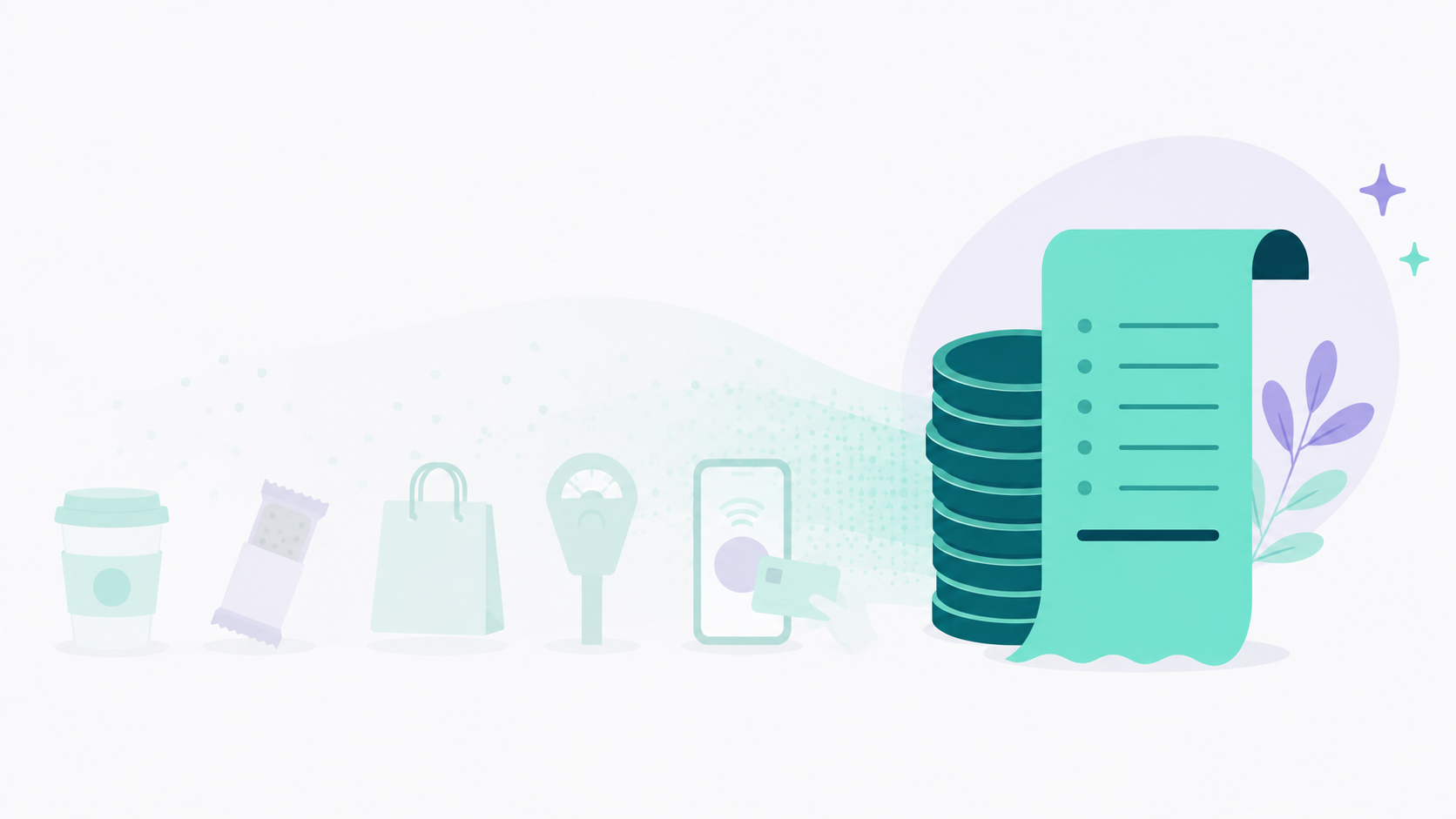
Small purchases feel invisible because your brain files them in a completely different mental category than "real" spending. A $6 coffee doesn't register as a financial decision the way a $600 car repair does, so it never gets counted. The money leaves your account either way, and the research on unplanned spending suggests those little decisions add up to a number most people would not guess correctly on the first try.
This isn't a discipline problem. It's a visibility problem, and visibility is something you can actually fix. Below is what the behavioral research says about why tiny purchases slip past you, roughly what they cost in real dollars, and a handful of specific things you can do this week to bring them back into view.
Why do small purchases feel like they don't count?
Small purchases feel like they don't count because of mental accounting, the habit of sorting money into separate psychological buckets instead of treating it as one pool. Your brain tags a $4 snack as "spare change" and a $400 insurance bill as "money," even though both come from the same checking account.
Economist Richard Thaler laid this out in his 1999 paper "Mental Accounting Matters," published in the Journal of Behavioral Decision Making. The core idea is that people run informal internal budgets, and those budgets have wildly different rules depending on the label attached to the money. A $50 refund feels like fun money. Fifty dollars from your paycheck feels like rent. Same fifty dollars.
Here's the thing about small purchases specifically. They're almost never planned, which means they never got assigned to a bucket in the first place. And anything that doesn't belong to a bucket doesn't get subtracted from a bucket. So the purchase happens, the money moves, and your internal ledger stays exactly where it was.
There's a second layer, too. Small purchases usually come with a story attached that makes them feel like something other than spending. The coffee is "getting through the afternoon." The delivery fee is "buying back an hour." Those stories are reasonable, honestly, but they move the transaction out of the spending column in your head while leaving it firmly in the spending column at your bank.
What is the denomination effect, and does it really change how you spend?
The denomination effect is the tendency to spend money more freely when it comes in smaller units. Research published in the Journal of Consumer Research found that people given four quarters were more than twice as likely to spend the money as people given a single dollar bill, even though the amounts were identical.
The specific numbers are worth sitting with. In the study by Priya Raghubir and Joydeep Srivastava, 63 percent of students who received four quarters bought candy, compared with just 26 percent of students who received a $1 bill. The researchers ran the same idea at a gas station and again in China with larger sums, and the pattern held up. Big bills feel like a resource you're protecting. Small ones feel like something you're supposed to use.
Now apply that to a debit card, which has no denomination at all. There's no bill to break, no physical unit to protect, and nothing that signals "this is the last of it." Every single transaction, from a $3 parking fee to a $300 flight, comes out of the same undifferentiated pool. Your brain loses the one cue it was relying on.
Does tapping a card make you spend more than paying cash?
Yes, and the effect is measurable. MIT researchers Drazen Prelec and Duncan Simester found in a well-known 2001 study that people bidding on real sports tickets were willing to pay up to 100 percent more when told to use a credit card instead of cash. Frictionless payment reduces what behavioral economists call the pain of paying.
That pain sounds like a bad thing. It isn't. It's a natural brake, and it's the reason handing over four twenties for groceries lands differently than tapping a phone at the reader. More recent work backs this up: a 2024 study from researchers at De Nederlandsche Bank, published in the Journal of Economic Behavior and Organization, found that electronic payments hurt less than cash, that contactless payments hurt least of all, and that consumers rated cash as the most helpful method for preventing overspending and contactless as the least.
So the modern payment stack has quietly removed almost every friction point that used to make small purchases feel real. Tap, done, no receipt, no running total, no moment where you look at what's left in your wallet. The convenience is genuinely great. But it means the awareness has to come from somewhere else now, because the payment itself isn't going to supply it.
How much do small purchases actually add up to?
More than most people estimate. Capital One Shopping's 2025 research puts average impulse spending at roughly $254 per month, or about $3,045 a year, spread across nearly ten unplanned purchases a month averaging around $26 each. Nothing on that list would strike you as extravagant in the moment.
Look at what that number is competing with. Three thousand dollars is a used car, a fully funded starter emergency fund, or roughly a year of maxed out Roth IRA contributions for someone earning a modest income. It's not a rounding error. It just arrives in $26 pieces, which is exactly why it doesn't feel like $3,000.
Everyday food spending tells a similar story. The Bureau of Labor Statistics Consumer Expenditure Survey found that the average U.S. household spent $3,945 on food away from home in 2024, which includes restaurants, takeout, and delivery. That works out to about $329 a month. Very few of those transactions were large. Most were a lunch here, a coffee there, a delivery order on a night nobody wanted to cook.
Run the math on a single habit and it gets concrete fast. A $6 coffee four times a week is $24 a week, about $104 a month, and just under $1,250 a year. A $12 lunch three times a week is $1,872 a year. Neither of those is a moral failing, and neither needs to be eliminated. But you should get to decide whether that's what you want $1,250 doing, and you can't decide anything about a number you've never seen.
The subscription blind spot
Recurring charges are the purest version of this problem, because after the first month you stop making the decision entirely. A survey commissioned by C+R Research and covered by CNBC found that consumers guessed they spent about $86 a month on subscriptions, but when walked through category by category, the real average came to $219. That's a gap of $133 a month, or close to $1,600 a year, in charges people had genuinely forgotten about. The same research found that 42 percent of people were still paying for something they no longer used.
Subscriptions bypass every awareness mechanism you have. There's no checkout moment, no tap, no notification you actually read. The charge lands on a date you don't remember, on a card you don't check daily, for an amount small enough that it never triggers a second look on the statement.
How do you make small purchases visible again?
You make small purchases visible by giving them a name, a category, and a number to compare against. Awareness alone doesn't hold, because the whole problem is that these transactions don't stick in memory. The fix has to live outside your head.
Build categories that match your actual life
Most budgeting tools hand you a preset list and expect you to squeeze into it. "Food and Dining" is the classic offender, because it lumps a $180 grocery run in with eleven coffees and a Tuesday burrito, and then you look at the total and learn nothing at all.
Lucky Friday takes the opposite approach with unlimited custom categories and subcategories, each with its own icon and color, so you can build a structure that reflects how you actually spend. Make "Coffee" its own subcategory. Make "Convenience store runs" its own subcategory. The point isn't precision for its own sake, it's that a line item you can see is a line item you can make a decision about. All of that lives on the permanently free tier, no credit card and no trial clock.
Log the cash and the one offs manually
Cash purchases are the ones that vanish completely, because nothing anywhere records them. The farmers market, the tip jar, the $8 you handed a coworker for a group lunch order. Manual transaction entry exists exactly for this, and it's included free in Lucky Friday. If you'd rather have transactions import on their own from your bank, bank sync through Plaid is available on the premium plan, which connects to over 11,000 financial institutions across the US, Canada, and Europe.
Set rules so the sorting happens without you
The reason most people quit tracking is the tedium of categorizing the same twelve merchants over and over. Category rules solve that. You tell the app once that anything matching a given keyword or pattern belongs to a specific category, and from then on it files itself. Set up rules for your five most frequent small merchants and you've automated the boring part of the whole exercise.
Judge the month, not the moment
A single $6 coffee will never look like a problem, and it isn't one. The unit of analysis that matters is the month. Lucky Friday's budget view has a monthly and annual toggle with planned versus actual tracking, plus doughnut charts that break spending down by category, so you can see the aggregate instead of the individual transaction. That's where a habit becomes legible.
Set a number instead of a ban
Prohibition tends to fail, and it's not much fun either. Give the category a real budget, something like $80 a month for coffee and snacks, and then track against it. The trick is that a number turns an invisible drip into a game with a scoreboard. Most people naturally spend less once they can watch the meter, without ever making a dramatic promise to themselves.
What should you do with the money once you can see it?
Give it a job before it drifts back. Found money that isn't assigned to something specific tends to quietly re-absorb into the same small purchases you just clawed it back from, which is the mental accounting problem all over again.
If you don't have a cash cushion yet, that's the first destination. Our guide to starting an emergency fund when you're already behind walks through building a first buffer without waiting for a raise or a windfall. Redirecting $100 a month from a category you weren't consciously choosing is a very reasonable way to fund it.
If you already have a buffer, the real measure is what percentage of your income you keep. We wrote about that in why most budgeting apps never move your savings rate, and small purchase visibility is one of the more direct levers you have on that number. And if your income varies week to week, which makes small spending even harder to eyeball, our approach to budgeting on an irregular income covers how to set category limits when there's no steady paycheck to anchor them.
One last thing worth saying plainly. Lucky Friday never sends your financial data to AI models, never sells it to third parties, and never uses it for advertising. Building a habit around looking closely at your own spending only works if you trust where that data goes. You can see the full breakdown of what's free and what isn't on the pricing page, and the app works on both iOS and web.
Common Questions About Why Small Purchases Feel Invisible
Why do I always spend more than I think I do?
Because you remember large transactions and forget small ones, and small ones are more numerous. Your memory naturally stores the unusual and discards the routine, so a $400 repair sticks while forty small purchases blur together. Tracking works precisely because it doesn't rely on memory at all.
Is it actually worth tracking purchases under $10?
Yes, but track them as a category rather than agonizing over each one. Individually a $7 purchase is meaningless, and collectively those transactions run into the thousands per year for the average person. The goal is seeing the monthly total for a category like coffee or convenience runs, not judging any single receipt.
Does paying with cash really help you spend less?
Research suggests it does, mostly because cash restores friction. Studies on the pain of paying consistently find that people spend more with cards than with cash, and consumers themselves rate cash as the most helpful method for controlling spending. If going cash only sounds miserable, the same effect can be approximated by using one dedicated card for discretionary spending so the total is easy to see.
How do I find subscriptions I forgot I'm paying for?
Scan three months of statements rather than one, because annual and quarterly charges won't show up in a single month. Sort transactions by name to spot repeating merchants, then cancel anything you haven't used in the last 60 days. Creating a dedicated subscriptions category afterward keeps the total in front of you instead of scattered across a dozen billing dates.
What's the fastest way to start seeing my small spending?
Pick one category you suspect is bigger than you think, give it a subcategory of its own, and track it for 30 days without changing any behavior. The number by itself usually does most of the work. Once you can see it, you can decide whether it's worth what it costs, which is a very different question from telling yourself to stop.
Sources
Thaler, Richard H. "Mental Accounting Matters." Journal of Behavioral Decision Making, vol. 12, no. 3, 1999, pp. 183 to 206.
Raghubir, Priya, and Joydeep Srivastava. "The Denomination Effect." Journal of Consumer Research, vol. 36, no. 4, 2009, pp. 701 to 713. https://academic.oup.com/jcr/article-abstract/36/4/701/1791668
Prelec, Drazen, and Duncan Simester. "Always Leave Home Without It: A Further Investigation of the Credit Card Effect on Willingness to Pay." Marketing Letters, vol. 12, no. 1, 2001, pp. 5 to 12. https://link.springer.com/article/10.1023/A:1008196717017
Broekhoff, Marie Claire, and Carin van der Cruijsen. "Paying in a Blink of an Eye: It Hurts Less, but You Spend More." Journal of Economic Behavior and Organization, 2024. https://www.sciencedirect.com/science/article/pii/S0167268124001100
Capital One Shopping Research. "Impulse Buying Statistics." https://capitaloneshopping.com/research/impulse-buying-statistics/
U.S. Bureau of Labor Statistics. "Housing and Transportation Accounted for 50 Percent of Household Spending in 2024." The Economics Daily, Consumer Expenditure Surveys. https://www.bls.gov/opub/ted/2026/housing-and-transportation-accounted-for-50-percent-of-household-spending-in-2024.htm
CNBC, reporting on research commissioned by C+R Research. "Consumers Spend an Average $133 More Each Month on Subscriptions Than They Realize." https://www.cnbc.com/2022/06/02/consumers-spend-133-more-monthly-on-subscriptions-than-they-realize.html