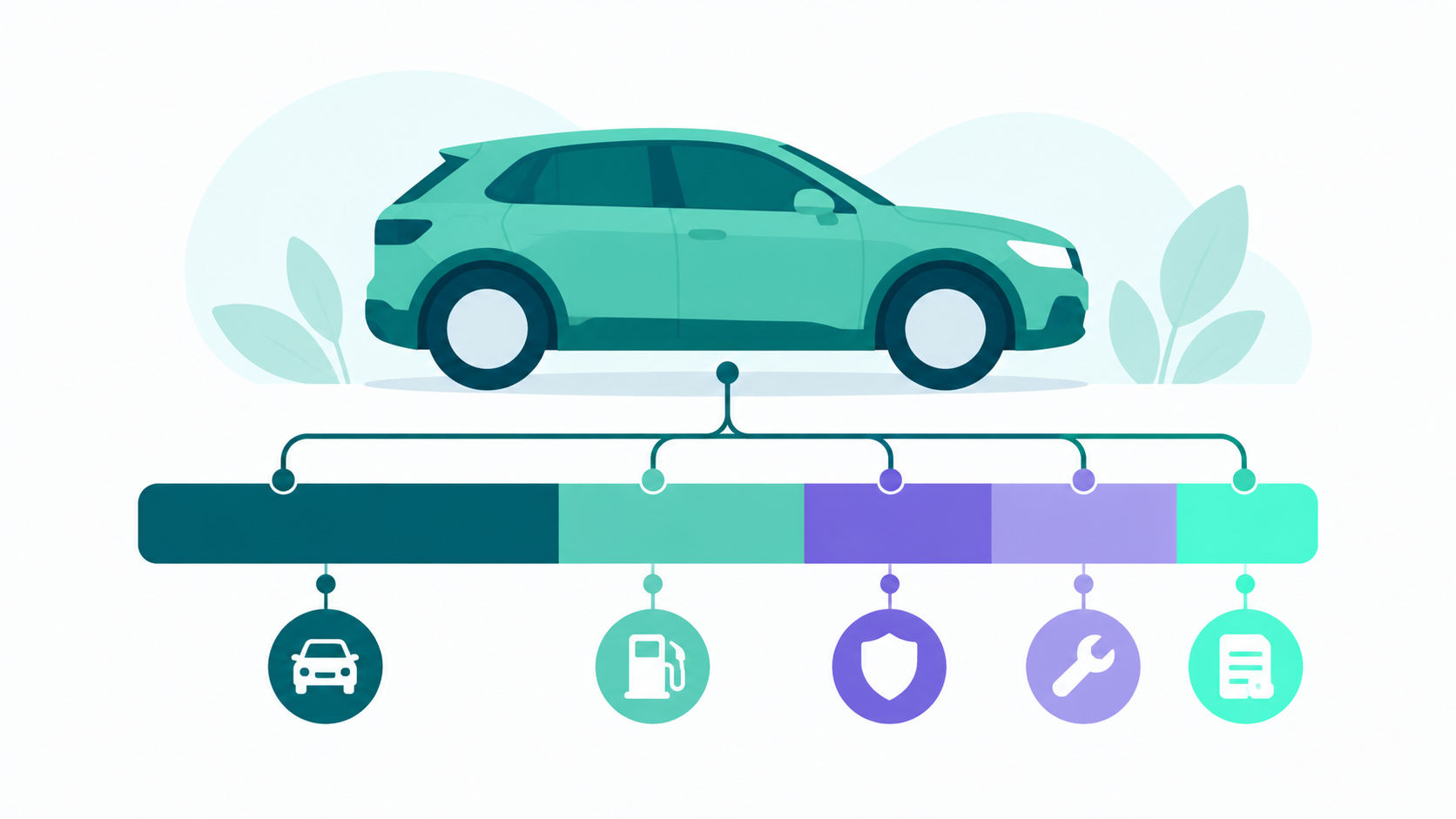
The monthly payment is less than half of what a vehicle costs. AAA's Your Driving Costs study put the total cost of owning and operating a new vehicle at $11,577 a year, or about $965 a month, based on five years of ownership at 15,000 miles annually. Average new car financing runs around $748 a month, which means everything else adds roughly as much again.
The largest single cost never appears on any bill you receive. Depreciation averages around $4,334 a year, about 37 percent of the total, and it's invisible until the day you sell. That's why most drivers underestimate what their car costs by a wide margin, and it's the main thing worth pricing before you commit to anything.
What does a car actually cost per year?
AAA's most recent Your Driving Costs analysis found an average of $11,577 annually, or $964.78 a month, for a new vehicle. The study covers 45 models across nine vehicle categories, assuming a five year ownership period and 15,000 miles driven per year.
AAA breaks it into six categories: depreciation, fuel, insurance, maintenance and repairs including tires, license and registration and taxes, and finance charges. Roughly speaking, depreciation runs about $4,334 a year, fuel around 13 cents per mile or close to $1,950 at 15,000 miles, and licensing, registration, and taxes about $813.
One important caveat about those figures. That study reflects conditions before the 2026 energy shock, and two of the six categories have moved substantially since. Gasoline averaged around $4.15 a gallon nationally in early September 2026, up roughly 25 percent year over year, and Insurify put the average full coverage auto premium at $2,237 annually for the first half of 2026. So treat $11,577 as a floor rather than a current figure, and price your own numbers rather than using a national average.
Why does the monthly payment mislead you?
Because it covers one of six costs and it's the only one anyone quotes you. Experian data from late 2025 put average monthly payments at $748 for new vehicle financing, $596 for new leases, and $532 for used vehicles, and all three sit well below the true monthly cost of ownership.
Three things make the payment a bad proxy.
Depreciation never bills you. A new vehicle typically loses roughly 20 percent of its value in the first year and around half over five years. That loss is real money, it's larger than your fuel and maintenance combined, and there's no statement that shows it.
The loan term and the ownership period don't match. A 72 month loan ends in year six. Your ownership costs continue for as long as you own the car, and the years after the loan ends are usually the years maintenance costs rise.
And the payment is fixed while everything else isn't. Fuel, insurance, and repairs all move, sometimes sharply, as 2026 demonstrated. A budget built on the payment plus a rough guess breaks the first time one of those categories jumps.
What six costs should you price before committing?
Get a real number for each one before you sign, not after. Most take a phone call or ten minutes online, and together they turn a guess into a decision.
Depreciation
The biggest cost and the easiest to reduce. Buying a vehicle that's two or three years old skips the steepest part of the curve, since the first year alone accounts for roughly a fifth of the loss. Look up what your specific model is worth at three and five years old, since depreciation varies enormously between makes.
Insurance
Get an actual quote on the specific vehicle before you buy it, not after. Premiums vary by thousands between similar vehicles, and separately, carriers price the same driver very differently. Industry analysis suggests one carrier can charge 20 to 30 percent more than another for identical coverage, so get three quotes on the car you're considering.
This is the single most common expensive surprise, and it takes fifteen minutes to avoid.
Fuel or charging
Work in cents per mile rather than dollars per tank. Divide the fuel price by the vehicle's real world miles per gallon, then multiply by your annual mileage. At $4.15 a gallon, a car getting 25 mpg costs about 16.6 cents a mile, or roughly $2,500 a year at 15,000 miles. At 35 mpg that's about $1,780, a difference of $720 a year for the same driving.
For electric vehicles, run the same calculation using your local electricity rate. AAA used a national average of 16.7 cents per kilowatt hour in its analysis, and it found EVs had the second lowest maintenance costs of any category while hybrids had the lowest.
Maintenance and repairs
The number that rises as the vehicle ages, which is exactly why averages mislead. A car under warranty costs very little in repairs. The same car at six or seven years is a different financial proposition entirely, and the transition out of warranty is a step change rather than a gentle slope.
Look up common repair costs for the specific model you're considering. Some vehicles are dramatically more expensive to maintain than others, and that information is freely available before you buy and expensive to learn afterward.
Registration, taxes, and fees
These vary enormously by state and sometimes by county. AAA's average is around $813 a year, and your state could be a fraction of that or a multiple. Check your state's DMV site for the actual figure on the vehicle you're considering, since some states tie registration to vehicle value, which makes an expensive car expensive twice.
Financing charges
Calculate the total interest across the full term, not the monthly amount. A longer loan lowers the payment and raises the total cost, and it also extends the period where you owe more than the car is worth.
One widely cited heuristic is the 20/4/10 rule: put 20 percent down, finance for no more than four years, and keep total transportation costs under 10 percent of gross income. It's a rule of thumb rather than a law, and it's a useful sanity check on whether a deal is stretching you.
How do you compare options honestly?
Compare against the real alternatives rather than against nothing. The choice is rarely car versus no car. It's usually this car versus a cheaper car, versus keeping what you have, versus transit for part of the week.
Work in cost per mile, which makes different options comparable. Total annual cost divided by annual miles gives you a number you can put against a transit pass, a rideshare budget, or a second vehicle.
Then apply it to the decision you're actually making. If a job pays $4,000 more a year but adds 20 miles each way to your commute, that's about 10,000 additional miles annually. At AAA's overall cost per mile, you're looking at a substantial share of the raise consumed by driving, before counting the extra hours. That's not an argument against the job, it's an argument for doing the arithmetic before accepting it.
The same logic applies to housing. A cheaper place farther out can cost more once transportation is included, and the transportation cost is the one people leave out of the comparison.
What should you check before you sign?
Six things, and none of them take long.
Get three insurance quotes on the specific vehicle, not a similar one. Look up your state's registration and tax cost for that vehicle. Calculate fuel cost per mile at your real annual mileage. Find out when the warranty expires and what typical repairs cost after it does. Add up total interest across the full loan term rather than looking at the payment. And check what the vehicle is worth at three and five years so you know what depreciation you're signing up for.
Write all six down as annual figures and add them. If the total surprises you, that's the post doing its job, and it's better to be surprised now than in month fourteen.
How do you track transportation costs once you own the vehicle?
Split transportation into subcategories rather than one lumped line, because the whole point is knowing which part is moving.
A single "Transportation" category absorbs the payment, insurance, fuel, and a repair into one number that tells you nothing when it changes. Lucky Friday lets you create unlimited custom categories and subcategories with your own icons and colors, so you can build a Transportation parent with the payment, fuel, insurance, maintenance and repairs, registration, and parking and tolls underneath, then read each one independently. That's on the permanently free tier, with no category limits and no credit card required.
Three things make this genuinely useful rather than just tidy.
Category rules let you set a keyword once per fuel station or insurer so those transactions file themselves, which keeps the review short enough that you'll actually do it.
The monthly and annual toggle matters because several of these costs are annual rather than monthly. Registration, an insurance premium paid in full, and a major service all make no sense in a monthly view and considerable sense across twelve months.
And net worth tracking is where depreciation finally becomes visible. It isn't a cash expense, so it never appears in a budget, but it does show up as a declining asset on a balance sheet. Adding the vehicle as an asset and updating its value once or twice a year is the only way most people ever see the largest cost of ownership actually happening.
Build a maintenance sinking fund while you're at it. Something like $75 to $150 a month, depending on the vehicle's age, means a $900 repair is an inconvenience rather than a crisis. Our guide to starting an emergency fund when you're already behind covers building that kind of buffer when the budget is already tight.
If your income varies, our approach to budgeting on an irregular income covers setting fixed obligations like a car payment against your leanest recent month rather than your average, which matters a great deal for a commitment you can't easily undo. And if you've tracked spending before without your numbers changing, our piece on why most budgeting apps never move your savings rate explains the missing half.
Common Questions About Transportation Costs
How much does it really cost to own a car?
AAA's Your Driving Costs study put the average for a new vehicle at $11,577 a year, or about $965 a month, based on five years of ownership at 15,000 miles annually. That covers depreciation, fuel, insurance, maintenance, registration, and finance charges. Since that analysis, fuel and insurance have both risen substantially, so treat it as a floor rather than a current figure.
What's the biggest hidden cost of owning a car?
Depreciation, averaging around $4,334 a year and roughly 37 percent of total ownership cost. It never appears on a bill, which is why most drivers overlook it entirely. A new vehicle typically loses about 20 percent of its value in the first year and around half over five years.
Should I get an insurance quote before buying a car?
Yes, on the specific vehicle you're considering rather than something similar. Premiums differ by thousands between comparable models, and carriers price the same driver differently, with industry analysis suggesting a 20 to 30 percent spread between insurers for identical coverage. Getting three quotes takes about fifteen minutes and is the easiest expensive surprise to avoid.
How do I compare the cost of driving versus public transit?
Convert both to cost per mile or cost per year and compare the totals, including parking, tolls, and any second vehicle you might avoid. A car's full cost per mile is far higher than fuel alone, so comparisons based on gas prices consistently favor driving by a wide margin over what the real numbers show.
What's the 20/4/10 rule for buying a car?
It's a common guideline suggesting a 20 percent down payment, a loan term of no more than four years, and total transportation costs kept under 10 percent of gross income. It's a rule of thumb rather than a requirement, and it works best as a check on whether a particular deal is stretching your budget further than it should.
Sources
AAA Newsroom. "AAA: New Vehicle Costs Drop to $11,577," Your Driving Costs study methodology and results. September 2025. https://newsroom.aaa.com/2025/09/aaa-new-vehicle-costs-drop-to-11577/
Auto Club Group. "AAA Releases Annual Report on Vehicle Costs." https://newsroom.acg.aaa.com/aaa-releases-annual-report-on-vehicle-costs/
NerdWallet, citing AAA Your Driving Costs and Experian State of the Automotive Finance Market Report. "What Is the Total Cost of Owning a Car?" https://www.nerdwallet.com/auto-loans/learn/total-cost-owning-car
Cars.Zone, ownership cost modeling based on AAA Your Driving Costs data. https://cars.zone/ownership-cost-modeling/
Axios, reporting AAA Your Driving Costs figures. "Charted: the price of owning a new vehicle." https://www.axios.com/2024/09/05/charted-the-price-of-owning-a-new-vehicle-closer
AAA. "State Gas Price Averages," daily national and state averages. https://gasprices.aaa.com/state-gas-price-averages/
Insurify. "Car Insurance Costs Climb in the First Half of 2026." https://insurify.com/car-insurance/report/