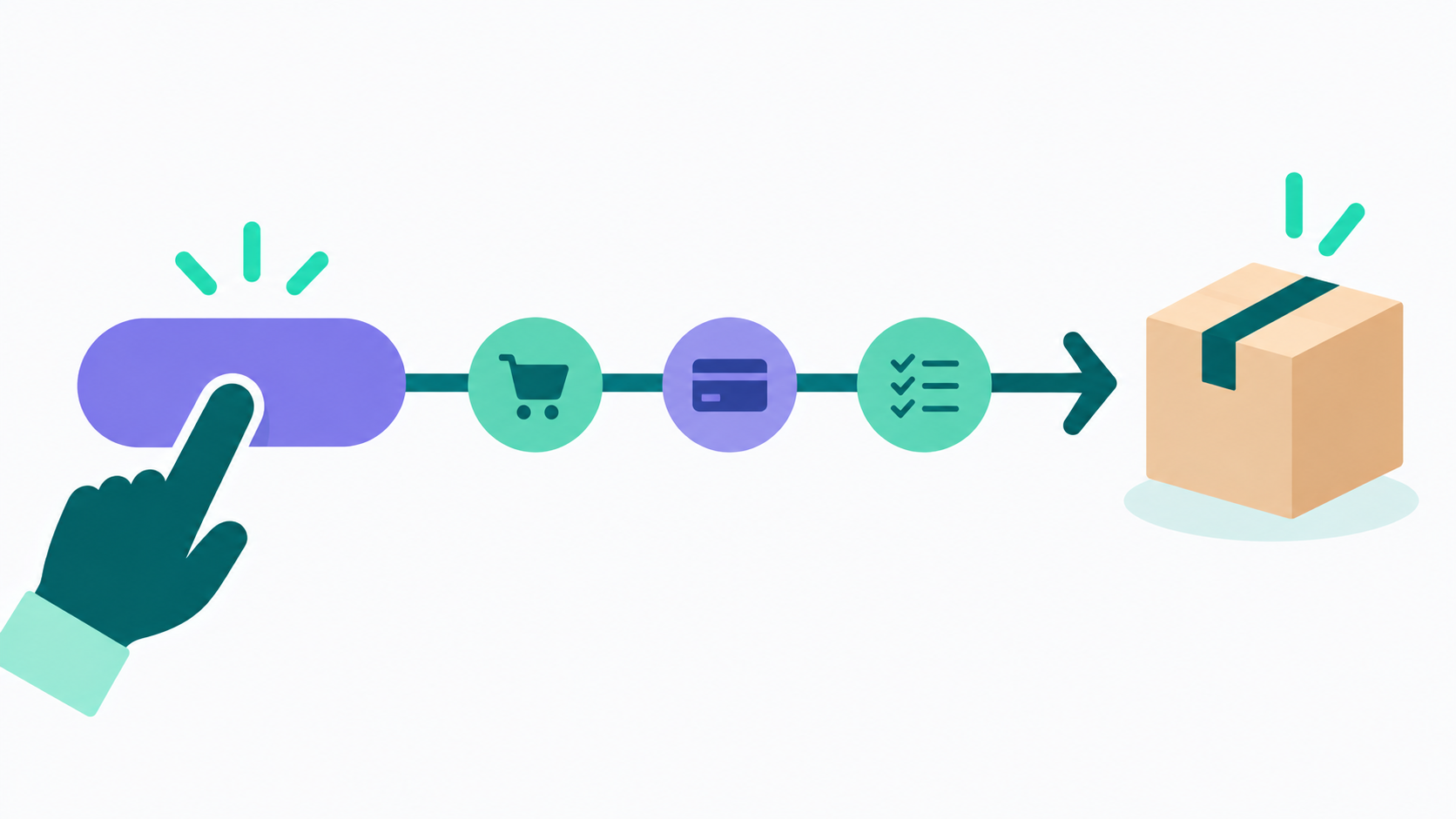
One-click purchasing increases spending by deleting the moment where you used to decide. The pause between wanting something and owning it was never dead time. It was the window where you asked whether you actually needed it, and frictionless checkout removes that window by design.
The research is fairly direct about the size of this effect. MIT researchers Drazen Prelec and Duncan Simester found that people bidding on real sports tickets were willing to pay up to 100 percent more when told to use a credit card instead of cash. That study predates one-click buying entirely, and one-click removes considerably more friction than a credit card ever did.
Why does one-click buying make you spend more?
Because paying used to hurt a little, and that discomfort was functional. Behavioral economists call it the pain of paying, and it acts as a natural brake on spending that has nothing to do with willpower or arithmetic.
Recent work quantifies how much of that brake modern payment methods have removed. A 2024 study from researchers at De Nederlandsche Bank, published in the Journal of Economic Behavior and Organization, found that electronic payments hurt less than cash, that contactless payments hurt least of all, and that consumers themselves rated cash as the most helpful method for preventing overspending and contactless as the least helpful.
Note the second half of that finding. People know frictionless payment makes them spend more. Knowing it doesn't stop it, because the mechanism operates below the level where knowledge helps.
There's a related effect worth understanding. Research published in the Journal of Consumer Research found that people given four quarters were more than twice as likely to spend the money as people given a single dollar bill, at 63 percent versus 26 percent, despite identical amounts. Physical form changes behavior. A stored card has no form at all, no denomination, and no visible remainder, which strips out the last cue your brain was using.
What exactly does one-click remove?
Four separate frictions, and each one was doing a job. Removing any single one matters. Removing all four is why a $30 purchase can happen in under three seconds while you're half watching television.
The payment moment
Entering a card number takes maybe forty seconds, and during those forty seconds you're looking at the number and thinking about it. A stored card eliminates that entirely. There is now no moment in the transaction where the price is the thing you're attending to.
The review step
A cart used to be a staging area. Items sat there, you saw the running total, and some of them didn't survive the trip to checkout. One-click skips the cart, which means the running total never exists and the second look never happens.
The wait
Ordering something that arrives in two weeks leaves plenty of time for the wanting to fade. Same-day and next-day delivery collapse the gap between impulse and possession to almost nothing, which removes the natural cooling-off period that used to cancel a share of purchases before they were fulfilled.
The record
There's no receipt in your hand and often no email you actually open. The purchase leaves your account and enters your memory as nothing at all, which is why people so consistently underestimate what they spend on frequent small buys.
Stack those together and you have a purchase that involved no deliberate decision at any point. That's not a failure of discipline. USC psychologist Wendy Wood's research found that roughly 43 percent of daily behavior is repeated in the same context, typically while thinking about something else, and one-click purchasing was engineered to slot neatly into exactly that mode.
What are dark patterns, and how do they work?
Dark patterns are interface designs built to steer you toward a choice you wouldn't otherwise make. The term is used by the Federal Trade Commission itself, and it has real legal weight now.
The clearest example is the Amazon Prime case. In September 2025, Amazon agreed to a $2.5 billion settlement with the FTC, comprising a $1 billion civil penalty and $1.5 billion in refunds to roughly 35 million customers, over allegations that it used manipulative interface designs to enroll people in auto-renewing Prime subscriptions and made cancellation unnecessarily difficult. The settlement requires Amazon to include a clearly labeled decline option, disclose material terms before collecting billing information, and allow cancellation through the same medium used to sign up.
The patterns worth recognizing in the wild:
Pre-selected options, where a box arrives already checked and doing nothing means agreeing.
Buried declines, where the accept button is large and colorful while the decline is small grey text that doesn't look like a button.
Asymmetric cancellation, where signing up takes one click and canceling takes a multi-page sequence.
Manufactured urgency, like countdown timers and "3 people are viewing this" notices that compress the decision window.
Drip pricing, where fees appear one at a time as you progress rather than up front.
About the legal protections, honestly
You may have heard about a click-to-cancel rule requiring cancellation to be as easy as signup. That rule was finalized in 2024 and then vacated by a federal appeals court in 2025 over procedural problems with the rulemaking, so it isn't currently in force. The FTC restarted the rulemaking process in early 2026, and it has continued bringing enforcement actions under existing law, including cases involving subscription cancellation practices at several companies.
The practical read: enforcement is active, a rule may return, and neither of those helps you this month. Build your own friction rather than waiting for a regulation to do it.
How much is one-click spending actually costing?
Capital One Shopping's research puts average unplanned spending at roughly ten purchases a month at about $26 each, totaling around $254 a month, or just over $3,000 a year. That figure comes from a retail research group rather than a peer-reviewed study, so treat it as an order of magnitude rather than a precise number.
Even discounted, the scale is worth sitting with. Three thousand dollars is a used car, a fully funded starter emergency fund, or a year of meaningful retirement contributions. It arrives in $26 pieces, which is precisely why it never triggers a reaction.
How do you put the friction back?
Rebuild the checkpoints deliberately, because they won't return on their own. Six changes, most taking under five minutes, and you don't need all six.
Remove stored payment methods
The single highest-return change on this list. Delete saved cards from the retailers where you buy most often, and turn off browser autofill for payment details. Having to physically retrieve your wallet reinstates the forty seconds that the whole system was built to eliminate.
Turn off one-click checkout where it exists
Most platforms let you disable instant ordering in account settings. Some devices let you require a passcode or biometric confirmation for every purchase, which is a small friction that fires at exactly the right moment.
Write a rule with a specific trigger
Vague resolutions don't work here, but specific if-then plans do. Research by Gollwitzer and Sheeran covering 94 studies found that specifying the when, where, and how of an intention produced a medium to large improvement in follow-through.
So make it concrete: "If an item costs more than $50 and isn't on my list, then it goes in the cart and I decide tomorrow." A meaningful share of those items simply won't be wanted tomorrow, and that's the whole mechanism.
Cut off the triggers upstream
Unsubscribe from retailer emails and turn off shopping app notifications. A significant portion of one-click purchases start with a prompt you didn't seek out. Removing the prompt is easier than resisting it, and it's a one-time action rather than a recurring test of willpower.
Log purchases yourself
Manual entry sounds like a chore and functions as a checkpoint. Writing down what you spent creates a moment of attention that an automatic import skips entirely, which is the exact awareness that one-click was designed to bypass.
Audit recurring charges quarterly
Scan three months of statements rather than one, since quarterly and annual charges won't show up in a single month. Cancel anything you haven't used in 60 days, and check whether any subscription started as a free trial you never consciously accepted.
How do you see it in your own numbers?
Track frequency, not just totals, and give your highest-volume merchants their own subcategory. A category with fourteen small transactions tells a different story than one with two large ones, even at the same total, and only one of those is a one-click problem.
Here's where category structure does real work. A preset list lumps everything from one retailer into a single line, so a $340 monthly total could be groceries and a car part or it could be eleven impulse buys. Lucky Friday lets you create unlimited custom categories and subcategories with your own icons and colors, so you can split a big retailer into household, groceries, and everything else, then read them independently. That's on the permanently free tier, with no category limits and no credit card required.
Two things make it stick. Category rules let you set a keyword once so those transactions file themselves rather than needing sorting every week. And the monthly and annual toggle matters more here than almost anywhere else, because $26 reads as nothing while $3,000 a year reads as a decision. Selecting any past month lets you compare direction rather than a single snapshot, which is how you catch a habit forming rather than discovering it a year later.
Manual transaction entry is included free too, and for this specific problem it's arguably the better tool. If you'd rather have transactions import automatically, bank sync through Plaid is available on the premium plan.
Then do something with whatever you claw back. Money without a destination gets reabsorbed within about six weeks, so set up an automatic transfer the same day you make the change. Our guide to starting an emergency fund when you're already behind covers where to send it, and if you've tracked spending before without your savings moving, our piece on why most budgeting apps never move your savings rate explains the gap between noticing a number and acting on it.
Common Questions About One-Click Purchases
Does one-click buying really make you spend more?
The research on frictionless payment consistently points that way. A well known MIT study found people willing to pay up to 100 percent more using a credit card versus cash, and a 2024 study found contactless payments produce the least pain of paying of any method, with consumers themselves rating them as the least helpful for controlling spending. One-click removes even more friction than either.
What are dark patterns in online shopping?
Interface designs built to steer you toward choices you wouldn't otherwise make, including pre-checked boxes, hard-to-find decline buttons, countdown timers, and cancellation processes far harder than signup. The FTC uses the term directly, and in September 2025 Amazon agreed to a $2.5 billion settlement over allegations it used them in Prime enrollment and cancellation.
Is there a law requiring easy subscription cancellation?
The FTC's click-to-cancel rule was finalized in 2024 and vacated by a federal appeals court in 2025 over procedural issues, so it isn't currently in effect. The FTC restarted the rulemaking process in early 2026 and continues bringing enforcement actions under existing consumer protection law. Don't rely on a rule that isn't in force.
How do I stop impulse buying online?
Remove stored cards, disable one-click checkout, and write a specific rule with a trigger, like waiting 24 hours on anything over $50 that wasn't on a list. Research on implementation intentions found that specifying when and how you'll act substantially improves follow-through compared with a general resolution. Unsubscribing from retailer emails removes the prompt entirely.
How much do people spend on impulse purchases?
Retail research puts average unplanned spending at roughly ten purchases a month at about $26 each, or around $254 monthly. That figure comes from an industry research group rather than academic work, so treat it as a rough scale rather than a precise measure. Your own transaction history is the only reliable source for your number.
Sources
Prelec, Drazen, and Duncan Simester. "Always Leave Home Without It: A Further Investigation of the Credit Card Effect on Willingness to Pay." Marketing Letters, vol. 12, no. 1, 2001. https://link.springer.com/article/10.1023/A:1008196717017
Broekhoff, Marie Claire, and Carin van der Cruijsen. "Paying in a Blink of an Eye: It Hurts Less, but You Spend More." Journal of Economic Behavior and Organization, 2024. https://www.sciencedirect.com/science/article/pii/S0167268124001100
Raghubir, Priya, and Joydeep Srivastava. "The Denomination Effect." Journal of Consumer Research, vol. 36, no. 4, 2009. https://academic.oup.com/jcr/article-abstract/36/4/701/1791668
Gollwitzer, Peter M., and Paschal Sheeran. "Implementation Intentions and Goal Achievement: A Meta-Analysis of Effects and Processes." Advances in Experimental Social Psychology, vol. 38, 2006. https://cancercontrol.cancer.gov/brp/research/constructs/implementation-intentions
Wood, Wendy, and David Rünger. "Psychology of Habit." Annual Review of Psychology, vol. 67, 2016. https://pubmed.ncbi.nlm.nih.gov/26361052/
Time. "Amazon Reaches $2.5 Billion Settlement Over 'Deceptive' Prime Program." https://time.com/7320708/amazon-prime-ftc-lawsuit-settlement-membership-subscription-cancel-dark-patterns/
Jones Day. "FTC Revives Click-to-Cancel Rule: New Risks for Subscription Businesses." May 2026. https://www.jonesday.com/en/insights/2026/05/ftc-revives-clicktocancel-rule-new-risks-for-subscription-businesses
Goodwin. "FTC's Click-to-Cancel Rule Gets New Life As FTC's Enforcement Wave Continues to Target Negative-Option Sellers." February 2026. https://www.goodwinlaw.com/en/insights/publications/2026/02/alerts-practices-ba-ftcs-click-to-cancel-rule-gets-new-life
Capital One Shopping Research. "Impulse Buying Statistics." https://capitaloneshopping.com/research/impulse-buying-statistics/