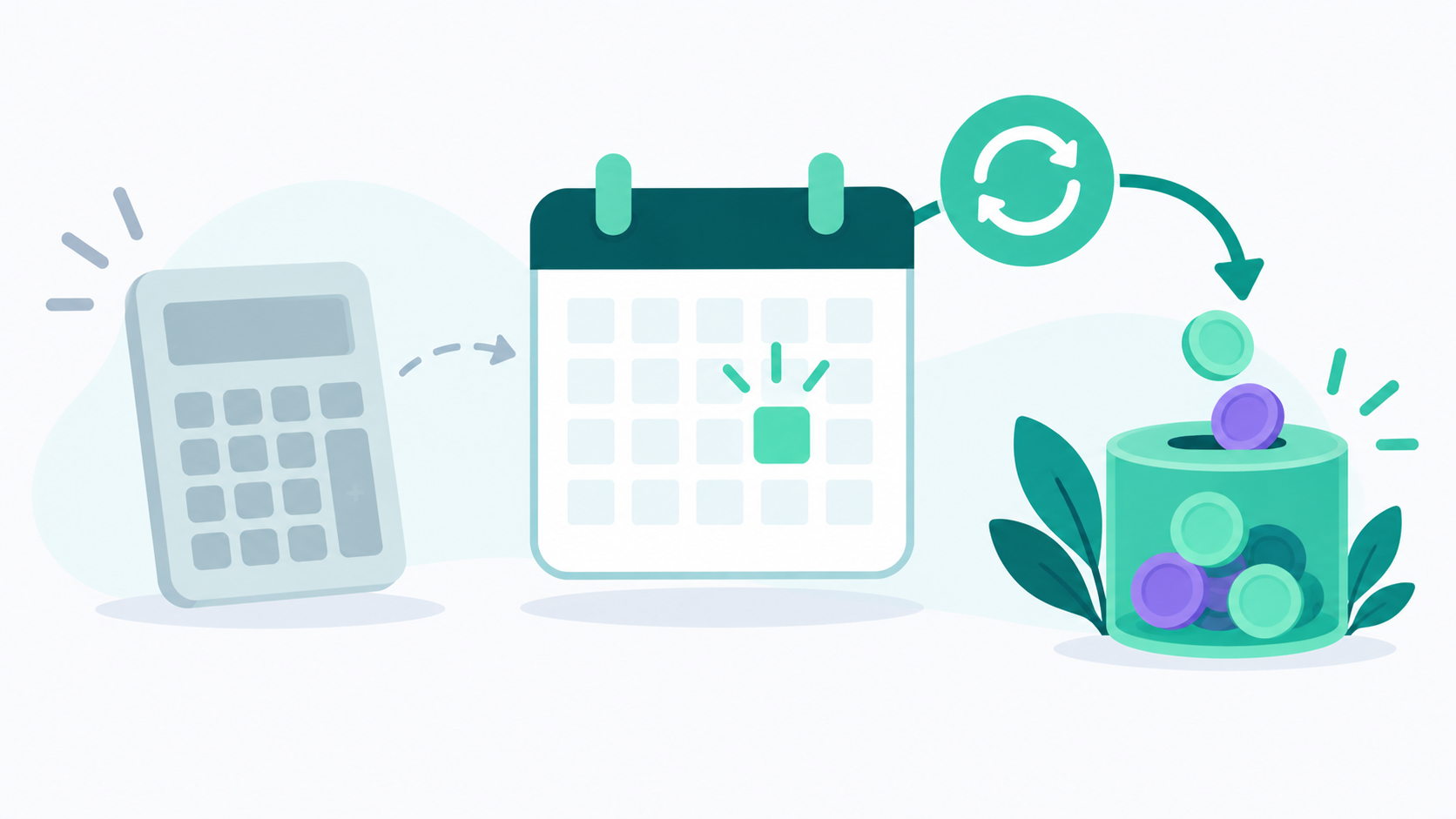
The most important money skill is deciding in advance, not calculating. Almost nobody's finances fall apart because they couldn't work out 20 percent of $80. They fall apart in the gap between knowing what to do and doing it at 9 p.m. on a Tuesday when the decision actually arrives.
The research on this is more pointed than you'd expect. A meta-analysis covering 168 papers and 201 studies found that interventions to improve financial literacy explained only about 0.1 percent of the variance in financial behaviors, with weaker effects among low income participants and effects that decayed to almost nothing 20 months after instruction. Teaching people more didn't reliably change what they did.
Does financial education actually change behavior?
Somewhat, though far less than most people assume. The most cited study in this area, by Daniel Fernandes, John Lynch, and Richard Netemeyer in Management Science, found that financial education interventions explained roughly 0.1 percent of the variance in downstream financial behavior, and that even lengthy programs had negligible effects nearly two years later.
That finding gets quoted a lot, sometimes as proof that financial education is worthless, which overstates it. A later meta-analysis by Kaiser, Lusardi, Menkhoff, and Urban, published in the Journal of Financial Economics in 2022 and focused on randomized controlled trials, found that financial education does produce positive effects on both knowledge and behavior, at magnitudes broadly comparable to educational interventions in other fields.
So the honest summary is this. Financial education works about as well as education generally works, which is to say it moves the needle a little and then fades unless something reinforces it. Knowledge isn't useless, it just isn't the bottleneck. Most people reading this already know they should spend less than they earn, keep an emergency fund, and avoid carrying a credit card balance at 22 percent. The knowing was never the hard part.
If it isn't math, what is the skill?
Deciding in advance, while you're calm, and then building something that executes the decision without needing you to be calm again. The technical term is an implementation intention, and it has one of the more robust evidence bases in behavioral science.
Peter Gollwitzer and Paschal Sheeran's meta-analysis covered 94 independent tests and found that specifying the when, where, and how of a goal in advance produced a medium to large improvement in actually achieving it, with a particularly strong effect on preventing derailment once a goal was underway.
The format is unglamorous. "I'll save more this year" is a wish. "On the 2nd of each month, $150 moves from checking to savings automatically" is a decision that has already been made and no longer requires you. That's the entire skill, and it takes about four minutes to apply to any given goal.
Notice what's absent from that sentence. No calculation, no willpower, no monitoring, no motivation. The work happened once, in advance, and the system carries it.
Why does knowing the right answer fail in the moment?
Because the version of you making the decision at the checkout isn't running the same process as the version reading a personal finance article on a quiet Sunday. Different context, different inputs, and often no deliberate decision at all.
Three findings explain most of it.
A large share of daily behavior is automatic. USC psychologist Wendy Wood's research found that roughly 43 percent of what people do on a given day is repeated in the same context, typically while thinking about something else entirely. You can't apply financial knowledge to a decision you never consciously registered making.
Payment methods have removed the friction that used to prompt a pause. MIT researchers Drazen Prelec and Duncan Simester found that people bidding on real tickets were willing to pay up to 100 percent more when using a credit card rather than cash. Tapping a phone doesn't feel like spending in the way that handing over four twenties does, and no amount of arithmetic ability restores that signal.
Your brain sorts money into buckets that don't correspond to your actual accounts. Chip Heath and Jack Soll's work on mental budgeting found that people set informal budgets per category, and that a purchase filed to the wrong category leads to systematically over or under consuming elsewhere. That's not an accuracy problem, it's a labeling one.
Add stress on top. Bankrate's Money and Mental Health Survey found that people who say money negatively affects their mental health are three times more likely to have paid a bill late in the past month, at 22 percent versus 7 percent. Worry produces avoidance, avoidance produces a fee, the fee produces more worry. Knowing the interest rate on a late payment doesn't interrupt that loop.
What are the sub-skills that actually matter?
Four, and none of them require arithmetic beyond addition. They work in sequence, and skipping straight to the last one is why a lot of budgeting attempts fizzle.
Noticing what you actually do
Not what you intended, not what you'd report on a survey. What actually happened. This is the foundational skill because every other one depends on accurate input, and self-reported spending is reliably wrong in the same direction.
The practical version is boring: look at your real transactions for one month and group them. Most people find at least one category meaningfully larger than they assumed, and that discovery does more work than any amount of reading.
Deciding in advance
Write the if-then sentence. "If it's payday, then $100 goes to the car fund." "If I want something over $75, then I wait 48 hours." "If a subscription renews and I haven't used it in 60 days, then I cancel it."
Specificity is what makes these work. A vague resolution can't fire, because there's no defined moment when it's supposed to.
Automating what you can
Every decision you remove from your hands is a decision that can't go wrong. Thaler and Benartzi's Save More Tomorrow program is the well known example: participants who pre committed to directing part of future raises into savings saw average savings rates rise from 3.5 percent to 13.6 percent over 40 months, with 80 percent still enrolled after four raises. The Department of Labor's evidence review rated that particular study's causal strength as low due to self selection, though the broader principle that defaults outperform intentions is supported by a large body of auto enrollment research.
For personal finances, this means automatic transfers, timed to land the day after payday rather than at month end when nothing is left.
Reviewing on a schedule rather than constantly
Once a month, fifteen minutes, three questions: what moved, what's new, what am I still paying for that I already stopped using. Daily checking produces anxiety rather than information, since daily numbers are too noisy to reveal anything.
How do you build this instead of just reading about it?
Do one small version of each of the four, today, in about half an hour. The temptation with this kind of post is to feel informed and change nothing, which is precisely the pattern the research describes.
Start with noticing. Pull up your last 30 days of transactions and group them into six or eight rough categories. Don't optimize, don't judge, just look. Whatever surprises you is your starting point.
Then write one if-then sentence about the category that surprised you, and make it specific enough to fire at a defined moment.
Then set one automatic transfer, sized so you'd have managed it during your tightest recent month rather than your best one. If that number is $40, the number is $40. A $40 transfer that runs twelve times beats a $200 transfer that runs twice, and it beats it by more than double.
Then put a recurring monthly date in your calendar for the review. That's the whole system, and it will outperform another ten hours of reading about compound interest.
Where does a budgeting app actually fit?
It handles the noticing and the reviewing. It doesn't handle the deciding or the automating, and being clear about that division is what keeps expectations honest.
Here's what an app genuinely contributes. It shows you what you actually spent rather than what you remember spending, and it lets you compare months so you can see direction rather than a snapshot. Both are hard to do from memory and easy with a structure.
The structure part matters more than most people expect. A broad preset category like "Food" absorbs a grocery run, four delivery orders, and eleven coffees, and the total moves for reasons you can't decompose. Lucky Friday lets you create unlimited custom categories and subcategories with your own names, icons, and colors, so the categories match the decisions you could actually act on. Category rules keep the sorting from becoming a chore, and being able to pull up any past month is what turns a review into a trend rather than a status check. All of that is on the permanently free tier, with no category limits and no credit card required. If you'd rather transactions import automatically than enter them yourself, bank sync through Plaid is available on the premium plan.
What no app does is move your money for you. We wrote about that directly in our piece on why most budgeting apps never move your savings rate, and the short version is that tracking is diagnostic while automation is the treatment. Plenty of people track diligently for a year and end it exactly where they started, because they never set up the transfer that the tracking was supposed to inform.
If the thing you're building toward is a cushion, our guide to starting an emergency fund when you're already behind covers the first tier and why it matters more than the distant six month target. And if your income arrives unevenly, which makes a fixed automatic transfer harder to hold, our approach to budgeting on an irregular income covers setting the amount against your leanest recent period.
One last thought, and it's the reason this post exists. If more information were the answer, the people who read the most personal finance content would have the best finances, and that isn't what the research shows. The skill is narrower and duller than it sounds: decide once, when you're calm, and build something that doesn't need you to be calm again.
Common Questions About Money Skills
Does financial literacy education actually work?
It helps modestly, less than most people assume. A meta-analysis of 168 papers found financial education interventions explained about 0.1 percent of the variance in financial behavior, with effects decaying substantially within two years. A later analysis of randomized trials found positive effects roughly comparable to education in other fields, so the honest read is that knowledge helps a little and isn't the main constraint.
What is the most important money skill?
Deciding in advance and automating the decision, so that follow-through doesn't depend on how you feel in the moment. Research on implementation intentions covering 94 studies found that specifying when, where, and how you'll act produces a medium to large improvement in actually doing it. Most financial mistakes happen in execution rather than in knowledge.
Why do I know what to do with money but not do it?
Because a large share of daily behavior runs automatically in response to context rather than deliberate thought, so the decision often happens before your knowledge gets a chance to apply. Frictionless payment methods removed the pause that used to prompt reflection, and stress tends to produce avoidance rather than better decisions. The fix is a system that fires without you.
Do I need to be good at math to manage money well?
No, beyond basic addition and percentages. The skills that predict outcomes are noticing your actual patterns, deciding in advance, automating transfers, and reviewing on a schedule. Complex calculations are handled by tools, and no calculation ability compensates for a decision made in the moment without a plan.
How often should I review my finances?
Once a month is enough for most people, and it beats daily checking because daily numbers are too noisy to show a trend. Give it fifteen minutes and ask what moved, what's new, and what you're paying for that you no longer use. Consistency matters considerably more than depth.
Sources
Fernandes, Daniel, John G. Lynch Jr., and Richard G. Netemeyer. "Financial Literacy, Financial Education, and Downstream Financial Behaviors." Management Science, vol. 60, no. 8, 2014, pp. 1861 to 1883. https://papers.ssrn.com/sol3/papers.cfm?abstract_id=2333898
Kaiser, Tim, Annamaria Lusardi, Lukas Menkhoff, and Carly Urban. "Financial Education Affects Financial Knowledge and Downstream Behaviors." Journal of Financial Economics, vol. 145, no. 2, 2022, pp. 255 to 272. https://www.nber.org/system/files/working_papers/w27057/w27057.pdf
Gollwitzer, Peter M., and Paschal Sheeran. "Implementation Intentions and Goal Achievement: A Meta-Analysis of Effects and Processes." Advances in Experimental Social Psychology, vol. 38, 2006. https://cancercontrol.cancer.gov/brp/research/constructs/implementation-intentions
Thaler, Richard H., and Shlomo Benartzi. "Save More Tomorrow: Using Behavioral Economics to Increase Employee Saving." Journal of Political Economy, vol. 112, no. S1, 2004. https://papers.ssrn.com/sol3/papers.cfm?abstract_id=489693
Prelec, Drazen, and Duncan Simester. "Always Leave Home Without It." Marketing Letters, vol. 12, no. 1, 2001, pp. 5 to 12. https://link.springer.com/article/10.1023/A:1008196717017
Heath, Chip, and Jack B. Soll. "Mental Budgeting and Consumer Decisions." Journal of Consumer Research, vol. 23, no. 1, 1996, pp. 40 to 52. https://academic.oup.com/jcr/article-abstract/23/1/40/1841483
Bankrate. "Survey: 43% of Americans say money is negatively impacting their mental health." https://www.bankrate.com/banking/money-and-mental-health-survey/
Wood, Wendy, and David Rünger. "Psychology of Habit." Annual Review of Psychology, vol. 67, 2016. https://pubmed.ncbi.nlm.nih.gov/26361052/