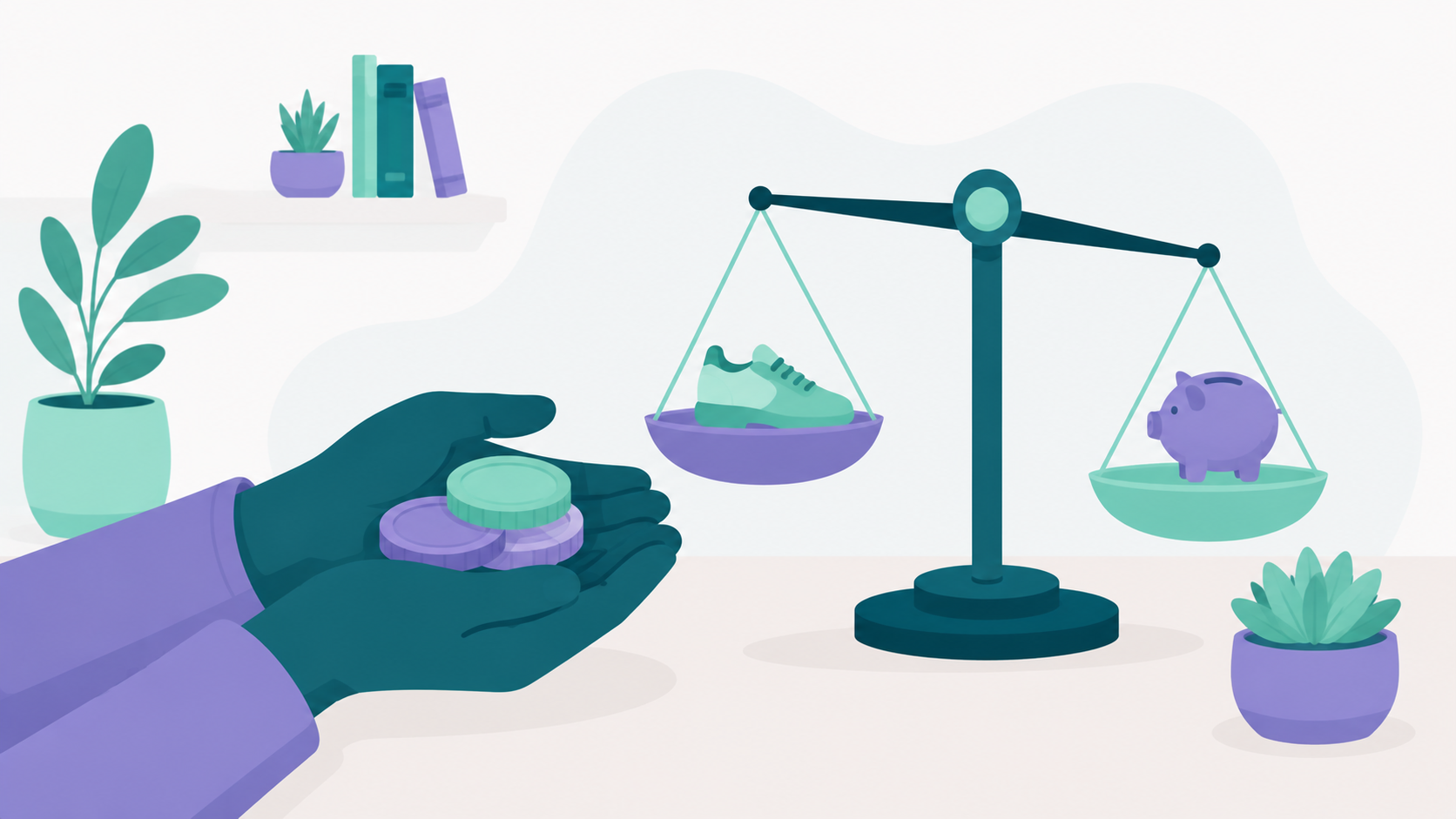
Lectures about money don't work nearly as well as most parents hope. Research consistently shows that kids build financial responsibility through hands-on experience, not through being told what to do. If you've ever delivered a careful speech about saving only to watch your kid blow their allowance on candy an hour later, this is why. Here's what actually works instead.
Does lecturing kids about money actually teach financial responsibility?
Not on its own. A large study published in the journal Family Relations surveyed over 4,000 young adults about how they learned money management growing up, and found that talking to kids about money and modeling good habits weren't enough by themselves to build real financial confidence.
The researcher behind that study, Dr. Ashley LeBaron-Black of Brigham Young University, found that the biggest factor wasn't the conversation at all. It was whether kids actually got to manage their own money and make real decisions with it. Kids who had that hands-on experience were significantly more likely to feel confident making financial decisions as young adults. That doesn't mean talking is pointless. It means talking alone is treating a practice skill like a knowledge problem, and money management is closer to riding a bike than memorizing a fact.
Why does hands-on experience teach money skills better than talking?
Kids absorb financial concepts through repetition and real consequences, not through verbal instruction. A structured framework used by financial educators breaks this down into three parts: earning money through effort, allocating it across different purposes, and making real decisions with real limits.
That third piece, deciding, is where most of the actual learning happens. A kid handed ten dollars at a store who has to choose between two things they want is doing more financial education in five minutes than a month of lectures could accomplish. The reason is simple. A lecture describes a tradeoff. An actual purchase decision forces a kid to feel one, and that feeling is what sticks.
This tracks with something LeBaron-Black's team found in follow-up research too. Kids who got real experience managing money didn't just become more confident with finances. They also reported higher life satisfaction and lower anxiety as young adults, and the effect even extended to how well their adult romantic relationships handled financial disagreements. That's a wide ripple for something as small as letting an eight year old manage their own allowance.
How do you give kids real financial decisions without real financial risk?
Start with small amounts and low stakes, so a mistake costs a few dollars instead of anything that actually hurts. A ten dollar allowance a kid manages themselves teaches more than a hundred dollars a parent manages for them.
The three jar or three envelope system (spend, save, and give) is one of the most common ways to operationalize this for younger kids without requiring abstract thinking. It gives a kid a concrete, physical decision to make every time money comes in, without any of it being dangerous if they get the split wrong one week. As kids get older, the stakes can rise gradually. A middle schooler might manage a clothing budget for a season. A teenager might handle a monthly allowance that has to stretch across gas money and going out with friends. Each step up in responsibility should come with a step up in the actual dollar amount at stake, but never so much that a mistake becomes a real problem.
What happens when a kid makes a bad financial decision?
Let the consequence play out instead of stepping in to fix it. If a kid spends their whole allowance on a toy that breaks in a week, or blows their spending money before a trip to the movies with friends, that natural consequence teaches the lesson far more effectively than a parent's intervention would.
This is genuinely the hard part for most parents, harder than actually handing over the money in the first place. It's tempting to bail a kid out, especially over something small. But the entire point of practicing with low stakes is that the practice includes the discomfort of a mistake. A kid who never experiences the letdown of an empty spend jar at age nine is more likely to experience it for the first time with a credit card at nineteen, where the consequences are a lot less forgiving.
Does modeling financial behavior still matter if it's not enough on its own?
Yes, modeling still plays an important role, it just works better as a supplement to hands-on experience rather than a replacement for it. Kids notice how the adults around them handle money constantly, whether or not anyone's explicitly teaching a lesson.
Michigan State University Extension has pointed out that young children absorb financial habits from parents whether or not the teaching is intentional. Hearing you and a partner talk through setting priorities, or watching you choose to wait on a purchase, shapes a kid's instincts even without a formal conversation attached to it. The research is clear that this modeling by itself isn't sufficient, but it's also not nothing. Think of it as the backdrop against which the hands-on lessons actually happen.
This same principle applies just as much to adults, honestly. A lot of budgeting apps quietly fail to raise anyone's savings rate, and the pattern is identical: watching numbers passively doesn't build the habit any more than watching a parent model good behavior teaches a kid on its own. In both cases, the missing ingredient is active participation, not more information.
How do you make a kid's financial decisions actually visible?
Give them a place to see their own money clearly, whether that's a physical jar they can watch fill up or a digital view they can check themselves. Visibility turns an abstract concept into something concrete a kid can track and feel proud of.
This is where a lot of families start layering in a digital option as kids get a bit older, especially once they're managing more than one goal at a time or earning money from more than one source. Lucky Friday's free tier includes junior accounts for kids under 18, giving a child their own view into their money with unlimited custom categories they can set up around whatever they're actually saving or spending for, whether that's a specific toy, a phone fund, or money set aside to give to a cause they care about. Instead of a vague number, a kid gets a concrete picture of exactly where their money stands, which supports the same kind of self-directed decision making that the research points to as the real driver of financial confidence.
If your kid is getting close to their first bigger purchase goal, we've written more about helping kids save for their first big goal, which walks through how to structure that first real savings decision so it stays motivating instead of overwhelming.
What age should kids start managing their own money?
Earlier than most parents expect, even if it starts very small. Preschool aged kids can begin learning what money is and what different denominations are worth, and by around age three or four, many kids can handle a basic version of dividing money across a few simple categories.
The exact dollar amounts matter far less than the fact that a kid is making a real decision with real, if small, consequences. A four year old choosing which of two snacks to buy is doing the same fundamental exercise as a sixteen year old deciding whether to spend or save a paycheck. The scale changes. The skill being practiced doesn't.
Common Questions About Teaching Kids Financial Responsibility
Is talking to kids about money enough to teach financial responsibility?
Research suggests it's not enough on its own. A large study from Brigham Young University found that hands-on experience managing real money was the strongest predictor of financial confidence in young adulthood, more so than conversations or parental modeling alone.
What age should a kid start managing their own money?
Kids can start as young as three or four with very simple decisions, like dividing a small amount of money between spending and saving. The specific amount matters less than giving them a real, if small, decision to make.
Should I let my kid make a financial mistake instead of stepping in?
Generally, yes, as long as the stakes are low. Letting a kid experience the natural consequence of a bad spending decision, like running out of money before a planned outing, teaches the lesson more effectively than a parent correcting the choice before it happens.
Does modeling good money habits actually help if I'm not directly teaching my kids?
It helps, but research shows it isn't sufficient by itself. Kids do pick up habits from watching parents handle money, but they also need direct, hands-on practice managing their own money to build real financial confidence.
What's a simple first step for teaching a young kid about money?
A basic allowance combined with a simple system like three jars for spending, saving, and giving works well for kids as young as four or five. It gives them a small, repeated decision to make without any real financial risk attached.
Sources
Phys.org, "Study shows children need hands-on experience to learn financial responsibility," citing Dr. Ashley LeBaron-Black and the Family Relations study (phys.org)
BYU News, "It just makes cents: BYU study shows children need hands-on experience to learn financial responsibility" (news.byu.edu)
Synchrony, "How to Teach Financial Responsibility to Kids at Any Age," citing Dr. Ashley LeBaron-Black (synchrony.com)
National Parenting Authority, "Teaching Children About Money and Financial Responsibility," citing University of Cambridge research (nationalparentingauthority.com)
Michigan State University Extension, "Teach children financial management skills without ever talking about money" (canr.msu.edu)
NFEC, "Teaching Kids Financial Responsibility: Children Activities" (financialeducatorscouncil.org)