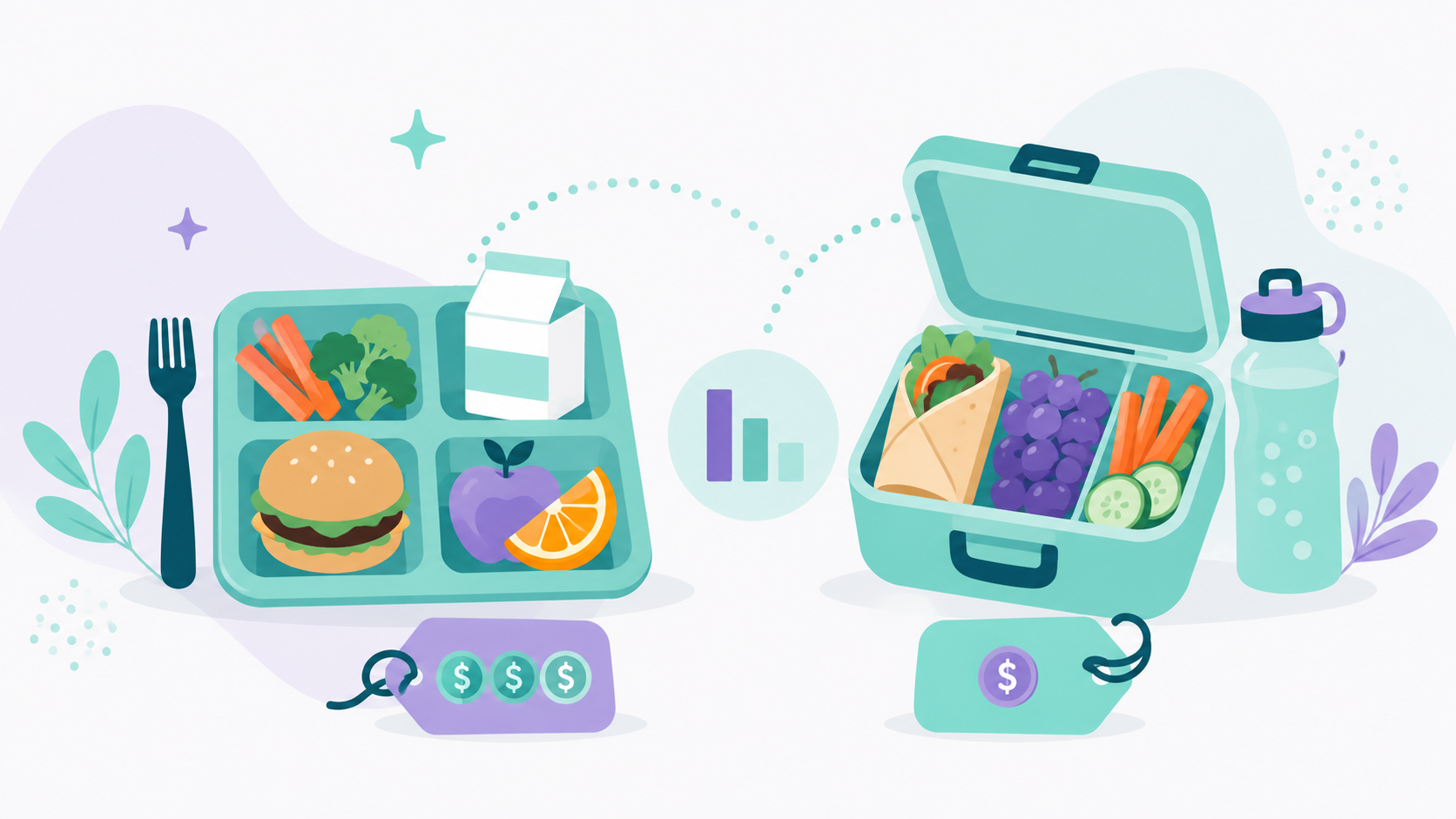
A standard school cafeteria lunch averages $3.15 a day in 2026, while the average packed lunch costs $6.15, according to Deloitte's school lunch cost index. That's nearly double, which surprises a lot of parents who assume packing lunch is automatically the cheaper option. It isn't, and the actual math depends heavily on what you're packing and what your district charges.
Is packing a lunch actually cheaper than buying school lunch?
Usually, no. A standard 2026 cafeteria lunch averages $3.15 across elementary, middle, and high school, while the average packed lunch costs $6.15 a day, according to Deloitte's tracking of lunch-related grocery prices. Even the cheapest packed option, a classic peanut butter and jelly lunch, runs $4.89, still well above the cafeteria average.
That gap has been widening, not narrowing. Grocery prices are up 23 percent over the past five years, according to Deloitte's analysis, which has pushed packed lunch costs up faster than a lot of parents have noticed. The "contemporary" packed lunch option Deloitte tracks, built around something like a chicken and avocado quesadilla, now averages $7.49, more than double the cost of a cafeteria meal. If your mental math for "packing is cheaper" is based on grocery prices from a few years ago, it's worth recalculating with current numbers.
Does school lunch pricing vary a lot by grade level?
Yes, somewhat. Typical paid school lunch prices run around $2.95 for elementary school, $3.10 for middle school, and $3.20 for high school, based on recent district pricing data, though your specific district sets its own prices and may vary from these medians.
It's worth checking your own district's actual posted price rather than assuming the national average applies, since local pricing can shift the math meaningfully if you have multiple kids across different grade levels. Nine states currently offer Healthy School Meals for All programs, providing free breakfast and lunch to every student regardless of income, which changes the entire comparison to zero dollars a day if you're in one of those states or districts.
How much does school lunch actually cost per month for a family?
For one child eating cafeteria lunch on 19 paid school days in a month at $3.25 a meal, the monthly cost comes to about $61.75. Add a second child, occasional school breakfasts, or an account-loading convenience fee, and this can quietly grow into a three-digit monthly budget category most families never explicitly plan for.
This is exactly the kind of recurring cost that benefits from its own tracked category rather than getting folded into general "groceries" or "school" spending. If you have two kids eating cafeteria lunch most days plus occasional breakfast, that's a specific, predictable monthly amount worth seeing clearly, especially since account balances tend to auto-reload without much visibility into the actual monthly total.
What is school meal debt, and how common is it?
School meal debt occurs when a student's cafeteria account runs a negative balance because a family can't cover the cost, and it's a widespread issue, with national public school meal debt totaling $194 million a year and 55.1 percent of surveyed schools reporting some unpaid student meal debt. The average meal debt per affected child is $556 annually.
A lot of families carrying this debt fall into a specific gap: they earn too much to qualify for free or reduced lunch under federal guidelines but not enough to comfortably absorb full-price meals every day. For a family of four in the 2026 to 2027 school year, free meals are available at household incomes at or below $42,900, and reduced-price meals (30 cents for breakfast, 40 cents for lunch) are available up to $61,050. If your household falls above those thresholds but the daily lunch cost is still a real strain, it's worth checking whether your district offers additional local assistance programs beyond the federal guidelines, since eligibility rules vary and some families don't realize they might still qualify for help.
What makes a packed lunch actually cost-effective compared to school lunch?
Sticking to simple, non-perishable staples, like a peanut butter and jelly sandwich, rather than more elaborate options keeps packed lunch costs closer to the cafeteria price, though even the cheapest packed option still tends to run higher than a standard school lunch. The gap widens significantly with more elaborate packed lunches involving specialty ingredients or pre-packaged convenience items.
If cost is your primary driver, a simple, repeatable packed lunch rotation, sandwich, piece of fruit, a basic side, tends to beat both a fancy packed lunch and, in some cases, even comes close to the school lunch price. That said, cost isn't the only factor worth weighing. Research on packed lunches has found they often miss key nutritional components, like vegetables and dairy, and tend to include more snacks and sweetened items than a standard school meal, which is worth factoring in alongside the dollar comparison.
Should you track school lunch spending as its own budget category?
Yes, especially if you're paying for cafeteria meals regularly, since it's a recurring cost that's easy to lose track of inside a broader grocery or school spending category. A dedicated category makes it clear whether your actual monthly lunch spending matches what you planned for, rather than discovering an inflated account balance after the fact.
This is worth separating from your general back-to-school shopping too, since lunch is a recurring monthly cost rather than a seasonal one-time expense. We've written about budgeting for back-to-school expenses, which covers the upfront seasonal costs, clothing, supplies, electronics, but lunch money deserves its own ongoing line since it repeats every single school month rather than showing up once in August. Lucky Friday's free tier includes unlimited custom categories and subcategories, so you could set up a "School Lunch" category, broken down by kid if you have more than one, and see exactly how much you're spending on cafeteria meals versus packed lunch groceries each month, rather than guessing which option is actually cheaper for your specific family.
Is there a way to combine both options to save money?
Yes, a lot of families do a hybrid approach, packing lunch on days with a less appealing cafeteria menu and buying school lunch on days the cafeteria offers something the kid actually wants, which can reduce food waste from an unwanted packed lunch while still controlling overall cost. This flexible approach also gives you room to adjust based on your actual monthly budget rather than committing entirely to one method.
If you're trying to actually compare which approach costs less for your household specifically, tracking both categories side by side for a month or two gives you real data instead of a guess. Some families find that a hybrid split, two or three packed days and the rest bought, ends up cheaper overall than committing fully to either the cafeteria or a homemade lunch every single day, particularly if packed lunch ingredients tend to go to waste on the days a kid doesn't feel like eating what was packed.
Common Questions About School Lunch vs. Packed Lunch Costs
Is it cheaper to pack lunch or buy school lunch?
Usually, buying school lunch is cheaper. The average cafeteria lunch costs $3.15 a day in 2026, compared to $6.15 for an average packed lunch, according to Deloitte's tracking of lunch-related food costs.
How much does school lunch cost per month for one child?
For a child eating cafeteria lunch on about 19 paid school days a month at roughly $3.25 per meal, the monthly cost comes to around $61.75. This can increase with school breakfast, account fees, or multiple children.
What is school meal debt?
School meal debt happens when a student's cafeteria account carries a negative balance because a family hasn't paid for meals. National public school meal debt totals $194 million a year, with an average debt of $556 per affected child.
Does my family qualify for free or reduced-price school lunch?
Eligibility is based on household income relative to the federal poverty level. For the 2026 to 2027 school year, a family of four earning $42,900 or less qualifies for free meals, and $61,050 or less qualifies for reduced-price meals.
What's the cheapest packed lunch option?
A classic peanut butter and jelly lunch remains the most affordable packed option, averaging $4.89 in 2026, though it's still more expensive than the average cafeteria lunch price of $3.15.
Sources
Deloitte, "The new 'value menu': Can school lunches be both affordable and healthy?" (deloitte.com)
Education Data Initiative, "School Lunch Debt Statistics [2025]: Total + Costs per Student" (educationdata.org)
School Nutrition Association, "School Meal Statistics" (schoolnutrition.org)
Expense Budget Tracker, "School Lunch Costs in 2026-27: How to Build a Monthly School Meal Budget" (expense-budget-tracker.com)
AOL via Deloitte, "$7.30 for a Packed Lunch? Parents Say Back-to-School Is Breaking the Bank" (aol.com)