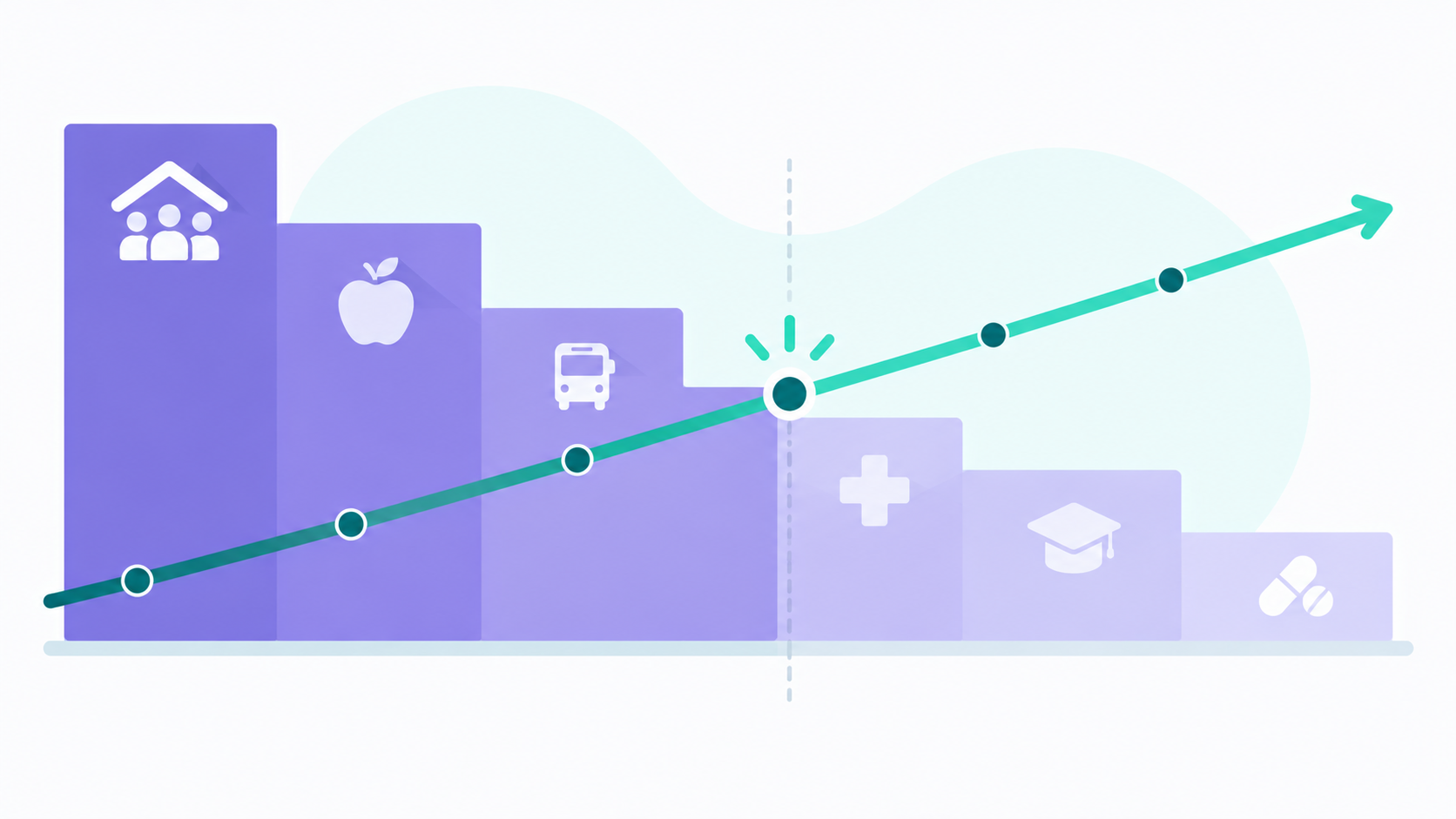
When your income changes, two things move at once: what you earn and the benefits tied to what you earn. The second one rarely moves smoothly. Benefits tend to drop in steps, which means a small raise can occasionally leave a household with less money than before.
That's a benefits cliff, and it's more common than most people realize. In one evaluation of an employer pilot program, around 40 percent of participants reported having experienced one. The good news is that these thresholds are knowable in advance, there are free tools built specifically to find them, and the right move is almost never to turn down income without running the numbers first.
What is a benefits cliff?
A benefits cliff happens when a small increase in earnings causes a sharp reduction or complete loss of a public benefit, leaving the household financially worse off than before the raise. It's the opposite of how most people assume the system works.
There's a related and gentler version worth knowing. A plateau is when an income increase is almost entirely offset by benefit reductions, so you earn more and end up roughly where you started. Less dramatic than a cliff, and considerably more common.
Research from the Federal Reserve Bank of Atlanta illustrates the scale. Their modeling found that a hypothetical single adult with one three year old child living in Washington, DC would see no financial gain from a wage increase anywhere between $11,000 and $65,000 in earned income. That's a $54,000 span of earnings across which the household is no better off, which is a striking result even accounting for the fact that it's a single modeled scenario in one jurisdiction.
Childcare subsidies produce the steepest cliffs. A 2022 study by researchers at the University of Chicago and the Atlanta Fed found that in Illinois, a $1,000 annual wage increase from $54,000 to $55,000 could cost a family over $25,000 in childcare benefits. That's not a plateau. That's a household going meaningfully backward for accepting a raise.
None of this is an argument that benefits are bad or that raises are bad. It's that thresholds exist, they're often invisible until you cross one, and the households affected are usually the ones with the least room to absorb a mistake.
Which benefits are most affected?
Childcare subsidies produce the sharpest drops, followed by health coverage, food assistance, and housing support. The UNC Charlotte Urban Institute evaluation of a benefits cliff pilot found SNAP and WIC, rental assistance, the Earned Income Tax Credit, and healthcare assistance were the programs most commonly affected by income increases.
A few specifics worth understanding.
Childcare assistance often has a hard eligibility ceiling rather than a gradual phase-out, so crossing it can mean losing the entire subsidy at once. Given what full-price childcare costs, this is frequently the largest single cliff a working parent will face.
SNAP generally tapers as designed, though the National Community Reinvestment Coalition's analysis found that deductions, particularly childcare deductions, can widen the cliff dramatically at the eligibility threshold. Steepness varies by state, since states set different gross eligibility thresholds.
Health coverage has a specific and recently sharpened cliff. The enhanced Affordable Care Act premium tax credits expired at the end of 2025, which means the 400 percent federal poverty level eligibility cliff returned on January 1, 2026. Ending the year above that line means no premium tax credit at all, plus repayment of the advance credits already paid on your behalf during the year.
The Earned Income Tax Credit phases out gradually rather than cliffing, but the phase-out reduces the value of each additional dollar earned, which contributes to the plateau effect.
And every one of these programs counts income differently and over different periods. Medicaid for most adults uses current monthly income. Marketplace subsidies use projected annual income. SNAP has its own rules. That inconsistency is a large part of why this is hard to reason about without a tool.
How do you find your cliffs before you hit them?
Use the Atlanta Fed's CLIFF tools, which were built for exactly this and are available in versions covering every U.S. state. They model how your specific benefits change as income rises, using state-specific thresholds.
The Career Ladder Identifier and Financial Forecaster, known as CLIFF, is a set of tools that show where along a career path the loss of public benefits exceeds the increase in income. The Atlanta Fed also maintains a Policy Rules Database compiling the relevant state-by-state rules in one place. In the employer pilot evaluation, the tools helped 90 percent of participants make a concrete plan of action.
These tools are often delivered through workforce agencies, nonprofits, and employers rather than directly to individuals, so if you can't access them yourself, ask your local workforce development board, a Goodwill or United Way affiliate, or your benefits caseworker.
Two lower-tech routes work too. Call your caseworker and ask directly where the income threshold sits for your specific program and household size, which most can tell you. And call 211 or visit 211.org, which connects you to local organizations that navigate this daily.
Do this before you accept a raise, take on extra shifts, or start a second job. Ten minutes of asking beforehand beats discovering the answer in a benefits termination letter.
What should you do when your income actually changes?
Four things, in this order, and the first two have deadlines attached.
Report it promptly
Most programs require you to report income changes within a set window, often 10 days. Failing to report can create an overpayment you'll be required to repay, sometimes long after you've spent the money.
Reporting also works in your favor when income drops, since it can increase your benefit going forward rather than only at the next scheduled review.
Understand which income counts, and over what period
Ask specifically: does this program use gross or net income, does it look at this month or an annual projection, and does it count a one-time bonus differently from a raise. Those answers change what your reported number should be.
For marketplace coverage in particular, you can update your projected annual income during the year, which adjusts your advance credit going forward. Almost nobody does this after enrollment, and it's the single best protection against a reconciliation surprise at tax time. Our post on managing healthcare costs on a variable income covers that piece in more depth.
Don't spend the increase for 90 days
This is the most practical rule in the whole post. When income rises, hold the difference in savings for three months while you find out what actually happens to your benefits, your taxes, and your withholding.
If nothing changes, you've built a cushion. If a benefit drops, you have the money to absorb the transition. If you'd already committed the raise to a car payment, you have a problem that takes years to unwind.
Watch for the lag
Benefit changes often take effect a month or two after you report, which means there's a window where your income has risen but your benefits haven't adjusted yet. That window feels like extra money and isn't. Treat anything arriving during it as temporary until the new steady state is visible.
What if your income goes down?
Re-check everything, because eligibility thresholds you didn't meet before may be within reach now. This runs in the opposite direction from a cliff and is just as commonly missed.
Report the decrease immediately rather than waiting, since most programs adjust from the report date rather than retroactively.
Check Medicaid specifically, because for most adults eligibility is assessed on current monthly income rather than annual projection. A genuinely lean stretch can qualify you even when your annual figure wouldn't.
A significant income change can also open a special enrollment period for health coverage, letting you change plans outside the normal window. Those windows are time limited.
And check the programs you may never have looked at: SNAP, utility assistance through LIHEAP, free and reduced-price school meals, and childcare assistance. Household size and current income determine eligibility, and both may have changed.
One thing worth saying to anyone hesitating. There's no threshold of hardship you have to reach before checking eligibility. Programs have income limits, not suffering requirements, and checking costs nothing.
How do you budget through the transition?
Baseline against your leanest recent month, and keep any increase visible as its own line rather than letting it dissolve into general income.
That second part is what makes the 90-day hold enforceable. If the raise blends into your total income, you can't tell whether you're spending it, and by the time a benefit adjustment lands you've quietly absorbed it into your ordinary spending.
Lucky Friday tracks planned versus actual on income as well as expenses, which is unusual and matters here, because your income is the thing changing. Creating a separate income subcategory for the increase, or for a second job, lets you watch it accumulate rather than disappear. Being able to select any past month or year gives you the year-to-date figure, which is what you need when a program asks for a projection or when you're checking your distance from a threshold.
The category structure matters on the expense side too. Most budgeting apps hand you a preset list that has no way to express a benefit-funded expense. Lucky Friday lets you create unlimited custom categories and subcategories with your own icons and colors, so you can track childcare, healthcare, and food with the benefit portion and your portion separated. That way, when a subsidy changes, you can see exactly what shifts onto you rather than guessing. All of it is on the permanently free tier, with no category limits and no credit card required. If you'd rather have transactions import automatically than enter them by hand, bank sync through Plaid is available on the premium plan.
If your income arrives unevenly to begin with, our approach to budgeting on an irregular income covers setting fixed obligations against your leanest recent period rather than an average. And whatever you hold back during the 90-day window, give it a destination once the picture is clear, since money without an assignment reabsorbs into ordinary spending within about six weeks. Our guide to starting an emergency fund when you're already behind covers where to send it.
Is it ever right to turn down a raise?
Rarely, and never without running the numbers. The honest answer is that a cliff can make a small raise a net loss in a single year, and that a career trajectory usually beats one year's math.
Think about it in three parts.
First, model it. If the raise is small and you're near a childcare or health coverage threshold, find out what actually happens before deciding anything.
Second, if the math is genuinely bad, look for alternatives before declining. Ask whether a larger increase is possible that clears the cliff rather than landing on it, whether the timing can shift to a different plan year, or whether non-wage compensation like employer-provided health coverage or a retirement match could substitute. Employers are increasingly aware of this issue, and some now use the CLIFF tools themselves.
Third, weigh the trajectory. Declining a raise can mean declining the promotion path behind it, and a cliff you're stuck under for years is worse than one you cross with a difficult twelve months.
Being straight about it: sometimes the numbers say the raise costs you, and that's a real constraint rather than a failure of nerve. What the numbers should never be is unknown, because a decision made blind is worse than either answer.
Common Questions About Changes in Income and Benefits
What is a benefits cliff?
It's when a small increase in earnings causes a sharp reduction or complete loss of a public benefit, leaving a household worse off overall. Atlanta Fed modeling found a hypothetical single parent with a young child in Washington, DC would gain nothing financially across earnings from $11,000 to $65,000. Childcare subsidies typically produce the steepest cliffs.
How do I find out if a raise will cost me benefits?
Use the Atlanta Fed's CLIFF tools, which model benefit changes using state-specific thresholds and are available in versions covering every state. They're often delivered through workforce agencies, nonprofits, and employers, so ask your local workforce board or a caseworker. You can also call your benefits office directly and ask where the income threshold sits for your household size.
When do I have to report an income change?
Most programs require reporting within a set window, frequently 10 days, and each program has its own rules. Failing to report can create an overpayment you'll have to repay later. Reporting also helps when income drops, since most programs adjust from the report date rather than retroactively.
What should I do with the extra money from a raise?
Hold it in savings for 90 days before committing it to anything. That gives you time to see what happens to your benefits, taxes, and withholding, and it leaves you a cushion if a benefit drops. Benefit adjustments often lag your report by a month or two, so early months can look better than the eventual steady state.
My income dropped. What should I check?
Report the decrease immediately, then re-check eligibility for programs you may not have qualified for before. Medicaid uses current monthly income for most adults, so a lean stretch can qualify you even if your annual income wouldn't. A significant income change may also open a special enrollment period for health coverage, and those windows are time limited.
Sources
Federal Reserve Bank of Atlanta, CLIFF Tools and Policy Rules Database, described at Fed Communities. "The benefits cliff, explained." https://fedcommunities.org/the-benefits-cliff-explained/
Federal Reserve Bank of Cleveland. "When Benefits Cliffs Turn Raises into Penalties, Local and National Efforts Help Workers and Employers Navigate Options." https://clevelandfed.org/en/newsroom-and-events/publications/notes-from-the-field/nftf-20220323-when-benefits-cliffs-turn-raises-into-penalties.aspx
American Enterprise Institute, citing Federal Reserve Bank of Atlanta and University of Chicago research. "Stranded by the Safety Net: How to Fix the Benefit Cliff Problem." December 2025. https://www.aei.org/research-products/report/stranded-by-the-safety-net-how-to-fix-the-benefit-cliff-problem/
UNC Charlotte Urban Institute. "Benefits Cliff Pilot Program Evaluation finds CLIFF Tools valuable for employees and job seekers." October 2025. https://ui.charlotte.edu/story/benefits-cliff-pilot-program-evaluation-finds-cliff-tools-valuable-for-employees-and-job-seekers/
National Community Reinvestment Coalition. "Trapped by Success: How Benefits Cliffs Undermine Economic Mobility for Single Mothers." November 2025. https://ncrc.org/trapped-by-success-how-benefits-cliffs-undermine-economic-mobility-for-single-mothers/
American Public Human Services Association. "Benefits Cliffs Resource Hub." https://aphsa.org/benefit-cliff-dashboard/