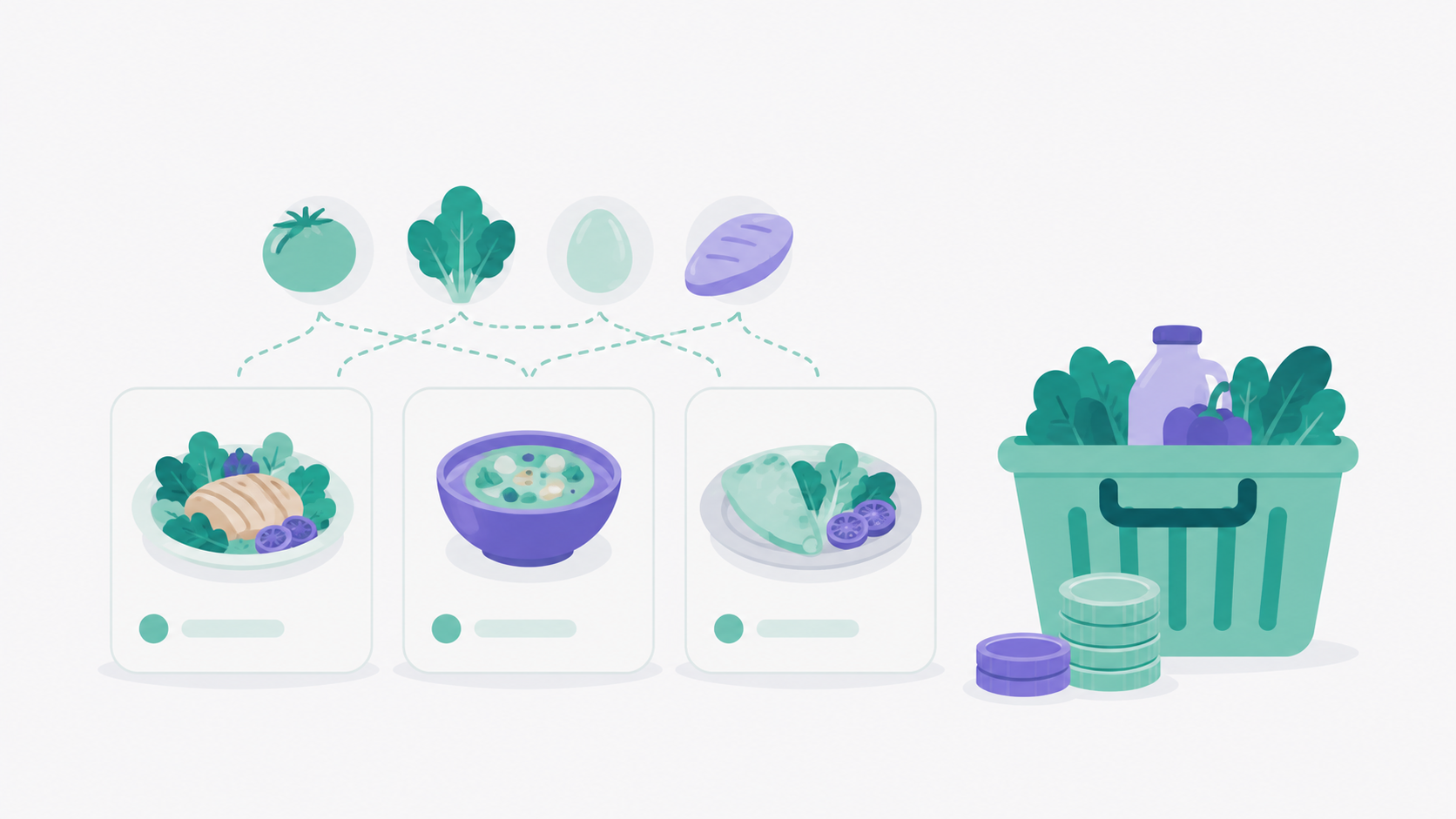
Meal planning saves money mostly by creating ingredient overlap and cutting waste, not by making you buy cheaper food. The USDA's own food plans put numbers on the gap: as of the April 2026 Cost of Food at Home report, a reference family of four runs about $1,013 a month on the Thrifty plan versus roughly $1,380 on the Moderate plan, and the difference between those tiers is largely planning, minimal waste, and cooking from staples rather than nutrition.
That's about $367 a month, or roughly $4,400 a year, for the same nutritional adequacy. You won't capture all of it, since the Thrifty plan assumes near perfect execution that almost nobody sustains. But it does tell you the size of the pool you're fishing in, and it's considerably bigger than the coupon clipping advice most grocery articles lead with.
Why does last minute shopping cost more?
Because you buy for tonight instead of for the week, and single meal purchases don't share ingredients. Four unplanned trips produce four unrelated sets of groceries, while one planned trip produces overlapping ingredients that stretch across multiple meals.
Here's the specific mechanism, and it isn't willpower.
You're buying complete meals instead of components
When you shop at 6 p.m. for dinner at 7 p.m., you buy exactly what that one meal requires. Rotisserie chicken, a bagged salad, a loaf of bread. Nothing you bought helps you on Wednesday, so Wednesday requires its own trip and its own complete set of items.
A planned week works differently. Two pounds of chicken thighs cover three dinners. One bunch of cilantro serves the tacos on Monday and the rice bowls on Thursday. That overlap is the actual savings mechanism, and it only exists if the meals were decided together.
Perishables die between trips
The bag of spinach bought for one specific salad has no second job. It sits in the crisper, goes slimy on day six, and gets thrown out. Multiply that by three or four items a week and you're paying for food nobody eats, which is a real and measurable expense rather than a rounding error.
The gap gets filled by takeout
This is the part that never shows up in grocery comparisons and is usually the largest single cost. When there's no plan and nothing obvious in the fridge at 6:30 on a Tuesday, delivery happens. The Bureau of Labor Statistics found that the average U.S. household spent $3,945 on food away from home in 2024, roughly $329 a month, and a good portion of that is not celebratory dining. It's the Tuesday problem.
So when you compare planned versus unplanned shopping, compare the total food number, not the grocery line. Otherwise a month where groceries dropped $80 looks like a win when restaurant spending went up $150.
How much does food waste actually cost a household?
More than most people would guess. The EPA's 2025 report on the cost of food waste estimated the annual per capita cost at $728, which works out to $2,913 for a household of four, or over 11 percent of that household's annual food budget.
That estimate is probably conservative, too, since it uses retail food prices and doesn't fully account for restaurant food, which costs more per calorie. For broader context, USDA's Economic Research Service estimates that 30 to 40 percent of the entire U.S. food supply goes uneaten, and food is the single largest category of material in American landfills.
There's a genuinely encouraging counterpoint, though. ReFED's 2026 U.S. Food Waste Report found that household food waste declined by about 950,000 tons in 2024, and attributed the drop to consumers managing their food better in response to sustained high prices. So this is a lever that people are actually pulling successfully, at scale, right now.
Cutting your household waste by half, which is achievable with planning rather than heroics, is worth somewhere in the range of $1,400 a year for a family of four. That's a meaningful number for a change that mostly involves deciding on Sunday what you'll eat on Wednesday.
What does meal planning look like if you hate meal planning?
Plan four dinners, not seven, and build them around shared ingredients. The rigid seven day plan is why most people try this once and quit, since life reliably breaks it by Wednesday and then the whole system feels like a failure.
Here's a version that survives contact with a real week.
Plan four, leave three open
Four planned dinners covers the nights you'd otherwise order delivery. The other three become leftovers, something from the freezer, or an easy default like eggs and toast. Leaving deliberate gaps means an unexpected work dinner doesn't wreck the plan, it just uses one of the gaps.
Build around two anchor ingredients
Pick two proteins and two produce items that appear across multiple meals. Ground turkey shows up in tacos, in a pasta sauce, and in a stir fry. A head of cabbage goes into the tacos as slaw and into the stir fry as bulk. This is where the actual savings live, since it means you're buying larger quantities of fewer things, which is almost always cheaper per unit and produces less waste.
Shop once, top up once
One real shop early in the week, one small top up midweek for fresh items. The midweek trip is what keeps produce from dying, and it's short enough that it doesn't turn into a full unplanned shop. Set a rule for that trip: a written list, no cart, basket only.
Cook once, eat twice
Doubling a recipe costs maybe six extra minutes and eliminates one shopping trip plus one takeout decision. Chili, soup, roasted vegetables, and rice all reheat fine. This is the single highest return habit on the list for the effort involved.
Check the fridge before you plan, not after
Ten minutes of looking at what you already have will change what you plan and prevent the classic mistake of buying a third jar of cumin. It also surfaces the items that need using this week, which is where most waste starts.
When is last minute shopping actually fine?
It's fine when your household is small, your store is close, and your schedule is genuinely unpredictable. Rigid plans waste more food than no plan at all if the plan never survives the week.
Look, meal planning gets sold as a universal virtue and it isn't one. If you live alone, a big planned shop can produce more waste than buying for two days at a time, because portion sizes at the grocery store assume families. If you work rotating shifts, or you're on call, or you have small kids whose appetites change hourly, a fixed Monday through Friday plan is going to fail and take your motivation with it.
The useful principle underneath meal planning isn't the calendar, it's overlap and waste reduction. You can get most of the benefit by keeping a short list of five meals you can build from staples you always have, and shopping for those staples rather than for specific dinners. That's planning without a plan, and for a lot of households it works better.
If your income arrives unevenly, which makes a fixed weekly grocery number harder to hold to, our approach to budgeting on an irregular income covers how to set category amounts against your lowest recent week rather than your average.
How do you know whether it's actually working?
Track groceries and restaurants as separate subcategories and compare them together, month over month. Watching groceries alone will fool you every time, because the easiest way to lower a grocery bill is to eat out more.
Here's where most budget setups fall down. A single "Food" category absorbs a $180 grocery run, four delivery orders, and eleven coffees, and the total moves for reasons you can't decompose. When the number goes up, you learn that food went up, which tells you nothing about whether your plan is working.
Lucky Friday lets you create unlimited custom categories and subcategories, so you can set up a Food parent with groceries, restaurants, delivery, and coffee underneath it, then read both the total and the split. That structure is what makes the comparison honest. All of it sits on the permanently free tier, with no category limits and no credit card. Category rules help with the tedious part: set one rule per frequent store so transactions file themselves rather than needing manual sorting every week. If you'd rather have transactions import automatically instead of entering them yourself, bank sync through Plaid is available on the premium plan.
Give it 60 days before judging. The first month of any new food routine is messy and usually costs more, because you're buying staples you don't have yet. The second month is where the comparison starts meaning something.
Then do something with the difference. If you find $200 a month, that money reabsorbs into the same habits within about six weeks unless it gets an assignment. Our guide to starting an emergency fund when you're already behind covers where to send it, and if you've tracked spending before without your savings actually changing, our piece on why most budgeting apps never move your savings rate explains the gap between seeing a number and doing something about it.
Common Questions About Meal Planning vs Last Minute Shopping
How much money does meal planning actually save?
The realistic range is $150 to $400 a month for a family of four, depending on how much takeout it displaces. The USDA's food plan tiers put roughly $367 a month between the Thrifty plan, which assumes planning and minimal waste, and the Moderate plan, which assumes more convenience foods. Most of that gap comes from ingredient overlap and reduced waste rather than from buying cheaper items.
Is it cheaper to shop once a week or multiple times?
One main shop plus one small midweek top up usually costs least. A single weekly shop creates overlap and bulk savings, while the short top up prevents produce from spoiling before you use it. Frequent full shops are the expensive pattern, since each trip tends to add unplanned items.
Does meal planning reduce food waste?
Yes, and the savings there are substantial. The EPA estimates household food waste costs about $728 per person annually, or $2,913 for a household of four, which is over 11 percent of the typical food budget. Planning meals around shared ingredients means fewer items bought for a single use and left to spoil.
How do I meal plan when my schedule is unpredictable?
Plan four dinners instead of seven and keep three nights deliberately open. Build the four around shared ingredients so a skipped night doesn't strand a set of groceries, and keep a short list of meals you can make entirely from shelf stable staples for the nights nothing goes as expected.
Should I count takeout in my grocery budget?
Track them separately but review them together, because they trade off directly against each other. A grocery bill that drops while delivery spending climbs isn't a saving, it's a transfer. Subcategories under one food parent give you both numbers, which is the only way to see whether a change actually worked.
Sources
U.S. Department of Agriculture. Official USDA Food Plans: Cost of Food at Home, April 2026, reference family of four tiers summarized at https://www.summitplate.com/blog/average-grocery-bill-by-family-size
U.S. Environmental Protection Agency. "Estimating the Cost of Food Waste to American Consumers." 2025. https://www.epa.gov/system/files/documents/2025-04/costoffoodwastereport_508.pdf
U.S. Food and Drug Administration, citing USDA Economic Research Service. "Food Loss and Waste." https://www.fda.gov/food/consumers/food-loss-and-waste
ReFED. "Progress on the Plate: The 2026 ReFED U.S. Food Waste Report." April 2026. https://refed.org/food-waste/refed-us-food-waste-report-2026/
U.S. Bureau of Labor Statistics. "Consumer Expenditures in 2024," food away from home spending.