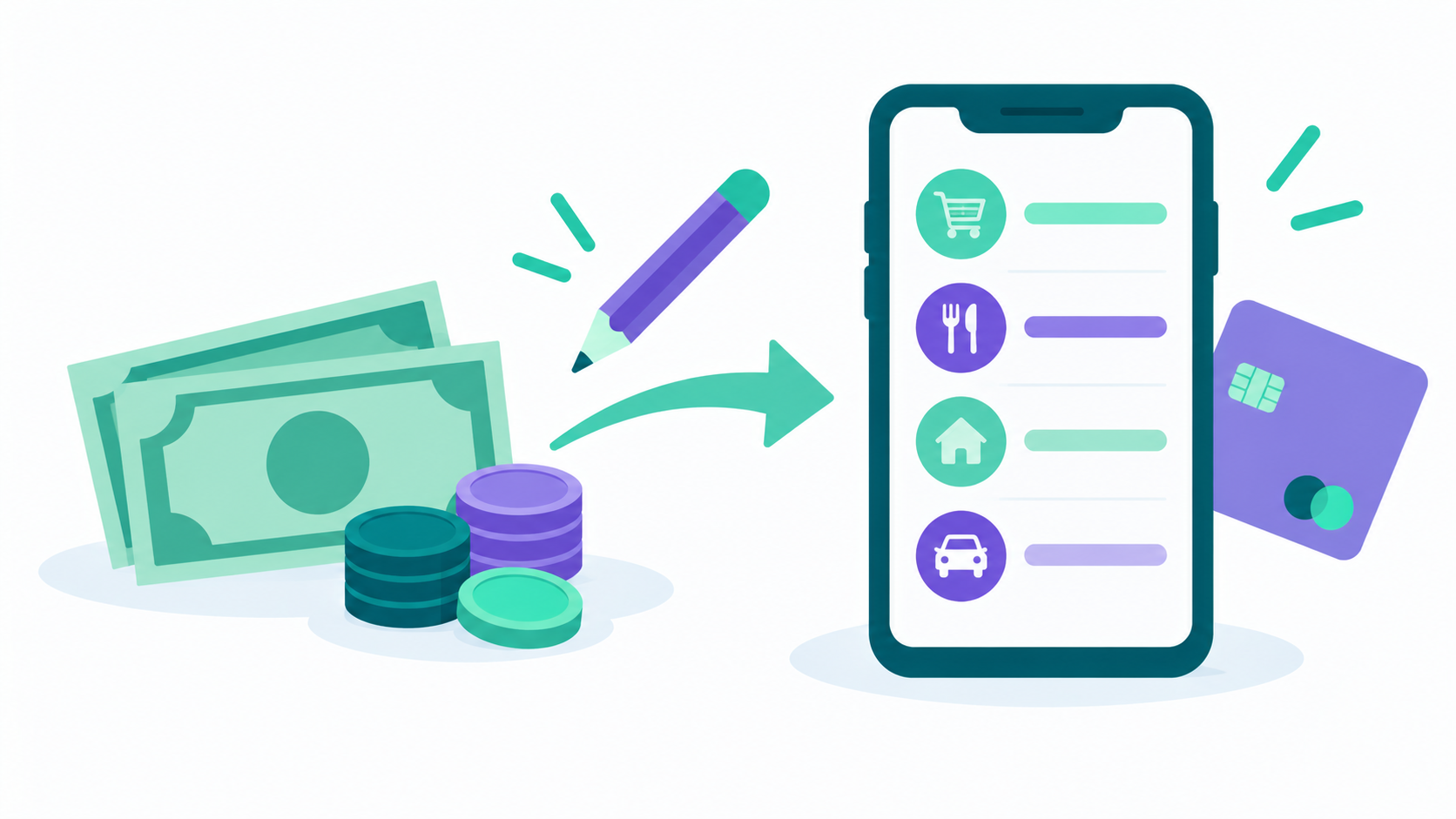
Cash accounts for roughly one in seven payments and close to zero percent of most people's tracking data. Bank syncing captures the $80 ATM withdrawal and has no idea what the $80 bought, which means every dollar of cash spending lands in your budget as a mystery.
There are three ways to fix that: log each purchase as it happens, log the withdrawal and reconcile later, or run an envelope system where you allocate cash up front and don't log individual purchases at all. Any of them works. Which one you pick should depend on how much cash you handle and how much effort you'll realistically sustain.
How much spending actually happens in cash?
More than most people assume. The Federal Reserve's 2026 Diary of Consumer Payment Choice found cash accounted for about 14 percent of all payments, roughly one in seven, and it has been the third-most-used payment instrument for six consecutive years.
The specifics are useful. U.S. consumers made an average of 47 payments a month, splitting into about 16 credit card payments, 15 debit card payments, and six cash payments. Four out of five consumers had used cash in the previous 30 days, 76 percent carried cash on their person, and 90 percent said they plan to keep using it.
Cash use isn't distributed evenly, either, and the pattern matters for who needs this most. Households earning under $25,000 a year averaged seven cash payments a month compared with five for households above $150,000. An earlier Diary edition put it in sharper terms, finding that consumers in households under $25,000 used cash for roughly one in three payments while those above $150,000 used it for about one in ten. Rural residents averaged nine cash payments a month against six for urban and suburban consumers, and adults 55 and older relied on cash more than younger cohorts.
So the people most likely to have significant untracked cash spending are often the people for whom accurate tracking matters most. That's worth naming, because most budgeting advice quietly assumes a fully carded life.
Why does untracked cash break a budget?
Because the withdrawal enters your records as one large lump in the wrong place, and everything it bought disappears. A $100 ATM withdrawal shows up as $100 of something, and your grocery, transport, and coffee categories all silently understate by whatever portion went there.
The effects compound in three ways.
Your category totals become unreliable, which defeats the whole purpose of categories. If groceries reads $410 but $90 of grocery spending happened in cash, the number you're making decisions from is wrong by more than 20 percent.
You get a mystery gap. Money left the account, nothing explains it, and month after month there's an unexplained difference between what you thought you spent and what actually left. That gap is corrosive, because it makes the whole budget feel untrustworthy.
And cash disproportionately buys the things you most want visibility on. Small purchases, food, transport, and the informal economy of tips and vendors are exactly where cash concentrates, and those are the categories where habits hide.
There's a psychological layer too. Research published in the Journal of Consumer Research found that people given four quarters were more than twice as likely to spend the money as people given a single dollar bill, at 63 percent versus 26 percent for identical amounts. Small denominations feel spendable in a way a larger note doesn't, which is one reason change disappears without leaving any memory behind.
Should you use less cash, then?
Not necessarily, and the research cuts the other way on the bigger question. Studies on the pain of paying consistently find people spend more with cards than with cash. A well known MIT study found people willing to pay up to 100 percent more using a credit card, and a 2024 study from De Nederlandsche Bank found contactless payments produce the least pain of paying of any method, with consumers themselves rating cash as the most helpful method for controlling spending.
So cash is a genuinely useful spending control. The problem isn't using it, it's not recording it. Track it and you get both the restraint and the visibility.
What are the three ways to track cash?
Pick one based on your cash volume and your tolerance for effort. The best method is the one you'll still be using in month three.
Method one: log at the moment of purchase
Record each cash purchase immediately, before you pocket the change. Takes about fifteen seconds per transaction.
This is the most accurate method and the best fit if you spend cash a few times a week rather than a few times a day. It also produces a side benefit that automatic tracking can't: the act of recording creates a moment of attention, which tends to reduce spending on its own.
Method two: log the withdrawal, then reconcile
Record the ATM withdrawal as a transfer into a cash account rather than as an expense, then once or twice a week, sit down with your receipts and split it into real categories.
Better suited to higher cash volume, and it batches the work into one session instead of scattering it. The tradeoff is that you're relying on receipts and memory, so accuracy drops for anything you didn't get a receipt for.
Method three: allocate rather than log
The envelope approach. Decide at the start of the week or month that $150 goes to groceries in cash, $60 to eating out, $40 to miscellaneous, and physically separate the money. Then don't record individual purchases at all.
The allocation is the budget, and running out is the feedback. Record only the initial allocation in your app, categorized appropriately, and let the envelope do the rest.
This suits people who use a lot of cash, dislike logging, or want a hard spending limit. It's less precise, since you know $150 went to groceries but not what the individual purchases were, and for many households that's enough.
How do you make it stick?
Attach the logging to something you already do, keep it under thirty seconds, and round the numbers.
Research on implementation intentions found that specifying exactly when and how you'll act substantially improves follow-through compared with a general resolution. So "I log the purchase while I'm still standing at the counter" works, and "I'll try to remember to log cash" doesn't.
A few practical things that raise the success rate.
Round to the nearest dollar. Chasing 47 cents adds effort and changes nothing about any decision you'll make.
Keep receipts in one pocket, then empty that pocket during a weekly ten minute catch-up. This is the safety net for the times you didn't log in the moment, and it turns forgetting into a recoverable error rather than a lost transaction.
Expect the first two weeks to be inconsistent, and don't treat a missed day as a failed system. Partial data beats no data by a wide margin, and a category that's 85 percent accurate is enormously more useful than one that's empty.
And if you handle cash constantly, switch to method three rather than fighting method one. Adjusting the method to fit your life is the right response to friction, not more discipline.
What about cash income?
Track it as income with its own subcategories, and set aside a percentage if it's self-employment income. Tips, side work, informal jobs, gifts, and reimbursements all arrive without landing in a bank feed.
The tracking reason is straightforward. Planned versus actual on the income side only means something if the income side is complete, and cash income is exactly what makes a variable-income budget look worse than it is. Our approach to budgeting on an irregular income covers setting your obligations against your leanest recent period, and that calculation needs your real income figure rather than the banked portion.
There's a tax dimension too. Self-employment income is reportable regardless of whether it arrives as cash and regardless of whether anyone issues a form. If a meaningful share of your income comes in cash, keeping a running record protects you at filing time and makes setting aside for taxes possible rather than theoretical. A tax preparer is worth the fee in that situation.
How do you track cash in an app built for cards?
You need manual transaction entry, and you need it without paying for it. Cash is the one category of spending that no bank connection can ever capture, so an app that treats manual entry as an afterthought doesn't work for cash-heavy households.
Lucky Friday includes manual transaction entry on the permanently free tier, which is the specific feature this whole problem requires. You can also add a custom manual account for cash itself, so withdrawals move into a cash account and purchases come out of it, which is what makes method two work cleanly. Every transaction stays editable afterward, so a purchase you logged to the wrong category or estimated badly can be corrected later.
The category structure matters too. Most budgeting apps hand you a preset list, which typically has no good home for the things cash actually buys, and often ends up with everything piled into a generic "cash" bucket that tells you nothing. Lucky Friday lets you create unlimited custom categories and subcategories with your own icons and colors, so cash purchases can go into the same real categories as your card spending and your totals become accurate rather than partial. That's the whole point: not a separate cash budget, but one budget that includes cash.
Being straight about the paid tier. Bank sync through Plaid is available on the premium plan and imports card and account activity automatically, covering more than 11,000 institutions. It will import your ATM withdrawal. It cannot tell you what you did with the money, and no service can. Manual entry is the only method that works for cash, and it's free.
This matters for a specific group too. The FDIC's most recent survey found 4.2 percent of U.S. households, roughly 5.6 million, had no bank account at all, with another 14.2 percent underbanked. For those households, an app that requires a bank connection to function isn't a budgeting tool. Manual entry and a permanent free tier are what make one usable.
One more thing worth doing. Filtering transactions by date range lets you pull a specific week or month when you're reconciling receipts, which turns the weekly catch-up from a scroll through everything into a two minute task. And if tracking alone hasn't previously changed your numbers, our piece on why most budgeting apps never move your savings rate covers why visibility needs an automatic transfer behind it. If a cushion is the goal, our guide to starting an emergency fund when you're already behind covers building that first tier.
Common Questions About Tracking Cash Spending
How do I track cash spending in a budgeting app?
Use manual transaction entry, since no bank connection can see what cash bought. Either log each purchase as it happens, or record the ATM withdrawal into a cash account and split it into real categories once or twice a week. Lucky Friday includes manual entry on its permanently free tier, along with custom accounts for tracking cash.
Why doesn't my budget match my bank account?
Untracked cash is one of the most common reasons. An ATM withdrawal leaves your account as a single lump, and everything it purchased is invisible, so your category totals understate while an unexplained gap appears. Cash accounts for about one in seven payments nationally, so the gap is often larger than people expect.
Is it better to use cash or a card for budgeting?
Cash generally reduces spending, which is why many people use it deliberately. Research consistently finds people spend more with cards, and a 2024 study found consumers themselves rate cash as the most helpful method for preventing overspending. The tradeoff is that cash requires manual tracking, so you're trading automation for restraint.
How do I track cash if I get paid in cash?
Record it as income with its own category so your planned versus actual income figures are complete. If it's self-employment income, it's reportable regardless of how it arrives, so keep a running log and set aside a percentage for taxes as you go. Talking to a tax preparer is worth it if cash is a meaningful share of your income.
What's the easiest way to track cash?
The envelope approach, if you handle cash frequently. Allocate a set amount to each category at the start of the week or month, record only that allocation in your app, and let running out serve as the limit. It's less precise than logging every purchase and considerably more sustainable for high cash volume.
Sources
Federal Reserve Financial Services. "2026 Findings from the Diary of Consumer Payment Choice." May 2026. https://www.frbservices.org/news/research/2026-findings-diary-consumer-payment-choice
Federal Reserve Financial Services. "2026 Diary of Consumer Payment Choice," full report. https://www.frbservices.org/binaries/content/assets/crsocms/news/research/2026-diary-consumer-payments-choice.pdf
Federal Reserve Financial Services. "Cash Remains Essential to US Consumers," Fed360, August 2026. https://www.frbservices.org/news/fed360/issues/080426/cash-remains-essential-us-consumers
Federal Reserve Financial Services. "2024 Findings from the Diary of Consumer Payment Choice," on cash use share by household income. https://www.frbservices.org/binaries/content/assets/crsocms/news/research/2024-diary-of-consumer-payment-choice.pdf
Raghubir, Priya, and Joydeep Srivastava. "The Denomination Effect." Journal of Consumer Research, vol. 36, no. 4, 2009. https://academic.oup.com/jcr/article-abstract/36/4/701/1791668
Prelec, Drazen, and Duncan Simester. "Always Leave Home Without It." Marketing Letters, vol. 12, no. 1, 2001. https://link.springer.com/article/10.1023/A:1008196717017
Broekhoff, Marie Claire, and Carin van der Cruijsen. "Paying in a Blink of an Eye: It Hurts Less, but You Spend More." Journal of Economic Behavior and Organization, 2024. https://www.sciencedirect.com/science/article/pii/S0167268124001100
Federal Deposit Insurance Corporation. "National Survey of Unbanked and Underbanked Households." https://www.fdic.gov/household-survey