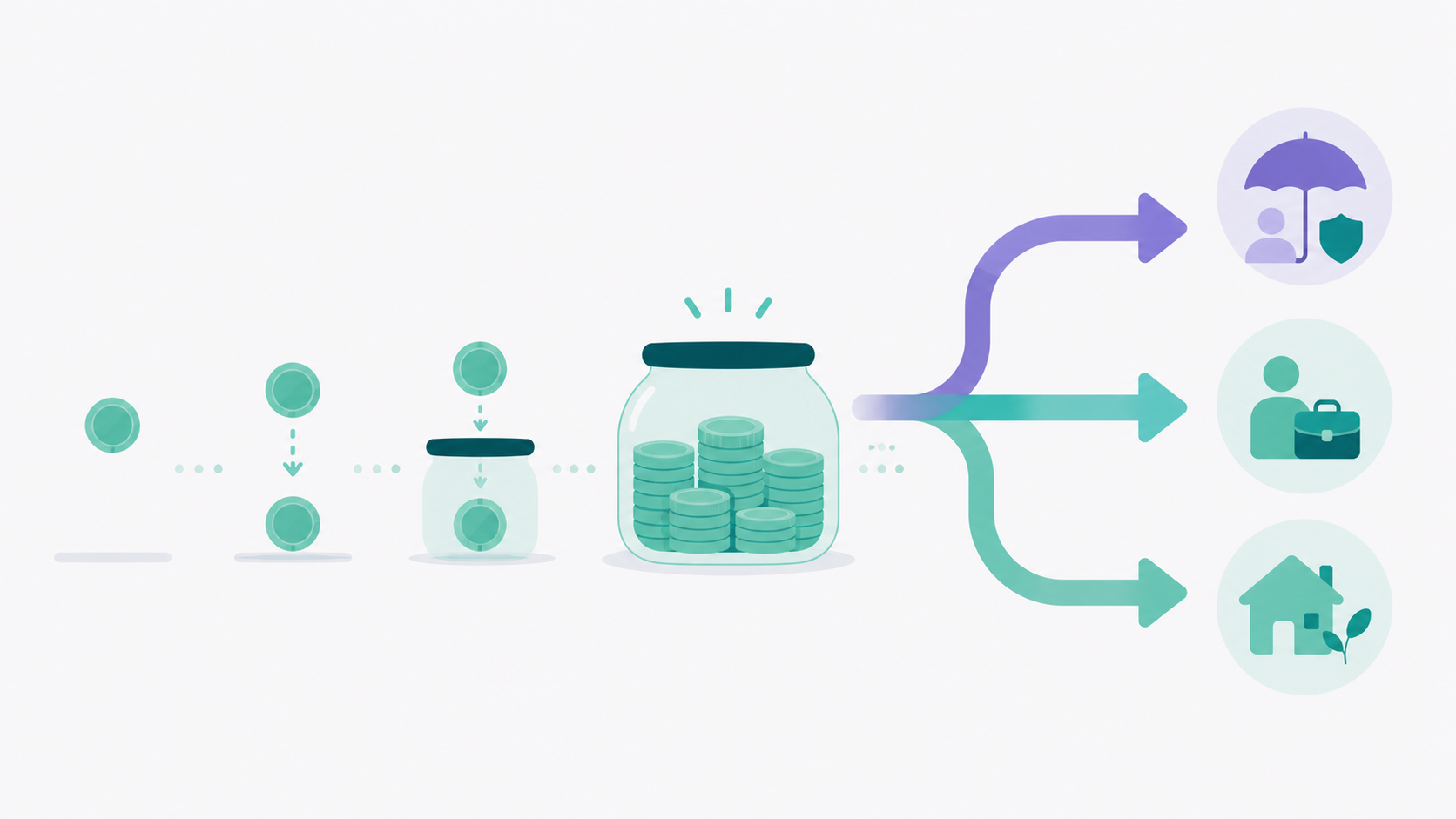
Small savings don't prevent crises. What they do is prevent the second crisis, the one caused by how you had to handle the first one. Urban Institute research found that families with as little as $250 to $749 set aside are less likely to be evicted, miss a housing or utility payment, or need public benefits after a job loss, health issue, or large income drop.
That's a much lower threshold than the standard advice implies, and it changes what you're actually working toward. You're not saving three to six months of expenses before anything improves. You're saving until you have enough to say no to the worst available option, and that number starts in the hundreds rather than the tens of thousands.
What does a small emergency fund actually do?
It converts forced decisions back into choices. When the car needs a $600 repair and you have nothing, the decision gets made for you: put it on a card at 24 percent, take a payday loan, or lose the way you get to work. When you have $600, you just pay for the repair and go to work on Monday.
Nothing about the crisis changed. The car still broke. What changed is that the crisis stayed one crisis instead of becoming a chain of them, and that chain is where most of the real damage happens. A missed rent payment becomes a late fee, then a mark on your rental history, then a harder time getting the next apartment. A card balance becomes an interest charge that recurs every month for two years.
The Urban Institute research puts numbers on this. Roughly 21 percent of families with between $1 and $249 in savings reported missing a housing payment during an income disruption, compared with about 15 percent of families holding $250 to $749. That's a meaningful drop for a few hundred dollars.
Here's the finding that reframes the whole thing, though. Urban's researchers also found that low income families with savings of $2,000 to $4,999 are more financially resilient than middle income families with no savings at all. Cushion beats paycheck size when it comes to weathering a shock, which means this lever is available to you regardless of what you earn.
How much do you need before it starts to matter?
The first meaningful threshold is around $250 to $500, not the three to six months of expenses most advice leads with. Each tier above that buys a different category of option, and reaching the first one takes months rather than years.
Think of it in three stages, because treating it as one enormous goal is exactly what makes people quit in week three.
Stage one: $250 to $500, the fee avoidance tier
At this level you stop paying to be broke. Overdraft fees are the clearest example: CFPB research found that 79 percent of combined overdraft and non sufficient funds fees are paid by about 9 percent of consumers, who incur more than ten fees a year and pay a median of $380 annually. A $400 buffer sitting in checking prevents most of that, which means the cushion pays for itself in the first year.
This tier also covers the small stuff that becomes big when unpaid: a copay, a utility disconnect fee, a phone bill, a tire. It won't cover a real emergency, but it stops the ordinary friction of life from generating debt.
Stage two: $1,000, the repair tier
This is where you can handle the classic unplanned expense without borrowing. Bankrate's January 2026 Emergency Savings Report found that only 30 percent of Americans would cover a $1,000 emergency from savings, and a third said they'd go into debt to handle it. So crossing $1,000 puts you in a minority, and it covers the majority of single incidents: most car repairs, most appliance replacements, most deductibles.
Stage three: one month of expenses, the decision tier
At one month, you buy time, and time is what changes outcomes during a real disruption. A month of runway means you can turn down the first job offer if it's badly underpaid, appeal a denied claim instead of just paying the bill, or take three days to research a decision instead of making it at 11 p.m. in a panic.
For context on how uncommon that is, the Federal Reserve's 2025 Survey of Household Economics and Decisionmaking found that 55 percent of adults had set aside enough to cover three months of expenses, while 30 percent said they could not cover three months by any means, including borrowing or selling assets.
Why do small amounts work better than big ones?
Because consistency compounds and enthusiasm doesn't. A $50 monthly transfer you actually maintain beats a $400 monthly plan you abandon in March, and the abandoned plan usually takes your confidence with it.
Run the math on modest amounts and the timeline is shorter than people expect. Fifty dollars a month crosses the $250 threshold in five months and reaches $600 in a year. Twenty five dollars a week, which is about $108 a month, hits $500 in under five months and $1,300 in a year. Even $20 a month gets you to $240 by the twelfth month, and that lands you right at the edge of the band where the Urban Institute found measurable differences in hardship outcomes.
Compare that to the standard advice. Six months of expenses for a household spending $3,500 a month is $21,000. At $50 a month, that's 35 years, which is why the standard target reads as impossible to a lot of people and gets dismissed entirely. The tiered version gives you a first win in five months instead.
There's a behavioral piece too. A savings habit that survives a bad month is worth more than a large deposit made once, because the habit is what rebuilds the fund after you spend it. And you will spend it, that's the entire point of having it.
What options does a cushion actually buy?
Concretely, these are the doors that stay open when there's money in the account, and quietly close when there isn't.
You can decline a payday loan or a title loan, both of which carry effective rates that can run into the triple digits. You can avoid putting an emergency on a credit card at 20 percent or more and carrying it for a year. You can pay rent on time and skip the late fee plus the record of it. You can fix the car that gets you to work rather than choosing between the repair and the paycheck it protects.
You can also do things that don't show up as line items. You can leave a job or a living situation that isn't working, since having a month of expenses is often the difference between leaving and staying. You can take a day to think, which reliably produces better decisions than acting immediately. You can say no to a family member's request without it being a crisis, or say yes because you can afford to.
That's what the word options means here. Not luxury, not freedom in the abstract, just the ability to choose the second worst option instead of the worst one.
How do you build a cushion when nothing's left at the end of the month?
Move the money at the beginning rather than the end, because whatever's left over at month end is reliably zero. Set a small automatic transfer for the day after payday and treat it like a bill you owe yourself.
Then find the money in three places, in this order.
Start with recurring charges you've stopped using. Scan three months of statements rather than one, since annual and quarterly charges won't appear in a single month, and cancel anything you haven't used in 60 days. This is usually the fastest $30 to $80 a month anyone finds.
Next, look at the category with the most transactions rather than the biggest total. Frequency is where habits live, and a category with eleven small purchases has more slack in it than one with a single large necessary payment. Giving that category its own budget line and watching it for 30 days tends to reduce it without any deliberate effort.
Last, capture irregular money before it disperses. Tax refunds, a bonus, a birthday check, a reimbursement. Send half of anything unexpected straight to the cushion the day it arrives. Most people can build their entire stage one fund from a single tax refund, and the median refund is well above $250.
Track the cushion as its own category rather than as a number in your head. Lucky Friday lets you create unlimited custom categories and subcategories, so you can set up a dedicated buffer category with its own target and watch it fill month over month, which is genuinely motivating in a way that a bank balance isn't. That's included on the permanently free tier, no credit card and no trial clock. If your income arrives unevenly, which makes fixed monthly transfers harder to sustain, our approach to budgeting on an irregular income covers how to set savings amounts against your lowest recent month rather than your average.
For a step by step version of the whole build, our guide to starting an emergency fund when you're already behind walks through the first buffer method specifically for people who aren't starting from a surplus.
How do you keep from spending it?
Put it somewhere with a little friction, but not too much. A separate savings account at the same bank, or an account at a different institution entirely, is enough to break the habit of spending it accidentally. Avoid anything that takes more than a day or two to access, since a cushion you can't reach during an actual emergency isn't doing its job.
Define what counts as an emergency in advance, while you're calm. Write it down: job loss, medical, car repair that affects getting to work, housing. Everything else waits. The definition matters because the decision gets made under pressure, and a rule you set beforehand is much easier to follow than a judgment call made at midnight.
And when you do spend it, refill it without treating the withdrawal as a failure. Using the fund is the fund working correctly. The only real failure mode is not rebuilding, which is why the habit matters more than the balance. If you've found that tracking alone has never actually changed your savings, our piece on why most budgeting apps never move your savings rate gets into why visibility only helps when it's paired with a transfer that happens automatically.
Common Questions About Small Savings and Financial Crises
How much emergency savings do you actually need to make a difference?
Less than most advice suggests. Urban Institute research found measurably lower rates of eviction and missed housing or utility payments among families holding just $250 to $749 compared with those holding under $250. The commonly cited three to six months target is a longer term goal, not the point where benefits begin.
Is it worth saving $25 a month?
Yes, because it crosses the first meaningful threshold in under a year. Twenty five dollars a month reaches $300 in twelve months, which puts you in the range where research shows fewer missed payments during income disruptions. Consistency also matters more than amount, since the habit is what rebuilds the fund after you use it.
Where should I keep a small emergency fund?
Somewhere separate from your daily checking account but still accessible within a day or two. A dedicated savings account creates just enough friction to stop accidental spending without making the money hard to reach when you need it. Locking it into anything with withdrawal penalties defeats the purpose at this size.
What counts as a real emergency?
Decide in advance and write it down, because the judgment is harder to make under pressure. A reasonable definition covers job or income loss, medical needs, a car repair that affects your ability to work, and housing costs. Everything else can usually wait a week, and waiting a week is often enough to find another solution.
Should I pay off debt or build savings first?
Building a small cushion first usually makes sense, even while carrying debt, because without one the next unexpected expense goes straight back onto the card. A common approach is to build $500 to $1,000, then focus on high interest debt, then return to the fund. The cushion is what keeps you from undoing the debt progress you make.
Sources
Urban Institute. "Thriving Residents, Thriving Cities: Family Financial Security Matters for Cities." McKernan, Ratcliffe, et al. https://www.urban.org/research/publication/thriving-residents-thriving-cities-family-financial-security-matters-cities
Urban Institute. "Why Cities Should Care about Family Financial Security." https://www.urban.org/features/why-cities-should-care-about-family-financial-security
Board of Governors of the Federal Reserve System. "Economic Well-Being of U.S. Households in 2025," Savings and Investments section, May 2026. https://www.federalreserve.gov/publications/2026-economic-well-being-of-us-households-in-2025-savings-investments.htm
Board of Governors of the Federal Reserve System. Press release on the 2025 SHED report, May 13, 2026. https://www.federalreserve.gov/newsevents/pressreleases/other20260513a.htm
Bankrate. "Just 30% of Americans Say They Would Pay an Emergency Expense of $1,000 From Savings." January 21, 2026. https://www.bankrate.com/press-releases/just-30-of-americans-say-they-would-pay-an-emergency-expense-of-1000-from-savings/
Consumer Financial Protection Bureau. "Overdraft Lending: Very Large Financial Institutions." Federal Register, December 30, 2024. https://www.federalregister.gov/documents/2024/12/30/2024-29699/overdraft-lending-very-large-financial-institutions