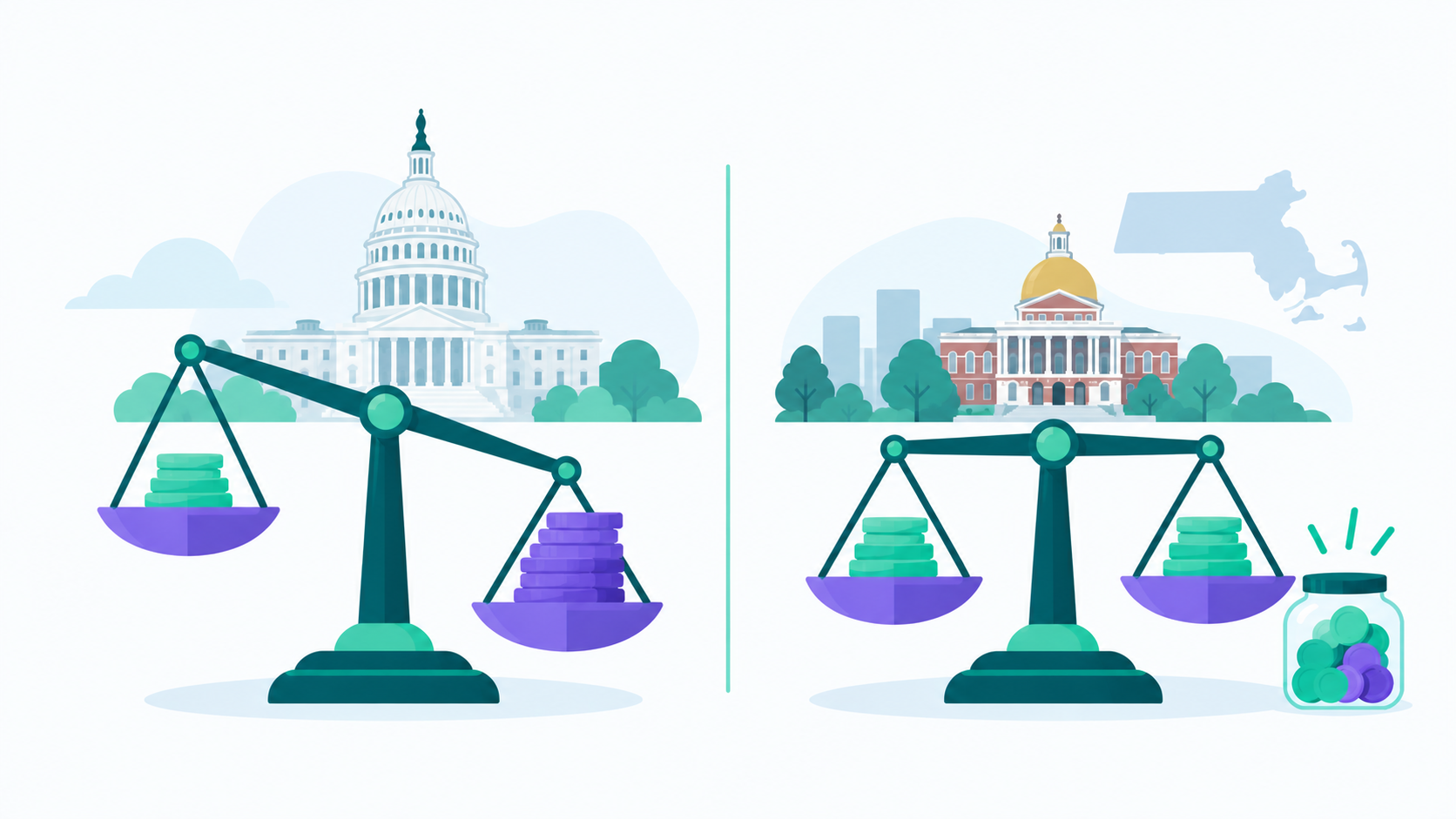
The core difference is that the federal government can run a deficit indefinitely and nearly every state legally cannot. Forty-nine states operate under some form of balanced budget requirement, with Vermont the usual exception, while the federal government is projected to run a $1.9 trillion deficit in fiscal year 2026.
That single structural difference drives almost everything else: why federal shutdown fights cluster around the end of September, why states cut services during recessions instead of borrowing through them, why states hold large reserve funds and Washington doesn't, and why your household budget is structurally far closer to a state budget than a federal one.
What's the single biggest difference?
Balanced budget requirements. States generally have to match spending to revenue within each fiscal year, while the federal government routinely spends more than it collects and borrows the difference.
The phrase "balanced budget requirement" is doing a lot of work there, though, and it means different things in different states. Requirements break into three distinct obligations that don't always appear together: the governor must submit a balanced budget, the legislature must pass one, and the state is prohibited from carrying a deficit into the next year. Roughly 44 states require the first, about 41 require the second, and approximately 38 require the third.
So a state that only requires a balanced proposal has a much weaker constraint than one that forbids ending the year in the red. And there's some genuine disagreement about the count, since NCSL has traditionally reported 49 states while other authorities also list Wyoming and North Dakota as exceptions.
The federal government has no equivalent constraint. Congress appropriates, Treasury borrows the gap, and the process repeats.
How do the two budgets compare in size and structure?
The federal budget is far larger and dominated by programs that run on autopilot, while state budgets are dominated by two categories: healthcare and education.
Federal composition
CBO projects federal outlays of $7.4 trillion in fiscal 2026, or 23.3 percent of GDP, against revenues of $5.6 trillion, or 17.5 percent. Spending splits three ways.
Mandatory spending, mostly Social Security, Medicare, and Medicaid, runs on formulas set in law rather than annual appropriations. It continues without Congress voting on it each year.
Discretionary spending covers defense and everything Congress appropriates annually, from national parks to scientific research. It's around 22 percent of total federal spending, and it's the portion that stops during a shutdown.
Net interest is the government's cost of servicing past borrowing. CBO projects it surpassing $1 trillion in fiscal 2026, about 3.3 percent of GDP, and doubling to roughly $2.1 trillion by 2036, making it the fastest-growing category in the budget.
State composition
States spend most of their money on a much shorter list. Medicaid and K-12 education together typically account for roughly half of state spending, with higher education, transportation, and corrections making up much of the rest.
States also can't put most of their spending on autopilot the way the federal government can, because the annual balancing requirement forces a fresh look every cycle.
Where the money comes from
Federal revenue comes mostly from individual income taxes and payroll taxes. State revenue is a different mix entirely, drawing on state income taxes, sales taxes, and various fees, with property taxes generally belonging to local governments rather than states.
There's one more piece that surprises people. Federal transfers are among the largest sources of state revenue, funding a substantial share of Medicaid, transportation, and education programs. That means changes in federal policy flow directly into state budgets, which is why state budget officers watch Washington closely.
Why can the federal government borrow when states mostly can't?
Because the federal government issues its own currency and states use it. A state that runs out of money has to raise revenue, cut spending, or draw down reserves. The federal government has an additional option that states structurally do not.
The scale reflects that. CBO puts federal debt held by the public at about 101 percent of GDP in 2026, projected to reach 120 percent by 2036, which would surpass the previous high of 106 percent set in 1946. Whether that trajectory is a serious problem, and what if anything should be done about it, is a genuine and contested policy debate that this post isn't going to settle.
States do borrow, just for different purposes. Most can issue bonds for capital projects like schools, roads, and bridges, spreading the cost of a long-lived asset across the years it serves. What they generally can't do is borrow to cover ordinary operating expenses, which is exactly the distinction a household should also draw between a mortgage and putting groceries on a credit card.
Credit ratings also bite harder at the state level. A downgrade raises a state's borrowing costs on future bonds in a way that constrains real decisions, which gives state officials a strong incentive to maintain reserves and balance.
Why do federal and state fiscal years differ?
The federal fiscal year runs October 1 through September 30, while most states run July 1 through June 30. That mismatch explains a lot of the timing of budget news you see.
Forty-six states use the July to June calendar. The exceptions are New York, which starts April 1, Texas, which starts September 1, and Alabama and Michigan, which align with the federal October 1 start.
The practical effect is that federal appropriations deadlines land at the end of September, which is why shutdown coverage tends to appear every autumn, while state budget fights play out in spring. It also means states are often finalizing budgets before knowing what federal funding will look like for the year, which is one reason state budget documents include contingencies.
What do rainy day funds do that the federal government doesn't have?
They give states a cushion to absorb revenue shortfalls without immediately cutting services or raising taxes. The federal government has no equivalent, because it can simply borrow instead.
The scale of state reserves has grown substantially. According to NASBO, the median state rainy day fund balance reached an all-time high of 14.9 percent of general fund spending in fiscal 2024, declined to 13.5 percent in fiscal 2025, and is estimated at 13.1 percent in fiscal 2026 with a projected 12.6 percent for fiscal 2027. Total balances, combining rainy day funds and general fund ending balances, represented 31.7 percent of general fund expenditures at the close of a recent fiscal year.
Nearly every state maintains one. Forty-nine states plus the District of Columbia and the territories have rainy day funds, with Colorado the exception, though Colorado maintains a required reserve that many public finance experts count as equivalent.
Here's why that matters beyond civics. A state with a 13 percent reserve has roughly six or seven weeks of general fund spending set aside. That's not a coincidence of scale, it's the same logic behind a household emergency fund, arrived at independently by people whose job is managing a budget that legally cannot go into the red.
Which model should your household budget follow?
The state model, almost entirely. You're a currency user rather than a currency issuer, you can't borrow indefinitely at low cost, and running a structural operating deficit ends badly for you in a way it doesn't for a sovereign government.
Three specific practices transfer directly.
Balance the operating budget annually
Ordinary recurring expenses should be covered by ordinary recurring income within the year. When they aren't, the gap gets financed by debt that compounds, which is the household equivalent of borrowing to make payroll. Our piece on why most budgeting apps never move your savings rate covers why tracking alone doesn't close that gap, and why an automatic transfer usually does.
Hold real reserves, not aspirational ones
States don't hold reserves because someone told them to feel prudent. They hold reserves because the balancing requirement means a revenue shortfall has to be absorbed somewhere, and reserves are the only alternative to immediate cuts.
Your situation is identical. Urban Institute research found families with as little as $250 to $749 saved were less likely to be evicted or miss a housing or utility payment after an income disruption, which is a far lower threshold than the standard advice implies. Our guide to starting an emergency fund when you're already behind covers building that first tier.
Separate capital borrowing from operating borrowing
States can bond for a bridge and not for salaries, and that line is worth drawing at home. A mortgage or a student loan buys a long-lived asset. A credit card balance covering regular monthly expenses is an operating deficit wearing a different name, and it's the one to attack first.
To watch this properly you need two views: a budget that shows the year, and a balance sheet that shows what you own against what you owe. Lucky Friday handles both, with monthly and annual budget views plus planned versus actual tracking on income and expenses, and net worth tracking showing assets minus liabilities with the trend over time. Unlimited custom categories and subcategories mean you can structure it however your finances actually work rather than fitting into a preset list built for someone else. All of that is on the permanently free tier, with no category limits and no credit card required. If you'd rather have transactions import automatically instead of entering them by hand, bank sync through Plaid is available on the premium plan.
The annual view is the one that makes this comparison click. Governments budget in years for a reason, since a single month tells you almost nothing about whether the structure works. Your household is the same, and most people never look at their finances on that timescale.
Common Questions About Federal and State Budgets
Do all states have to balance their budgets?
Forty-nine states operate under some form of balanced budget requirement, with Vermont generally cited as the exception, though the count varies by how strictly you define the requirement. The rules differ substantially in strength: roughly 44 states require the governor to submit a balanced budget, about 41 require the legislature to pass one, and approximately 38 prohibit carrying a deficit into the next year.
Why can the federal government run a deficit but states can't?
The federal government issues its own currency and can borrow at scale, while states use that currency and face legal limits on borrowing for operating expenses. States can generally issue bonds for capital projects like roads and schools, but not to cover ordinary running costs. That structural difference is why states hold large reserve funds and Washington doesn't.
When does the federal fiscal year start?
October 1, running through September 30. Most states use a July 1 to June 30 fiscal year instead, with New York starting April 1, Texas September 1, and Alabama and Michigan aligning with the federal October 1 date. The federal timing is why appropriations deadlines and shutdown coverage tend to land at the end of September.
What is a state rainy day fund?
A reserve account, also called a budget stabilization fund, that states use to cover revenue shortfalls without immediately cutting services or raising taxes. NASBO reported the median state rainy day fund balance at 14.9 percent of general fund spending in fiscal 2024, an all-time high, easing to an estimated 13.1 percent in fiscal 2026. Nearly every state maintains one.
Should I budget like the federal government or like a state?
Like a state, since you're a currency user rather than an issuer and can't borrow indefinitely. That means balancing your recurring expenses against recurring income within the year, holding real reserves, and separating borrowing for long-lived assets from borrowing to cover monthly costs. Household finances have far more in common with a state budget than a federal one.
Sources
Congressional Budget Office. "The Budget and Economic Outlook: 2026 to 2036." February 2026. https://www.cbo.gov/publication/61882
Bipartisan Policy Center. "The Fiscal Outlook in CBO's Latest 10-Year Baseline." https://bipartisanpolicy.org/explainer/the-fiscal-outlook-in-cbos-latest-10-year-baseline/
Peter G. Peterson Foundation. "Interest Costs on the National Debt." https://www.pgpf.org/programs-and-projects/fiscal-policy/monthly-interest-tracker-national-debt/
National Association of State Budget Officers. "The Fiscal Survey of States: Spring 2026." https://higherlogicdownload.s3.amazonaws.com/NASBO/9d2d2db1-c943-4f1b-b750-0fca152d64c2/UploadedImages/Fiscal%20Survey/Spring_2026_Fiscal_Survey_S.pdf
National Conference of State Legislatures. "NCSL Fiscal Brief: State Balanced Budget Provisions." https://docs.house.gov/meetings/JU/JU00/20170727/106327/HHRG-115-JU00-20170727-SD002.pdf
Tax Policy Center. "What are state rainy day funds and how do they work?" https://taxpolicycenter.org/briefing-book/what-are-state-rainy-day-funds-and-how-do-they-work
National Conference of State Legislatures. "Rainy Day Fund Structures." https://documents.ncsl.org/wwwncsl/Fiscal/RDF_2018_Report.pdf
Urban Institute. "Why Cities Should Care about Family Financial Security." https://www.urban.org/features/why-cities-should-care-about-family-financial-security