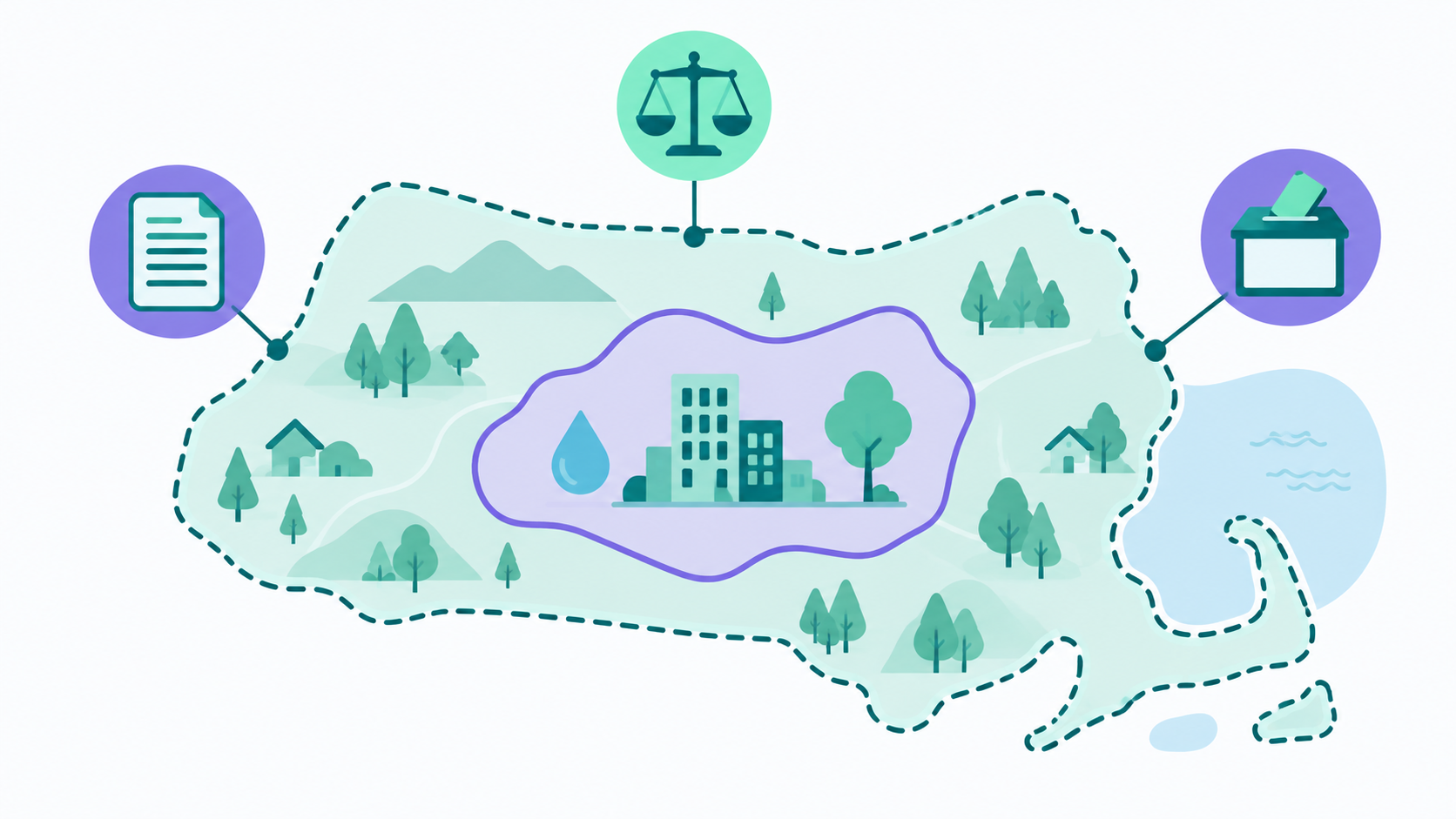
Counties and cities do fundamentally different jobs, and that drives everything about how their budgets look. A county is generally an administrative arm of the state, delivering state-mandated functions like courts, jails, elections, and property records across an entire territory. A city is a municipal corporation that residents chose to create, delivering local services like fire protection, water, and trash collection inside its boundaries.
That distinction explains a lot of things that otherwise seem arbitrary. It's why your property tax bill lists several separate governments, why your water bill can rise when your tax rate doesn't, and why moving two miles outside city limits changes which services you get and who provides them.
What's the fundamental difference between a city and a county?
Counties exist because states created them to administer state functions locally, while cities exist because residents in a specific area incorporated to provide services to themselves. Counties generally cover their whole territory. Cities cover only what's inside their limits.
The scale is substantial. The National Association of Counties counts 3,069 counties, parishes, and boroughs nationwide, and the form dates back to 1634, when the first county governments were established in Virginia. Counties are called parishes in Louisiana and boroughs in Alaska.
Their responsibilities vary enormously because states decide what counties do. Texas has 254 counties while Delaware and Hawaii have three each. And in some places counties barely function as governments at all: Connecticut, Rhode Island, and the District of Columbia have no county governments, with cities and towns handling the work counties do elsewhere. Massachusetts has 14 counties but only some have functioning county governments.
Cities work the other way around. They're chartered entities, and the range of what they do depends on their charter and on whether their state grants home rule authority, which allows more local flexibility, or operates under Dillon's Rule, where local governments can exercise only the powers the state explicitly grants.
What does each one actually pay for?
Counties tend to fund justice, records, health, and human services. Cities tend to fund public safety, utilities, and the physical fabric of the place you live.
Typical county spending
The county courthouse is not a coincidence. Counties usually run or house the trial courts, the sheriff's office, and the jail, which is often the single largest line in a county budget. They administer elections, maintain property records and deeds, and issue vital records like birth and marriage certificates.
Counties also carry a lot of the human services load. Public health departments, behavioral health, and in many states the local administration of Medicaid and other benefit programs sit at the county level. Some counties operate public hospitals. County road departments maintain roads outside city limits.
Typical city spending
Cities fund police and fire departments, which usually dominate a municipal general fund. They run water and sewer systems, garbage collection, parks, libraries, local street maintenance and snow removal, building inspection, and zoning and planning.
Where they overlap and where they don't
If you live inside city limits, you're generally getting both sets of services and paying both governments. Your city fire department responds to the fire, your county clerk records your deed.
If you live in an unincorporated area, the county is your local government for nearly everything. The sheriff is your police, the county maintains your road, and services like trash collection may be a private contract you arrange yourself rather than a municipal service. That's a genuine difference in what you pay and what you receive, and it's worth understanding before buying a home just outside a city boundary.
How does the money come in?
Both lean heavily on property taxes, but cities generally have more revenue tools available. Counties are more constrained by state law and more dependent on state and federal transfers.
The county picture is well documented. According to NACo, counties generate about 68 percent of their revenue themselves, with roughly 31 percent coming from other governments, split between state at 22 percent and federal at 8 percent. Property taxes are the top source, providing counties around $200 billion a year, or 38 percent of all county-generated revenue, with taxes overall accounting for 63 percent.
The variation between states is striking. Counties in Missouri lean heavily on local sales taxes, Indiana counties on charges and fees, and Kentucky and Maryland counties have local income taxes. Meanwhile, in five states (Maine, Massachusetts, New Hampshire, New Jersey, and Vermont) counties can't levy their own property taxes at all and must be funded another way. Georgia, Hawaii, and Tennessee impose no state restrictions on county property tax rates.
Cities typically draw from a broader mix: property taxes, local sales taxes where permitted, utility revenue, franchise fees paid by cable and energy companies for using public rights of way, building permits, business licenses, parking, and fines. That diversity is a mixed blessing, since sales tax revenue is far more volatile than property tax revenue and drops sharply in a recession.
What's an enterprise fund, and why should you care?
An enterprise fund is a self-supporting account for a service that charges users directly, like water, sewer, or municipal electricity. It's kept legally separate from the general fund, which pays for services funded by taxes.
This concept explains something that confuses a lot of people. Your water rate can rise substantially in a year when your city's property tax rate doesn't move, because the water system is supposed to cover its own costs from user fees rather than from taxes. A pipe replacement program shows up in your utility bill, not your tax bill.
It cuts the other way too. When a city says it can't use water revenue to fix a budget shortfall in the police department, that's usually a legal constraint rather than an excuse. Enterprise funds are generally restricted to their own purpose.
The idea transfers usefully to household finance, actually. Separating money that has a dedicated purpose and its own income stream from your general operating money is exactly what a sinking fund does, and it's why our guide to starting an emergency fund when you're already behind recommends naming a fund for a specific job rather than keeping one undifferentiated pile.
Why does your property tax bill list several governments?
Because you live inside several overlapping jurisdictions, and each one levies its own rate on the same property. One bill, multiple taxing entities, each setting rates independently.
A typical bill might include the county, the city, a school district, and one or more special districts. The Census Bureau counts 52,101 special purpose governments nationwide, covering things like fire protection districts, library districts, water districts, hospital districts, park districts, and in some places genuinely narrow ones like mosquito abatement.
Here's the practical implication. When your property tax bill goes up, the increase often has nothing to do with the government people complain to. School districts frequently account for the largest share of a residential property tax bill, and special districts can be quietly significant. Reading the itemization tells you which entity actually changed its rate, and which public meeting is the one worth attending.
It also means "my taxes went up" can be caused by three separate things: a rate increase by one entity, an assessment increase on your property, or the expiration of an exemption. Those have different remedies, and only the second is appealable in most places.
What about places where the line blurs?
Several arrangements break the clean city-versus-county model, and they're common enough to matter.
Consolidated city-counties merge both governments into one entity, which is how Denver, San Francisco, Philadelphia, Nashville, Indianapolis, and Jacksonville operate, among others. The Census Bureau counts these as municipal governments rather than counties.
Independent cities sit outside any county entirely, which is the standard arrangement in Virginia and the reason the Census counts 42 of them nationally.
In Connecticut and Rhode Island, where county government was abolished long ago, cities and towns perform the functions counties handle elsewhere. Rhode Island's 39 municipalities do essentially all local governing.
And a large share of Americans live in unincorporated areas served only by a county, where the county is doing municipal work in addition to its state-mandated functions.
The takeaway isn't to memorize these. It's that the answer to "who provides my services and who am I paying" is genuinely local, and you can only find it by looking at your own bill and your own jurisdiction.
What can you take from this for your own budget?
Three structural ideas from local government translate surprisingly well to household finance.
First, know who you owe and for what. Most people can't say what share of their property tax goes to schools versus the county versus a fire district, which means they can't tell what changed when the total moves. The household version is the same problem: a rising total with no visible driver is a number you can't act on.
Second, separate purpose-restricted money from general money. Cities keep enterprise funds legally distinct because mixing them destroys the accounting. Your version is keeping a car fund separate from a medical fund separate from general savings, so you know what's actually available for what.
Third, watch composition rather than just totals. A city budget analyst looks at which fund moved and why. A single number is almost never the useful unit.
That's where the structure of your own tracking matters. Most budgeting apps hand you a preset category list, which flattens things that should stay separate. Lucky Friday lets you create unlimited custom categories and subcategories with your own icons and colors, so you can build a Property Tax parent with subcategories for county, city, school district, and special districts if you want that visibility, and keep utilities split by service rather than lumped into one bill. All of it is on the permanently free tier, with no category limits and no credit card required.
Two features suit this particular kind of tracking. The monthly and annual toggle matters because property taxes and utility true-ups are annual or semiannual events that make no sense on a monthly view. And selecting any past year lets you compare this year's bill against two years ago, which is the timescale on which local rates actually change. If you'd rather have transactions import automatically instead of entering them yourself, bank sync through Plaid is available on the premium plan.
If tracking hasn't previously changed anything for you, our piece on why most budgeting apps never move your savings rate covers why visibility needs to be paired with an automatic transfer to produce a result.
Common Questions About City and County Budgets
What's the main difference between city and county government?
Counties are generally created by states to administer state functions across a whole territory, including courts, jails, elections, and property records. Cities are municipal corporations formed by residents to provide local services like fire protection, water, and trash collection inside their boundaries. If you live in a city, you're typically served by and paying both.
Do counties or cities collect property taxes?
Usually both, along with school districts and any special districts covering your address. Counties commonly handle assessment and collection for all of them, which is why one bill arrives listing several entities. Property taxes provide counties roughly $200 billion a year nationally, about 38 percent of all county-generated revenue.
What services does a county provide that a city doesn't?
Typically courts, the sheriff's office and jail, election administration, property and vital records, public health, and in many states the local administration of human services programs. Some counties also run hospitals and maintain roads outside city limits. The exact list varies by state, since states determine what counties do.
Why did my water bill go up when my taxes didn't?
Because water and sewer are usually run as enterprise funds, which are legally separate accounts meant to cover their own costs through user fees rather than taxes. Infrastructure work on the water system shows up in your utility rate, not your tax rate. Cities generally can't move money freely between enterprise funds and the general fund.
Are there places without county government?
Yes. Connecticut, Rhode Island, and the District of Columbia have no functioning county governments, with cities and towns performing the work counties do elsewhere. Massachusetts has counties on paper but only some have active county governments. Consolidated city-counties like Denver and San Francisco merge both into a single entity.
Sources
National Association of Counties. "Counties 101." https://www.naco.org/page/counties-101
National Association of Counties. "County structure, authority and finances." https://www.naco.org/page/county-structure-authority-and-finances
National Association of Counties. "County Government Finance Primer." https://www.naco.org/sites/default/files/2025-03/County%20Government%20Finance%20Primer_v13_FINAL.pdf
U.S. Census Bureau. "Government Organization Summary Report," on states without county governments. https://www2.census.gov/govs/cog/g12_org.pdf
U.S. Census Bureau. Census of Governments technical documentation, on special purpose government counts. https://www2.census.gov/programs-surveys/gus/datasets/2022/2022_gov_org_meth_tech_doc.pdf
National League of Cities. "Cities 101: Types of Local Governments." https://www.nlc.org/resource/cities-101-types-of-local-governments/
Connecticut General Assembly, Office of Legislative Research. "County Government in Connecticut." https://www.cga.ct.gov/2015/rpt/2015-R-0274.htm