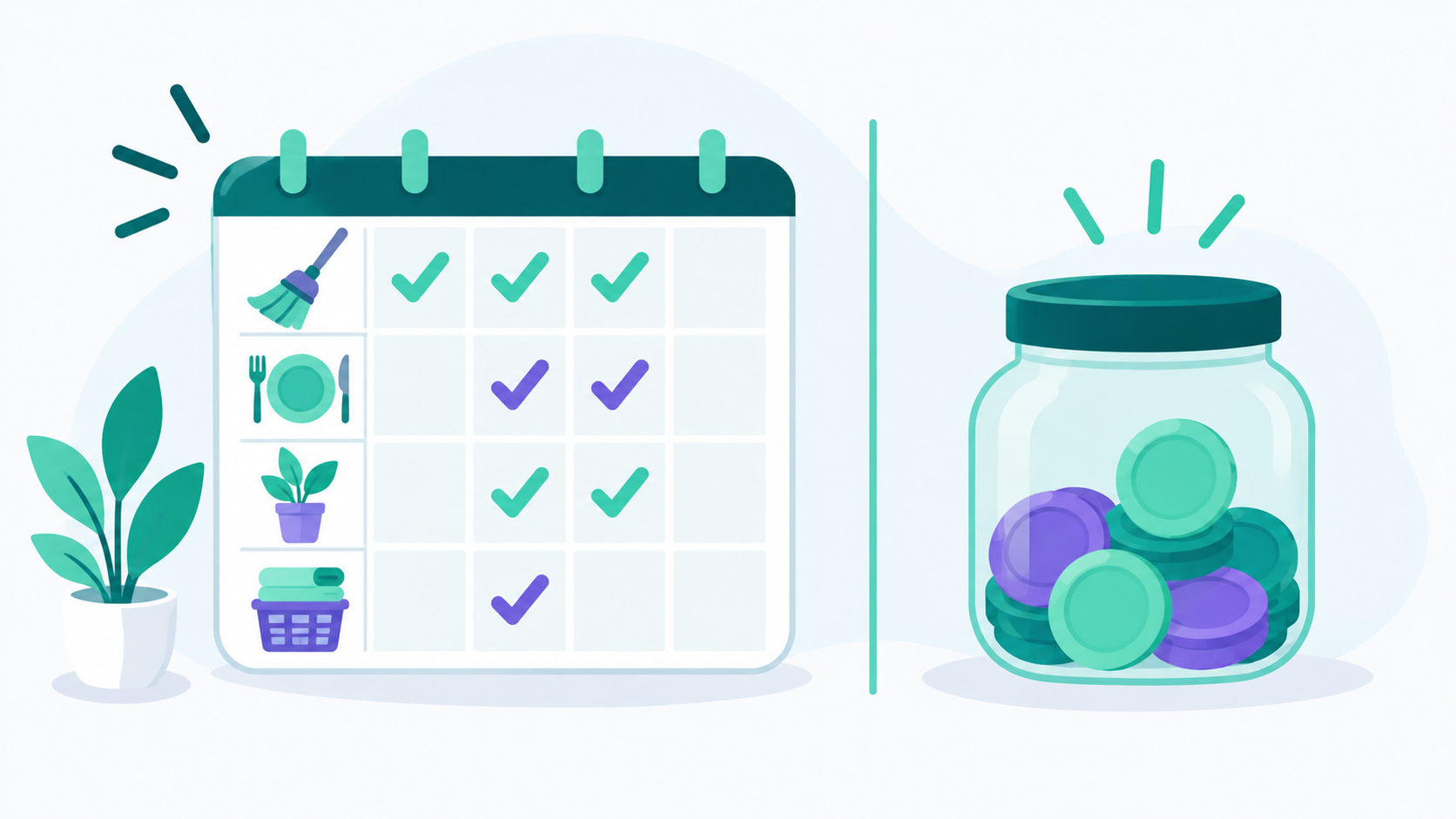
The motivation research leans toward keeping routine chores and allowance separate, because paying someone for something they'd do anyway can reduce their willingness to do it. In practice, most families land on a hybrid: baseline household tasks are unpaid because they're part of belonging to a household, extra jobs beyond that baseline can earn money, and the allowance itself arrives on schedule regardless.
Parents genuinely split on this. One survey of families using an allowance app found 53 percent tie allowance to chores, 27 percent pay a flat allowance plus extra for big jobs, and 20 percent keep the two completely separate. So there's no consensus to defer to, which means it's worth understanding what the evidence actually shows before picking a lane.
What does the research say about paying kids for chores?
The clearest finding comes from a 2008 study in Developmental Psychology. Toddlers who received a material reward for helping an adult were subsequently less likely to help than toddlers who received social praise or no reward at all.
That study, by Felix Warneken and Michael Tomasello, is worth understanding in detail because the design is so clean. Twenty month old children readily help adults with simple tasks, apparently for their own reasons, before anyone has had much chance to train them into it. When the researchers introduced a material reward during a treatment phase, helping dropped in the later test phase. Praise didn't produce that drop. The reward did.
This is the overjustification effect, and it shows up across a much wider literature. A 1999 meta-analysis by Deci, Koestner, and Ryan covering 128 experiments found that tangible rewards, particularly expected rewards contingent on completing a task, reliably undermined intrinsic motivation. The mechanism is a shift in why someone thinks they're doing something. An activity that was simply worth doing becomes a thing you do in order to get paid, and when payment stops, so does the activity.
Apply that to a chore chart. Once emptying the dishwasher is a $2 job, the question "will you empty the dishwasher?" invites a perfectly logical answer: "how much?" That's not defiance. It's the child correctly understanding the system you built.
Here's the honest caveat, though. These are controlled studies of specific tasks, mostly with young children, not longitudinal research following teenagers and their laundry through adolescence. Real households are messier, and no study tells you what to do about your particular eleven year old. Treat this as a strong signal about direction rather than a rule.
What's the case for paying for chores?
It builds a concrete link between effort and income, which is genuinely useful. According to a 2019 AICPA survey, 80 percent of parents who give an allowance require kids to earn it, and those parents aren't being irrational.
The arguments hold up reasonably well. Money that arrives for nothing teaches a different lesson than money that arrives for work, and at some point a child needs to understand that most income in adult life is conditional on doing something. Paid work also creates natural negotiation, tracking, and delayed gratification practice, since a child saving for a $60 item now has a lever to pull rather than just a wait.
There's a fairness argument too. In a household where one child does considerably more, an unconditional equal allowance can feel arbitrary in a way that grates.
So the split isn't between a right answer and a wrong one. It's between two things you want, and the hybrid exists because you can have both if you separate them properly.
What does the hybrid actually look like?
Two tracks, clearly labeled, with different rules. Baseline responsibilities are unpaid and non-negotiable. Extra work is optional, posted with a price, and paid on completion.
Here's how to set it up.
Baseline chores stay unpaid
Making the bed, clearing their own plate, keeping their room to an agreed standard, putting laundry in the hamper, feeding a pet. Frame these explicitly: these are things we do because four people live here and the house doesn't run itself. Nobody pays you and nobody pays me.
Keep this list short and age appropriate. A list of fourteen daily non-negotiables produces conflict rather than character.
Extra jobs get posted rates
Washing the car, mowing, cleaning the bathroom properly, weeding, organizing the garage, helping with a project. These sit on a list with a price next to each, and the child chooses whether to take one.
Common rates run around $0.50 to $1 for small tasks at ages six to eight, $1 to $2.50 at nine to eleven, and $2 to $5 for bigger jobs at twelve to fourteen. Scale by time and effort rather than by age alone, since a seven year old making a bed takes two minutes and a thirteen year old mowing takes forty five.
The key design detail: these are opt-in. A job nobody takes stays undone, which is a real and useful piece of information for a kid to sit with.
Allowance arrives on schedule, unconditionally
Same day every week, same amount, not contingent on behavior or chores. The allowance's purpose is practice managing money, and practice requires a predictable supply. An allowance that might not arrive teaches vigilance about your parents' mood rather than budgeting.
Don't claw it back as punishment
This is the one to hold firm on. Taking allowance away for a behavior problem converts your money teaching tool into a discipline tool, and it undermines both jobs at once. Consequences for behavior are a separate conversation, handled with separate tools.
Roughly half of parents who tie allowance to chores reduce the amount when chores aren't done, and about a third withhold it entirely. If you're in that group and it's producing arguments rather than learning, the two-track structure is worth trying instead.
How much allowance should you give?
The most common rule of thumb is $1 per week per year of age, so a seven year old gets $7 and a twelve year old gets $12. It tracks the survey data reasonably well through about age eleven and then falls behind.
The published averages vary by source, which tells you something about how much families differ. Greenlight reported an average weekly allowance of $13.15 across ages 5 to 19 in 2025, with 5 to 7 year olds averaging $6.66. Till Financial's 2025 and 2026 data from around 9,000 families put the mean at $17 a week and the median at $10, and that gap matters: a small number of families giving large amounts pulls the average well above what most people actually do. When you see an average allowance figure quoted anywhere, the median is usually the more useful number.
Honestly, the amount matters less than what the allowance is expected to cover, and that should expand with age. Small amounts for small choices at younger ages, where the point is feeling the difference between spending and saving. More in the middle years, covering things like movie tickets, snacks with friends, and gifts. Considerably more for older teens, sometimes covering clothing, social spending, and gas, with some families shifting to monthly payment to practice a longer planning horizon.
Set the number by working backward from what you want them buying instead of by what a chart says.
What actually teaches money skills?
Three things matter more than the amount or the chore question: paying consistently, giving the child real control over the money, and expanding what it covers as they grow.
Real control is the hard one. It means letting them buy something you know is a mistake, then not rescuing them when the money's gone before the week is. A $12 lesson at age ten is dramatically cheaper than the same lesson at twenty two, and the discomfort of watching it is the price of the teaching.
Say the boundary in advance and then hold it. Something like "this is yours to spend how you want, and when it's gone it's gone until Friday, and I won't be topping it up." Then don't top it up. An allowance with an invisible safety net teaches that there's always an invisible safety net.
A simple split helps structure the thinking. Some portion to spend now, some to save toward something specific they chose, and some to give if that fits your family. The saving portion works best when it's aimed at a named goal they picked rather than a vague virtue, because a target with a picture attached is something a child can actually hold in mind. The same principle applies to adults, which is why our guide to starting an emergency fund when you're already behind recommends naming the fund rather than treating it as generic savings.
How do you track it without it becoming your second job?
Give the child their own view of their money rather than keeping a ledger for them. Kids who can see their own balance and watch a savings goal fill engage with it far more than kids who have to ask a parent what they have.
Lucky Friday includes junior accounts for under 18s at no cost on the permanently free tier, alongside unlimited custom categories and subcategories. That last part matters more than it sounds for this purpose, because letting a child build their own categories with their own icons and colors is the actual lesson. Most budgeting apps hand you a preset list built for an adult with a mortgage, which teaches nothing to a nine year old saving for a specific Lego set. A category they named themselves, with an icon they chose, is a category they check.
A few practical notes. Manual transaction entry is included free and is genuinely better for this age group, since logging a purchase by hand creates a moment of awareness that an automatic import skips entirely. Planned versus actual tracking lets a child see the gap between what they meant to do and what happened, which is the whole skill in miniature. And Lucky Friday doesn't sell user data, use it for advertising, or send it to AI models, which is worth knowing before setting up anything financial for a child. Bank sync through Plaid is available on the premium plan if you want transactions importing automatically, though for a kid's allowance manual entry is usually the better teaching tool anyway.
One more thing worth saying to yourself rather than to them. Children learn far more from watching how you handle money than from any system you design for them, which is uncomfortable but useful. If tracking has never actually changed your own numbers, our piece on why most budgeting apps never move your savings rate covers why, and modeling the fix is worth more than any chore chart.
Common Questions About Allowances and Chores
Should I pay my kids for doing chores?
The research leans toward not paying for routine household tasks, since studies on motivation found that material rewards can reduce willingness to help. A hybrid works well for most families: baseline chores are unpaid because they're part of running a household, while extra jobs beyond that baseline can be paid at posted rates.
How much allowance should a 10 year old get?
Most surveys put ten year olds somewhere between $7 and $10 a week, and the common $1 per year of age rule lands in the same place. The amount matters less than what you expect it to cover, so decide that first and set the number accordingly. Consistency of payment matters more than the exact figure.
Should I take away allowance as punishment?
Generally no, because it converts your money teaching tool into a discipline tool and weakens both. An allowance works as practice only when it's predictable, since a child who might not get paid learns to monitor your mood rather than manage a budget. Handle behavior consequences separately.
What's the overjustification effect?
It's the finding that rewarding someone for an activity they were already doing willingly can reduce their motivation to keep doing it. A 2008 study found that toddlers given a material reward for helping became less likely to help later, while praise had no such effect. A meta-analysis of 128 experiments found the same pattern across many contexts.
At what age should I start giving an allowance?
Many families start around age five or six, when a child can grasp that money is finite and that spending it on one thing means not having it for another. Start small, a few dollars a week, and pay in cash or coins at first so the amount is physically tangible. Expand both the amount and what it covers as they get older.
Sources
Warneken, Felix, and Michael Tomasello. "Extrinsic Rewards Undermine Altruistic Tendencies in 20-Month-Olds." Developmental Psychology, vol. 44, no. 6, 2008, pp. 1785 to 1788. https://pubmed.ncbi.nlm.nih.gov/18999339/
Deci, Edward L., Richard Koestner, and Richard M. Ryan. "A Meta-Analytic Review of Experiments Examining the Effects of Extrinsic Rewards on Intrinsic Motivation." Psychological Bulletin, vol. 125, no. 6, 1999.
Greenlight. "Average weekly allowance by age for kids and teens," 2025 data. https://greenlight.com/learning-center/earning/average-allowance-by-age-for-kids
Till Financial. "The Average Allowance for kids and teenagers in 2026." https://www.tillfinancial.com/financial-literacy/average-allowance-for-kids-and-teens
NatWest RoosterMoney allowance approach data and AICPA survey figures, compiled at https://www.pennytime.app/learn/blog/average-allowance-by-age-what-parents-actually-pa/
Kids' Money allowance survey on chore-linked allowance practices. https://www.kidsmoney.org/parents/allowance/statistics/