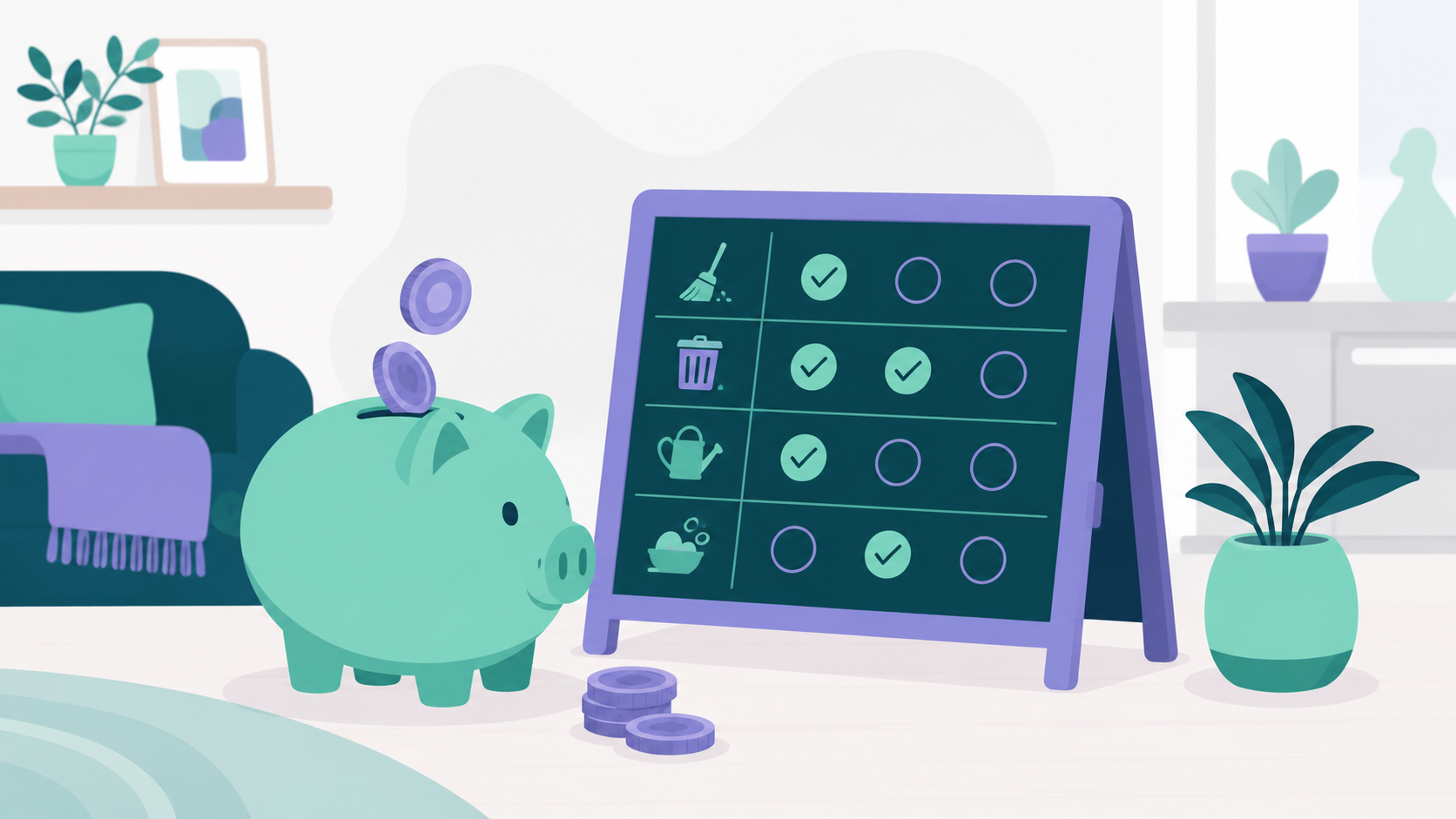
Should allowance be tied to chores?
Research is mixed, but the short answer is that most financial literacy experts now recommend keeping the two separate. Chores teach kids they're responsible members of a household, while allowance works better as a hands-on tool for learning to save, spend, and plan ahead. That said, plenty of families do fine linking the two, and the "right" answer depends more on what you're trying to teach than on some universal rule.
This is one of those parenting debates that never really settles. Ask ten parents and you'll get ten different systems, and most of them will tell you their way is obviously correct. So let's look at what the actual research says, where it disagrees, and how you can build a system that works for your family instead of just copying whatever your parents did.
What's the debate about allowance and chores?
American parents are close to evenly split on this. A T. Rowe Price survey found that 79 percent of parents give their kids an allowance, and 64 percent of those parents require kids to earn it through chores. That same research pointed to a 2019 University of Michigan study finding that children who earned their allowance were more likely to develop strong work ethics and financial responsibility.
So there's real evidence on the "link them" side. But there's just as much evidence on the other side, and the disagreement usually comes down to what researchers are actually measuring. Are we measuring work ethic? Savings behavior? Financial literacy test scores? Depending on which outcome you care about, the "correct" system changes.
The case for linking allowance to chores
Tying allowance to chores makes an intuitive kind of sense. Kids learn that money comes from effort, not just from being alive in your household. It mirrors how adult income works. You do a job, you get paid, and if you don't do the job, the paycheck doesn't show up.
The downside researchers point to is that this system can turn into a negotiation. Some kids will simply skip chores on weeks they don't need cash. And when only certain chores are tied to payment, kids can start treating everything else as somebody else's job, which quietly sends the message that helping around the house is optional rather than a shared responsibility.
The case for keeping them separate
The competing view treats chores as membership dues, the price of living in a house with other people, and allowance as a separate financial education tool. A 2011 analysis published in the Journal of Consumer Psychology found that kids who received allowance without it being tied to task completion actually showed better savings habits and were more likely to plan their spending in advance than kids whose allowance depended on finishing chores. Researchers think the chore-linked group may have treated the money more like payment for a job than a resource to manage, which led to more spending and less saving.
Honestly, both camps have a point, which is probably why this debate hasn't gone away in fifty years of parenting advice.
Does linking allowance to chores actually work?
It depends on what "work" means to you. If your goal is getting the dishwasher unloaded without a fight, sure, a chore chart tied to cash can help. If your goal is raising a kid who understands saving, spending, and credit, the picture gets murkier.
Financial literacy researcher Lewis Mandell has reviewed studies showing that kids who receive no-strings allowances actually knew less about saving, spending, and credit than kids in other systems, and they also showed a weaker work ethic overall. That finding cuts against both the "always link them" and "never link them" camps, since it suggests the money itself isn't really the teacher. Mandell has argued that the real value of an allowance comes from the conversation between parent and child about money, not from the mechanism of how it's paid out.
That lines up with newer research too. The Consumer Financial Protection Bureau's work on youth financial education has found that early hands-on experience managing money is one of the strongest predictors of healthy financial habits later in life. The system matters less than the fact that a system exists at all, and that you're actually talking about it with your kid.
This is honestly not that different from adult budgeting. We've written before about why so many budgeting apps quietly fail to move the needle on your savings rate (luckyfriday.app/blog/why-budgeting-apps-fail-savings-rate-wake-up-call), and the reason is usually the same one showing up here. A tool by itself doesn't build the habit. The habit comes from consistent attention, whether that's a parent checking in weekly with a ten-year-old or an adult actually looking at their own numbers instead of letting an app run in the background.
What do child development experts say?
Most financial educators now land somewhere in the middle: chores stay unpaid and mandatory, allowance stays separate and predictable, and the two get connected through conversation rather than through a cash-for-task exchange.
Personal finance author Beth Kobliner has made a version of this argument publicly, noting that tying allowance to chores can quietly turn it into a punishment. When kids skip a chore and lose their allowance as a result, the conversation shifts away from financial literacy and into discipline, which isn't really what allowance is supposed to teach. Her view is that unpaid chores still teach kids the value of contributing to a household, and that this lesson works better when it isn't tangled up with a paycheck.
Developmentally, this timing matters more than people expect. Kids can generally grasp delayed gratification and saving as concepts starting around age six or seven, but more abstract money ideas like interest and budgeting usually don't click until closer to age ten to twelve. That's worth keeping in mind before you hand a seven-year-old a spreadsheet and expect them to understand compound growth.
What's a fair amount of allowance to give?
There's no official rule, but the most common guideline among parents and financial educators is roughly a dollar per week for every year of the child's age. A seven-year-old gets around seven dollars a week, a twelve-year-old gets around twelve.
Data from RoosterMoney, an allowance tracking app, found that four-year-olds received an average of $4.18 a week, while fourteen-year-olds averaged $13.87, which tracks closely with that same age-based guideline. The same research found kids typically start receiving a regular allowance around age four, often because an older sibling already gets one.
The exact dollar amount matters less than consistency. A kid who gets three dollars every single week learns more about budgeting than a kid who gets twenty dollars sporadically whenever a parent remembers.
What's a better way to combine chores and money lessons?
A system a lot of financial educators land on looks something like this. Chores are mandatory and unpaid, framed as "this is how our family takes care of our home," not as a job listing. Allowance is separate, given on a predictable schedule, and treated as the raw material for teaching money skills.
From there, you layer in the actual lessons. Split the allowance into buckets for spending, saving, and giving, so the kid practices all three instead of just spending everything immediately. Let natural consequences do the teaching. If they blow their spending money on a toy that breaks in a week, that's a better lesson than a lecture. Offer paid "bonus" jobs that go beyond normal household chores, like washing the car or helping with yard work, so kids still get exposure to earning money for extra effort without it replacing their baseline responsibilities. And talk about money regularly, not just on allowance day. Point out real decisions as they happen, like why you're comparing prices at the grocery store or why you're skipping a purchase this month.
If you want a physical or digital tool to make this concrete, giving a kid their own place to track money, even a simple one, helps a lot. Lucky Friday's free tier includes junior accounts for kids under 18, which lets a child see their own categories, watch their savings bucket grow, and start building the habit of checking in on their money regularly, all without you having to hand over a debit card before you're ready to.
How do you teach a kid to budget without overwhelming them?
Start small and concrete. A ten-year-old doesn't need a 50/30/20 breakdown. They need three jars, three envelopes, or three categories in an app: spend, save, give.
Custom categories help here more than people expect, because kids relate to concrete labels a lot better than abstract ones. "Video games" and "birthday gift for Grandma" mean something to a ten-year-old in a way that "discretionary spending" never will. This is part of why unlimited custom categories (luckyfriday.app/features) tend to work well for family budgeting in general, not just for adults. You're not stuck with a preset list that doesn't match how your household actually spends or saves.
As kids get older, you can layer in bigger goals. A young teen saving for a bike or a laptop gets a real, hands-on lesson in delayed gratification that no lecture can replicate. If you're modeling this yourself with your own savings goals, we've written about a way to start a savings buffer even if you feel like you're already behind (luckyfriday.app/blog/how-to-start-an-emergency-fund-when-youre-already-behind-the-my-first-buffer-method), and the same small, consistent approach works well as a model for a kid's first savings goal too.
Should older teens have more financial independence?
Generally, yes. By the time a kid is thirteen or fourteen, most financial educators recommend shifting from a fixed allowance toward something closer to a monthly budget they manage themselves, sometimes covering their own clothing or entertainment spending within a set amount you provide.
This is where the lessons start compounding. A teenager who's tracked their own spending for a few years already understands concepts that a lot of adults are still figuring out in their twenties. That's a lot of the thinking behind building tools that stay free for life (luckyfriday.app/pricing) rather than locking core budgeting features behind a paywall. Financial literacy shouldn't come with a subscription fee, especially not for a kid who's just starting to learn.
Common Questions About Allowance and Chores
Should you take away allowance if chores aren't done?
Most financial educators recommend against this. Chores work better as a mandatory part of household membership, and using allowance as a penalty can turn a financial teaching tool into a disciplinary one, which muddies the actual lesson you're trying to teach.
What age should a kid start getting an allowance?
Many parents start around age four, though there's no strict rule. What matters more than the starting age is consistency. A predictable, regular allowance teaches more than an inconsistent one, regardless of when it starts.
How much allowance should I give my child?
A common guideline is about a dollar per week for every year of age, though this varies a lot by family and region. The consistency of the schedule matters more than the exact dollar amount.
Should teenagers get a bigger allowance or a monthly budget?
Once kids reach early to mid teens, shifting toward a monthly amount they manage themselves, sometimes covering things like clothing or entertainment, tends to build stronger budgeting skills than a small fixed weekly allowance.
Is it bad to pay kids for chores?
Not necessarily. It works for plenty of families. The main risk is that kids may start skipping chores when they don't need the money, or start viewing helping around the house as optional rather than expected. If you go this route, it helps to keep some baseline chores unpaid and reserve payment for extra tasks beyond the basics.
Sources
Mandell, Lewis, cited in "Allowances Don't Teach Kids About Money, You Do," First Internet Bank (firstib.com)
"Should You Tie Allowances to Chores? Some Experts Say No," Members Advantage Community Credit Union (mapscu.com)
Consumer Financial Protection Bureau research on youth financial education, cited in "Should you pay kids an allowance for chores?" Happily Family (happilyfamily.com)
Kobliner, Beth, cited in "Allowances 101: Should You Give Your Child An Allowance?" Montana's Credit Union (mcun.coop)
Cohen, Roni Habas, 2011 analysis, Journal of Consumer Psychology, cited in "Does Giving Kids an Allowance Actually Build Money Habits?" HiWave (hiwavemakers.com)
RoosterMoney data, cited in "How allowance teaches children about money and financial literacy," CNBC (cnbc.com)